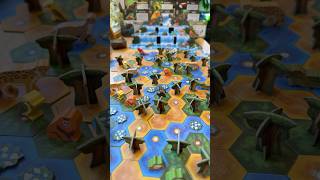
Build your very own thriving jungle by discovering various wild animals, insects, and plants in this beautiful board game.
Life of the Amazonia is a strategic meeple placing game that combines bag building and pattern building. Players will restore land, place various animals, and plant trees and flowers to enrich their jungles and create the most ecologically rich jungle. Various lives must be placed in the jungle taking into account each unique characteristic of the plants and animals in order to create synergies within one another. To carry out these actions, bag building that fits in with the player’s strategy is crucial. With 60,000+ various ways to set up the animal cards and diverse strategic options, every game of Life of Amazonia will differ from the next.
—description from the publisher
Life of the Amazonia Solo Rules Only
- Array
- Array
- Jungle ecosystem building and resource gathering
- Array
- Jungle environment with animals and flora
- Array
- Array
- Array
- positive
Mechanics (from transcript analysis)

Video topics + discussion points
Quotes (from this video)
- geometry in the game is amazing
- oh so so good
- it's such a beautiful game
References (from this video)
- Strong production values and components
- Engaging resource flow and card-based tableau development
- Potentially derivative of other, similar games
- Specific thematic flavor may not appeal to all players
- collection and management of creatures into a reserve
- Amazon rainforest exploration and wildlife discovery
- nature documentary-style exploration with light storytelling
Mechanics (from transcript analysis)
- Deck-building / tableau integration — cards collected become a tableau or reserve
- end game bonuses — endgame scoring tied to symbol sets and discoveries
- Set-collection and endgame bonuses — endgame scoring tied to symbol sets and discoveries
- worker placement — place workers to gather resources and trigger actions
Video topics + discussion points
Quotes (from this video)
- the production on the retail is essentially a half Deluxe game with dual layer boards, beautiful meeples
- the act of placing your worker feels cooler because it feels like you're just getting more done
- freedom to do what you want and play everything you want and get all of these card combos and be as efficient as possible
- I really enjoyed this game I really really like it it's going to stay in my collection
- if you've outgrown Everdell, is this Everdell plus? I don't think so
- you can play two cards per action so that is a totally different Dynamic and feel
- there's a lot more freedom just to play and do more stuff
References (from this video)
- Enhanced decision space beyond simple tile placement
- Rich interaction between bag-building and track bonuses
- Strong thematic integration with wildlife and habitats
- High replayability from unique starting animals and card variety
- More complex rules than Cascadia or Harmonies
- Production components can be expensive to upgrade
- Array
- Array
- ecological land development and habitat optimization through bag-building and resource management
- Array
- Amazon rainforest environment with terrain tiles, trees, flowers, and animal habitats
- Array
- Array
- Array
- positive
- Harmonies
- Cascadia
Mechanics (from transcript analysis)
- Animal Scoring — place animals to meet location-specific conditions for points
- bag building — draw five tokens per turn, with tokens representing resources and influencing future actions
- Multi-use cards — one-time powers (insects) and endgame bonuses (scenery) accessed via card markets
- Nature and scenery cards — one-time powers (insects) and endgame bonuses (scenery) accessed via card markets
- Resource management — spend fruit, water, and leaf tokens to acquire animals and upgrade your bag
- Storage expansion — increase storage capacity to hold more tokens for powerful combos
- tile placement — place terrain tiles onto the board and connect them with resources and scoring opportunities
- Track advancement — use bonuses on tracks to gain extra actions or resources, influencing tempo
- Track bonuses — use bonuses on tracks to gain extra actions or resources, influencing tempo
Video topics + discussion points
Quotes (from this video)
- Life of Amazonia is so much more than that
- the bag building I love the considerations you have to make on the choices
- this game is about placing life on hex's
- Kim you were right if you've had any experience with any of these games
References (from this video)
- Clear and structured explanation of the solo rules and automa mechanics
- Two-sided board with an easier and a harder variant for scalability
- Scenario variations add replayability and different strategic targets
- Solo scoring method is intuitive and thematically aligned
- Rule explanation can be dense given the number of tokens and automa interactions
- Some icons and token interactions (e.g., comet spaces) may be confusing at first
- Solo mode scoring diverges from multiplayer, which may conflict with expectations for some players
- Conservation, habitat stewardship, wildlife management
- Amazon rainforest, wildlife habitat, ecological systems
- Educational/ecological simulation with real-world-inspired flora and fauna implications
Mechanics (from transcript analysis)
- automa (solo) opponent — An automated opponent is run via tiles and comet-shaped spaces that trigger token effects and advance tracks.
- bag drafting / token draw — Automaton and player actions are driven by tokens drawn from a bag, establishing a probabilistic yet controlled action economy.
- comet-shaped spaces and automa tokens — Landing on these spaces triggers drawing and resolving automa tokens with animal icons.
- endgame rules for solo — Solo scoring excludes certain multiplayer bonuses (e.g., Five Point bonus) and uses adjusted scoring.
- Reclaim as Action — Discard/refresh actions to replenish markets and tailor strategy (renew resource pools).
- renew action — Discard/refresh actions to replenish markets and tailor strategy (renew resource pools).
- Resource management — Management of seeds, terrain tokens, insect cards, and other resources to perform actions.
- scenario-based setup — Base scenario offered with multiple variations in the rulebook to alter setup and scoring.
- scoring tracks (Aquatic and Forest) — End-of-game scoring aggregates player points while subtracting automa advancement along two tracks.
- Time track — A dedicated track advances each automa turn, with a defined end condition after a set number of turns.
- time tracker / turn count — A dedicated track advances each automa turn, with a defined end condition after a set number of turns.
- Token economy — Management of seeds, terrain tokens, insect cards, and other resources to perform actions.
Video topics + discussion points
Quotes (from this video)
- The solo mode is driven by an automa opponent that is utilized primarily through these tiles that you have that you draw from a bag.
- Basically play the game as it is set up as freely as you would want to with the animals that you choose to play on whatever side that you choose and beat your own score.
References (from this video)
- fluid engine-building with thematic appeal
- strong replayability due to variable animal cards and drafting
- mini expansion noted, but desire for fuller future content persists
- conservation and animal care
- environmental stewardship in the Amazon, habitat restoration
- story-driven with environmental impact focus
- Cascadia (variance/drafting feel)
Mechanics (from transcript analysis)
- bag building — draw actions/resources from a bag rather than a deck
- bag-building — draw actions/resources from a bag rather than a deck
- Deck building — builds engine with card effects and synergies
- deck-building — builds engine with card effects and synergies
- tableau building — arrange actions and resources on personal boards
- tableau-building — arrange actions and resources on personal boards
- Track advancement — progress on various tracks to unlock scoring opportunities
Video topics + discussion points
Quotes (from this video)
- "I'm incl some games that I haven't gotten the chance to play its expansion or expansions yet"
- "I would love some added variability in the building tiles perhaps some additional modules"
- "this game deserves expansion"
- "I would love to see some additional content for that game"
- "I think there's plenty of room to expand this game"
References (from this video)
- ties ecological themes to gameplay in a meaningful way
- less mainstream visibility compared to Ark Nova
- environmental / conservation
- Amazon rainforest habitat creation and conservation
- eco-centric, habitat-building
- Ark Nova
- Cascadia
Mechanics (from transcript analysis)
- tile placement — Players place tiles to conserve habitat and manage ecological systems.
- tile placement / habitat building — Players place tiles to conserve habitat and manage ecological systems.
Video topics + discussion points
Quotes (from this video)
- I feel like theme really matters to me if I want to put myself in a setting in a board game and have a relatively good understanding of how to play
- the theme that it's set in as well as how well those mechanisms integrate with the theme
- I think it's my number one theme because of how interested I am in games that I'm previewing and looking at further in the Horizon
References (from this video)
- Seamless integration of bag-building, track advancement, and tableau-building creates a cohesive engine
- Intuitive to teach and approachable for players with experience in bag-building or tableau games
- Reserve mechanism adds foresight and agency, enabling strategic planning across turns
- Large variety of animal, insect, and scenery cards increases replayability and strategic depth
- Strong thematic cohesion and attractive components that support table presence
- Positions Life of the Amazonia as a meaningful point of reference in the medium-weight bag-building space
- Thin cardboard components draw complaints from some players about durability and production quality
- Base game can feel lengthy for some groups, with downtime and potential analysis paralysis increasing as options proliferate
- Rules burden and learning curve can be non-trivial for players new to this blend of mechanics
- Longer playtime and pacing concerns may deter players seeking a faster or lighter experience
- Ecology, wildlife conservation, resource management
- Jungle restoration and ecosystem development
- Asymmetric animal abilities and variable endgame objectives across games
- Dominion
- Orléans
- Cascadia
- Lost Ruins of Arnak
- At the Gates of Loyang
Mechanics (from transcript analysis)
- asymmetric_animals — Each animal offers unique drafting/ scoring variants; rescuing a player-specific animal grants asymmetric abilities that shape strategy.
- bag building — A core engine where players draw and reserve tokens from a bag to fuel actions; seeds function as wild resources to enhance flexibility and options.
- bag_building — A core engine where players draw and reserve tokens from a bag to fuel actions; seeds function as wild resources to enhance flexibility and options.
- card_insect_scenery — Insect cards provide one-time effects while scenery cards introduce endgame objectives, injecting variability into each session.
- Multi-use cards — Insect cards provide one-time effects while scenery cards introduce endgame objectives, injecting variability into each session.
- tableau building — Players assemble a personal tableau of plants, trees, and animals to unlock scores and synergy between different card types.
- tableau_building — Players assemble a personal tableau of plants, trees, and animals to unlock scores and synergy between different card types.
- tile placement — Tiles representing flora and fauna are placed into a personal ecosystem tableau, shaping scoring opportunities and board control.
- tile_placement — Tiles representing flora and fauna are placed into a personal ecosystem tableau, shaping scoring opportunities and board control.
- token_reservation — A reserve mechanic that lets players hold up to three tokens across turns, enabling longer-term planning and stronger future plays.
- Track advancement — Multiple advancement tracks offer rewards and endgame bonuses; advancement decisions impact tempo and possible scoring paths.
- track_advancement — Multiple advancement tracks offer rewards and endgame bonuses; advancement decisions impact tempo and possible scoring paths.
Video topics + discussion points
Quotes (from this video)
- you are restoring a jungle and placing rescued animals and plants into your own ecosystem utilizing the mechanisms of bag building tile placement and Tableau building
- the unique thing about this game when it comes to bag building is that this game has you reserving your tokens from turn to turn
- Dominion has a more straightforward goal and Life of the Amazonia is a little bit less complex in what you can do on your turns
- This is my new bar for what a mediumweight bag building Tableau Builder should feel like
- I'm torn between my rating for this game
- it's approachable for all types of Gamers
- the reserve mechanism opens up a lot of strategic planning and adds agency on when to trigger actions
- if you like Cascadia but want more complexity, Life of the Amazonia is a strong pick, though it can be longer and heavier
References (from this video)
- high artistic quality and colorful components
- compelling ecological theme that drives decisions
- weight and length may deter very casual players
- availability can vary by market
- conservation, biodiversity, ecosystem balance
- rainforest ecosystem development
- lush, ecological narrative with high visual appeal
- Cascadia
Mechanics (from transcript analysis)
- bag building — tokens are drawn from a bag to pay expansion or animal-placement costs.
- bag-building — tokens are drawn from a bag to pay expansion or animal-placement costs.
- recycling spent tokens — spent tokens go back into the bag, maintaining a loop of resource management.
- tile and animal placement — tiles create ecosystems; animals contribute to objective-based scoring.
- tile placement — tiles create ecosystems; animals contribute to objective-based scoring.
- tile placement and animal placement — tiles create a growing forest; animals are added to the forest for scoring.
- token cycling — spent tokens return to the bag, sustaining resource flow.
Video topics + discussion points
Quotes (from this video)
- this game is more about defense than offense
- it's a very tranquil peaceful game
- the joy of this game is finding cool moves
- I have so much fun with this game
- the colors and harmonies this game has
References (from this video)
- Cascadia-like puzzle with bag-building twists
- strong thematic integration with wildlife and habitats
- potential strong solo play
- bag-building can feel less strategic for some players
- ecosystem management with bag-building mechanics
- Amazon rainforest habitat management
- puzzle-y, grid/track driven
- Wondrous Creatures
Mechanics (from transcript analysis)
- animal meeples for scoring — animal tokens and pieces determine scoring patterns across habitats
- bag building — draw tokens from a bag to perform market and habitat actions
- bag-building — draw tokens from a bag to perform market and habitat actions
- tile placement — tiles form habitats and trigger scoring as they’re placed
Video topics + discussion points
Quotes (from this video)
- this is a dice worker placement game where basically it is hidden information of your dice
- I would love in the collection
- life of the amazonia is like Cascadia Plus
- galactic cruise is ginormous
- auzl duel is a two-player only game but with more strategic depth
- Explorers of Neoria has a very unique drafting-to-working mechanic
- Puerto Rico Special Edition. Fantastic
- Heaven and Ale was super fun, very strategic and satisfying
- Galileo Galilei is a fantastic game
References (from this video)
- Rich integration of bag-building, deck-building, and tile-placement
- Strong two-player experience with tight pacing and replayability
- Polished components and tactile flavor (bolts, tokens, and bag interactions)
- Never-feel-stuck design; meaningful decisions on almost every turn
- High thematic flavor and satisfying placement scoring synergies
- Steep learning curve for newcomers due to many action options and interactions
- Scoring can become complex and difficult to track, particularly with multiple animals and card interactions
- Turn length can vary and may slow down at four players or with dense decision trees
- Water and terrain cards can feel dense or fiddly to interpret at first
- Nature, biodiversity, forest stewardship, and animal habitats
- Amazon rainforest landscape where players cultivate a growing jungle with trees, waters, and terrain tiles to form scoring patterns
- Abstract thematic veneer with strong flavor via animal scoring and terrain placement
- Wingspan
- Cascadia
- Canopy
- Living Forest
Mechanics (from transcript analysis)
- Action selection from a fixed action set — Eight distinct actions exist; players choose among them each turn, driving variability.
- bag-building — Players draw and manage tokens from their personal bag to perform actions and acquire resources.
- deck-building — Cards grant powers and actions; players draft or acquire cards to enhance their options.
- End-game condition via animal exhaustion — There are eight animal types; the game ends when five animals have been removed from play.
- Resource/resource token economy — Tokens act as wilds or specific resources used to buy animals and upgrade bags.
- tile/terrain placement — Placement of jungle terrains, trees, and water features to shape scoring opportunities.
Video topics + discussion points
Quotes (from this video)
- This is better than Wingspan.
- This game is all about nature, about animals.
- There are eight animals that you can place in your Amazonian forest.
- The boats are a standout component.
- It's a great two-player game.
- The game gets better every time you play.
- There isn't a point in the game where you go like I guess I'll just skip it — there's always something to do.
- You never know who's winning the game until the end.
References (from this video)
- High complexity and depth
- Thematic richness with many upgrade options
- Long play time
- Steep learning curve for new players
- Biodiversity and ecological management
- Amazon rainforest ecosystem
- Educational with depth
Mechanics (from transcript analysis)
- bag building — Draw tokens from a bag to determine actions
- bag-building — Draw tokens from a bag to determine actions
- Deck building — Build a deck of upgrades and actions to enhance your engine
- deck-building — Build a deck of upgrades and actions to enhance your engine
- Resource management — Use tokens to perform increasingly powerful actions as the game progresses
- Resource management / action economy — Use tokens to perform increasingly powerful actions as the game progresses
Video topics + discussion points
Quotes (from this video)
- Creature Comforts is a cozy family worker placement game
- Spirit Island ... it's a Cooperative game where all players play together
- Earth you build well your island essentially it's a tableau building game through and through
- Wingspan... it's an action selection game
- Life of Amazonia is a big game it's essentially a bag building deck building game
References (from this video)
- Calm, peaceful solo experience
- Satisfying sense of collaboration with the game
- Beautiful theme and environmental feel
- Rules/access may be approachable for non-collectors
- Less crunchy than heavier titles
- ecology, biodiversity, sustainable balance
- Amazon rainforest ecosystem building
- cooperative ecosystem-building with peaceful progression
Mechanics (from transcript analysis)
- bag building — Draft and assemble resources to improve your forest
- bag-building — Draft and assemble resources to improve your forest
- biodiversity scoring — Points rewarded for harmony and diversity
- resource placement and habitat development — Place animals and plants to create a thriving ecosystem
Video topics + discussion points
Quotes (from this video)
- Playing board games alone isn't a compromise. It's not some sad consolation prize. It's its own adventure where you're not just the player, but also the storyteller.
- The journey itself was enough.