/pic3978960.png)
Lincoln is a fast-paced, light, two-player, card-driven strategic level board-wargame set in the American Civil War that allows you to re-fight the entire American Civil War in under two hours.
Game play uses point-to-point movement and area control, hidden army strengths, and decks of cards providing the command choices and luck; there are no dice. The Union and Confederate players each have their own card decks, reflecting the relative strengths and weaknesses of both sides. The Union player must do all the running to win the game by the time they have cycled through the Union card deck for the third time, having accumulated the required amount of victory points by capturing Confederate controlled areas, as well as squeezing the Confederate player with a naval blockade. The Confederate player must hold on and thwart the North's victory ambitions to win!
Each time the decks are cycled, the Union player adds some better quality cards, becoming stronger as the game progresses, where as the Confederate player adds lower quality cards, becoming weaker. The underlying game mechanism is one of "deck destruction" rather than the more normal deck-building.
Cards have multiple uses and can be recycled if used one way but during the course of the game you have to decide which cards are going to be permanently sacrificed from your deck cycle to allow you to build units.

- Purchased due to a half-price deal.
Mechanics (from transcript analysis)
Video topics + discussion points
Quotes (from this video)
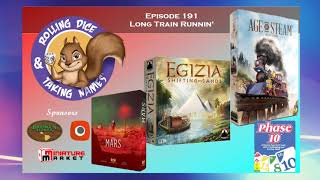
- it's like, falling into a warm comfortable bed. It's just all nice and cozy and you know what to expect
- I enjoy train games don't know why but I enjoy a train game
- for an old-school euro game I really enjoyed this too it didn't have a lot of flash or dazzle or anything unique it's an older game reprinted
- the person who wants to be first has to pay full price person who wants to be second it's got to pay full price then the next people have to pay half price and the last person doesn't underpass it's that half-price and zero price
- if you don't have enough money to pay your expenses you're in a world of hurt
- there's not a lot of flash to it mm-hmm solid mechanics solid concepts concepts that I enjoy
- theme doesn't draw me in but theme turns me off maybe we are sitting there looking at what's flashy too
- portability I can't argue with that that is the selling point of that console right now
- Oh okay I should not have dismissed this game strictly on theme because it's a solid no little euro game
References (from this video)
- Good historical game
- Educational
- Not necessarily a beginner game
- Historical simulation
- American Civil War
Mechanics (from transcript analysis)
- Resource Management — Implied by the mention of 'muro' and learning aspects.
Video topics + discussion points
Quotes (from this video)
- to me that was a very simple game easy to learn but kind of recreated what really happened during that time
- if y'all ever seen a GMT rule book They're they're not pretty books with glossy pages and big images and very few words per page they're double column they're they're numbered almost like a contract a legal document that's just how they're formatted
- it's basically the conflict between uh uh basically the US and and that region of the world between China and us trying to influence and control that area
- this is coming from somebody who complained I did a 45 minute history lesson on Cuba Libra when I taught it to you
- I knew nothing about how Castro took over CU I I knew he did it how he did it and why I don't know but playing that game three or four times now I have a I'm not a master by any means but I have a much better understanding of what really happened during that time
- I am learning about stuff that happened during the Vietnam war knew nothing about super excited as I play through this game learning about that
- you do learn as you're playing the game how the forces had to build towards that final battle of waterl you learn the players that took place
- yes I have that one I've never play amazing historical game from Marton Wallace yes I had some Muro stuff in it but I actually learned a lot about that from Lincoln
- we got access and allies coming up talking about jumping to the deep end we'll jump straight into that
References (from this video)
- Considered a good two-player game
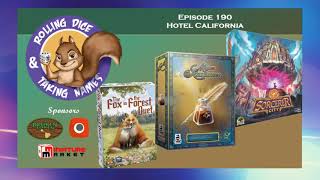
- Refreshing 'vanilla' euro experience without new gimmicks
- Felt old-school and potentially stale initially
Mechanics (from transcript analysis)
- Area Control — Players place tokens to build buildings and gain points.
- Worker Placement — Players place workers on a track, always moving further down the track.
Video topics + discussion points
Quotes (from this video)
- The name does it a disservice even I'm gonna say who it was it was mark when we taught him the rules he didn't seem that thrilled at all
- The market burst like you said I don't think there's a bubble here that's gonna burst but maybe there's some slowness in the growth
- The staples are getting to be more staple as the thousands of new games continue to struggle
- This is not a game this is not a game that I would play with Donna and my friends who enjoy Carcassonne they don't like using timers you have to have the timer
- The odds are against you which what meant was what makes it a fun co-op game
References (from this video)

- Never got to the table.
Mechanics (from transcript analysis)
Video topics + discussion points
Quotes (from this video)
- So, we have a game here called Sequoia. This is from 2022.
- It's It's fine. I'm giving it a six. Uh Beasty Bars is is is a fun style game where you're playing these different type of animals, and I think each additional expansion made it more complex and less fun.
- Trias is an old dinosaur game that originally came with cubes, and eventually they had little dinosaurs in it instead. And it's kind of grow out to different things. This is a very I have this ranked as a seven. Probably now, the next time I go through my rankings, I'll probably rank it as a six because it's fine, but it's showing its age.
- All righty, of all the games we talked about today, my favorite here is clearly David Goliath, although Hooky is a very close second.
- Either way, it's always good to talk to you all.
References (from this video)
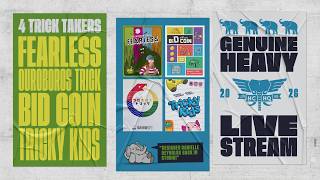
- Clever design.
- Elegant mechanics.
- Well-executed push-your-luck aspect.
- Math-focused gameplay.
- Good card stock.
- Offsetting luck of the draw.
- Can run long.
- The font on the cards is terrible.
- The interaction can be confusing.
- The card art is described as weird.
Mechanics (from transcript analysis)
- bidding — Players bid on the number of tricks they will win as they go, and cannot decrease their bid. Bidding zero is an option.
- Card Cycling — When a player wins a trick, they discard a number of cards based on the trick's value, effectively recycling cards into their hand. The number of discards depends on the trick's value and the cards played.
- Hand Management — Players manage their hand by discarding cards gained from winning tricks, with the goal of managing their score.
- special card abilities — Cards with a value of four or six count as two tricks. Zeroes beat tens if played in the same trick.
- Trick-Taking — A must-follow trick-taking game with no trump suit initially, but off-suits become trump. The goal is to end as close to zero as possible.
Video topics + discussion points
Quotes (from this video)
- Actually designed this game out of spite of trick taking games.
- if two players play the same number, they knock each other out, which is so fun and chaotic and I love it so much.
- Bidcoin. One of my favorite trick-taking games of recent.
- The goal of the game, it's one hand is to survive.
- It is the weirdest. It's a standard trick taking game in a sense that for the f until people start recycling their hands because then you can't track what cards have left the game coupled with who has won what cards.
- The overwhelming majority of tricktaking games are mid or bad.
References (from this video)
Mechanics (from transcript analysis)
Video topics + discussion points
Quotes (from this video)
- This is a trick digging game. It's called Bidcoin.
- There is a very limited amount of money in the trough and the first piggy to snuffle it all up basically just gets it.
- This is a game that doesn’t feel like it’s trying to be something it’s not.
- The world is a loosey goosey experience.
References (from this video)
- well-regarded for its historical flavor and approachable rules
- educational on Civil War political dynamics
- some players find it less accessible than lighter gatekeepers
- political maneuvering, leadership and strategic decisions
- American Civil War era
- historical narrative through card-driven play
- Gettysburg
- Fort Sumter
Mechanics (from transcript analysis)
- card_driven — cards drive actions and district control decisions
Video topics + discussion points
Quotes (from this video)
- the number one game on BGG was Twilight Struggle
- 13 Days which is based on the Cuban Missile Crisis and it's like a trimmed down version of Twilight Struggle
- Memoir 44 is a classic one to get into
- Watergate… very easy to learn
References (from this video)

- interesting twist on trick-taking
- potential strong interaction
- localization risk may limit playability
- Traditional card play adapted with clever bidding
- Trick-taking with a twist
- clever, retro-feel
- traditional trick-taking titles
Mechanics (from transcript analysis)
- Trick-taking with a twist — Win tricks to hit specific target combinations; adds a twist to the classic mechanic.
Video topics + discussion points
Quotes (from this video)
- This is my most anticipated Essen 2025 list.
- I pre-ordered this one and I’m sure to be getting this one.
- Two-player games are super hot right now.
- If I see it there, I will likely pick it up.