/pic5051666.jpg)
The ancient world is changing. The kingdom of Lydia has minted the world’s first gold coin. Bartering and trading will soon be supplanted by coins as the dominant medium of exchange throughout civilization...
Lions of Lydia is a bag-management and engine-building game about the dawn of currency. As an influential leader, you send merchants out to barter for resources and increase your landholdings. When the nobles arrive, they bring their Lydian Lion coins into play—which have unparalleled buying power.
To achieve victory, you must manage the merchants in your bag and complement their abilities with the cards in your tableau. Traditional merchants produce basic resources, which are necessary to build your engine—but if you fail to convert your resources into coins, you will not be able to buy the most valuable cards! Thus, noble Lydian merchants—and their golden Lion coins—are the key to success. When enough properties are developed, the game ends, and a winner is declared!
Will you draft the best merchants to achieve your goals? Will you be the first to gain the most valuable properties? Will you master the new, golden currency: the Lions of Lydia?
—description from publisher


Lions of Lydia Board Game - Live at GAMA 2020

- economy / currency introduction in ancient world
- ancient Lydia, dawn of currency
- engine-building / bag management
Mechanics (from transcript analysis)
- bag building / worker placement — investment, ownership, and tech-tree progression with multiple workers
Video topics + discussion points
Quotes (from this video)
- it's a fast-paced dungeon tile game where you end up to three fronts must explore a dangerous and ever-changing maze to win
- threading a string through one of the grommets either going up or going down
- it's a pinball game
- this is a loop based game where you're gonna keep playing the same thing over and over again
References (from this video)

- interesting concepts of trading
- very bright board
- more vibrant theme
- it's just okay
- Trading
Mechanics (from transcript analysis)
Video topics + discussion points
Quotes (from this video)
- Hey everybody, I'm Tom Vasel. Welcome to look back, a series where I take a look at games that I reviewed last year, 5 years ago, 10 years ago, and 20 years ago this week and tell you what I think about them now, if I think about them at all.
- So, let's jump back 20 years ago. I reviewed a game called Astro Plane, which was an abstract strategy game that almost required you to completely understand astrophysics to play it. It was not very good at all. I gave it a two out of 10 and it is one of the first times where the designer wrote me a very strong rant and went online and pretty much attacked me for being too stupid to understand this game, but it was pretty bad.
- I'm noticing games from 10 years ago didn't look necessarily great.
- And then surprisingly to me the game Face to Face. This is a two-player version of The Game. And I don't I think The Game is at best okay. But The Game Face to Face, that two-player version of it, I thought worked really well.
- So, this is a game where uh that Stonemaier Games did where I was like, "What is this Red Rising?" I went and read the the first trilogy so I could better play this game, which didn't matter because the theme is barely there.
- This is sort of like a Blackjack but with algebraic equations.
- Um algebra in a game, but I'm just amused by it.
References (from this video)

- Engaging engine-building and tableau-building core
- Gateway-level accessibility for new players
- Juicy resource combinations driving the engine
- Clear path to endgame via property upgrades
- engine-building, resource trading, currency-based economy, and card upgrades
- Lydian-themed world (as described in transcript)
- Merchant's Cove
- Fistful of Meatballs
Mechanics (from transcript analysis)
- bag drafting/draw — Players draw a set of tokens (meeples) from a bag to form their hand.
- card purchasing and upgrading — Spend resources to purchase cards and upgrade them by paying costs again.
- center drafting and wild/purple cards — Blue cards can be drafted from center; purple cards are wild and can be used to meet requirements or score points.
- end-game scoring and influence track — Endgame is triggered; scoring involves points on cards and an influence track.
- Engine Building — Players upgrade cards to generate more resources and points; engine becomes more powerful over time.
- Tableau Building — Players maintain a personal tableau with cards that grant effects and bonuses.
- Worker Placement — Players place a piece at one of four locations to gain resources.
Video topics + discussion points
Quotes (from this video)
- I really love it
- the resources then it's so juicy
References (from this video)
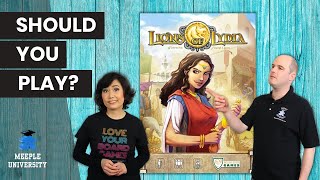
- Fast-paced engine-building with quick decisions
- Modular variability via modules
- Clear upgrade and buying flow with multiple scoring avenues
- Gold-meeple wilds add flexibility
- Escalating end-game tension
- Random bag draw can be frustrating and undermines planning
- Early-game pacing can feel slow
- Coins can be worth little at end-game (one coin equals one point) reducing some coin strategies
- Some decisions are not very tough and can feel predictable
Mechanics (from transcript analysis)
- Bag Building — On each turn you draw a meeple at random from a bag and place it at one of five locations on the board.
- bag drawing and meeple placement — On each turn you draw a meeple at random from a bag and place it at one of five locations on the board.
- card buying and upgrading — You can buy cards with resources and upgrade them; costs are present on the cards.
- coin scoring nuance — Coins have end-game scoring rules (e.g., some coins are worth points, some may be worth nothing depending on the end condition).
- End-game trigger — The game ends when a player upgrades enough buildings; other players get final turns after that.
- gate-based resource generation — Placing a meeple at a gate yields resources based on other meeples and the gate interactions.
- gold meeples and resource conversion — Gold medals on cards allow converting a resource into gold, adding wild flexibility.
- modules for variability — Modules provide additional rules or scoring variations to change the game's feel.
- resource tracking and maxing — Maxing out a resource column increases your track, enabling more cards and points.
Video topics + discussion points
Quotes (from this video)
- it's kind of a hand management with a deck
- you begin the game with a meeple of each of the four colors
- on each turn you draw a meeple at random and then you place it in one of five locations on the board
- it's engine building, it's very quick
- you can buy as many cards as you want from one of the four sides of the board
- the game has limits on all the resources
- max out a column you get to increase this track so you can get more cards
- one coin worth one point otherwise coins worth nothing
- it's a pretty solid game
- it's the engine building part
- it's very quick
- there's eight modules
- store one meeple permanently
- swap it out
References (from this video)
- short, snappy turns
- well-balanced choices with minimal downtime
- reliance on luck from bag draws may vary
- resource accumulation and district control
- Economic worker placement in a merchant-centric city
- fast turns with deep decisions
Mechanics (from transcript analysis)
- bag-drawing — random meeple from a bag to determine actions
- gate-based bonuses — placing meeples to gain color-matched bonuses and resources
Video topics + discussion points
Quotes (from this video)
- i just love how the mechanics blend well with the theme
- it's a more complex pirate game with so many choices
- most importantly i feel like i've enjoyed this game every single time i've played it
- this is my new favorite title of theirs
- it's cooperative and that might not make sense but if you are curious then you should totally check out the crew the quest for planet nine
- this is a nice medium weight game that game brewer hit out of the park in my opinion
References (from this video)
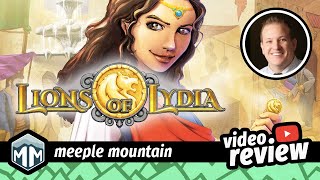
- Extremely easy to teach and begin playing, enabling quick table setup and immediate participation
- Bag-management delivers tactile, tactical decisions and a satisfying tempo as you draw and assign merchants
- Tableau-building with varied property cards creates meaningful, long-tail strategy and incremental payoffs
- Thematic tie-in with Lydia and ancient coinage provides strong flavor and historical resonance
- Art by Daryl Jones is striking; components feel premium and visually cohesive with the theme
- Playtime is concise (roughly an hour) yet offers substantial decision space and player interaction
- Coins and tooling feel robust, supporting flexible play and satisfying end-game scoring opportunities
- End-game tension emerges naturally as you approach the property development thresholds, encouraging careful pacing
- New players may find the bookkeeping and resource tracking a touch fiddly at first
- End-game triggering and fountain interactions can require extra attention to avoid mistakes or miscounting
- Some players seeking heavy crunch or highly asymmetric strategies may find it lighter than they prefer
- The reliance on a bag-drawn mechanic can introduce variance that slightly undercuts strategic planning for some groups
- Component density and color-coding may be visually overwhelming to absolute newcomers
- economic engine-building through merchant activity, resource orchestration, and property development tied to coinage
- Ancient Lydia, a river-valley trading hub in western Anatolia, featuring city gates, fountains, and a coin minting backdrop
- historical-thematic with light narrative flavor around Lydian merchants and property expansion
- Lords of Waterdeep (engine-building with worker/placement vibes and card-driven progression)
- A resource-management tableau builder with a tight playtime and accessible rules
Mechanics (from transcript analysis)
- bag-building — each turn you draw a merchant from your personal bag and decide where it will act (gate or fountain); you must manage the four-merchants-at-a-time constraint
- currency as wild / conversion — coins function as wilds and can be exchanged for other resources on a one-to-one basis when converting at gates or fountains
- engine-building — as you acquire and develop cards, additional actions become available and capabilities scale, creating a growth path across the game
- fountain actions / end-game trigger — fountain-based actions provide key bonuses; the game ends when a threshold of properties is developed, prompting a final round for all players
- gate color matching and placement — placing merchants at colored gates creates color-tied resource bonuses and can trigger cascading effects when multiple matching merchants occupy a gate
- influence track / loyalty incentives — an influence track on the player board determines the cap and bonus triggers; advancing it changes production and victory-point opportunities
- resource cap and wild-cards — players can never hold more than a fixed amount of a given resource and must plan around dwindling or expanding inventory; coins are wild and highly flexible
- Resource Management — you manage core resources (cattle, wheat, coins, and other resources) and use gate actions to convert or increase those resources
- set collection / tableau development — property cards exist in gray, gold, and purple varieties; developing cards flips them to active bonuses and end-game scoring potential
Video topics + discussion points
Quotes (from this video)
- I really like games like this because it's really easy to teach and explain to new players
- the coins are wild and can be substituted for anything
- this is a light to medium weight range that it explodes with tough choices
- Daryl Jones's art is amazing
- the upgraded metal coins feel and look super cool
- it's a tableau building game, things get bigger and better as you go
- I also love the bag management aspect of the game
- this is just another game that is an hour or under and it's a light to medium weight range
- I like games that balance thematic weight with accessible mechanics and this nails it
- the way gates and fountains interact creates a dynamic engine you can actually feel turn-by-turn