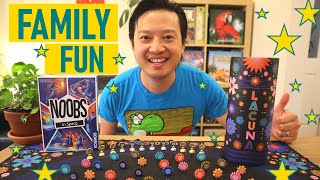












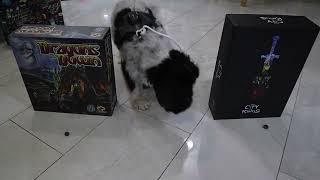

















"The end of her regency is nigh. It's time to clear the way for a new bearer of the burden. She will keep a wary eye on the novices representing their Orders and trying to win her favor. Eventually, she will have to come to a decision. Which Order will prove itself worthy to decide on her successor? There will be a new Moon Priestess and she will bear the title: LUNA."
"LUNA" is the title of the Moon Priestess, and before her very eyes, each of the up to four Orders competes for the right to decide on her successor. The players are the heads of the Orders who try to convince the Priestess of themselves. Over the course of six rounds, they need to collect as many influence points as possible by skillfully placing their novices to achieve that goal.
The players move their novices over seven islands surrounding a temple island. The novices are placed according to the "worker movement" principle, i.e. they aren't placed at the beginning of a round, but instead start where they ended the round before. Thus, novice movement is an important part of a round: Only if you're in the right place at the right time, you'll gain the deciding influence points. You'll have to build new shrines, work at the temple, and participate in the Priestess' divine services. But don't forget to recruit additional novices or win the favor of the local Priests; these are vital means to prepare and combine the diverse actions.
LUNA: In the Domain of the Moon Priestess is a challenging tactical game with strategic and interactive elements that takes about 20-25 minutes per player. The different placement of the islands and novices at the beginning of the game creates a different feeling each time you play and opens up new strategies.
Nunatak - First Play Review
- Fast-paced and easy to learn with minimal setup
- Two-player head-to-head focus delivers immediate, heads-up competition
- Clear, elegant win condition that rewards spatial foresight
- Diagonal counting adds a fresh twist to familiar grid-pursuit puzzles
- Good for players seeking a compact, puzzle-oriented abstract game
- abstract strategy with geometric polyomino elements
- abstract grid-based puzzle for two players in a head-to-head contest
- n/a
- Connect Four
- Tetris
Mechanics (from transcript analysis)
- Blocking / counter-play — Players actively block or constrain potential lines by placing pieces to control access to critical diagonals and edges, creating a tension between advancement and defense.
- Connectivity win condition (horizontal/vertical) — The objective is to create a connected line of your own pieces that runs left-to-right or bottom-to-top across the board. Diagonals count toward forming the line, which introduces a nuanced, multi-directional threat dynamic.
- Diagonals count for lines — Unlike many abstract line-building games, Lynx counts diagonal connections as valid for completing a line, expanding the strategic considerations beyond orthogonal alignment.
- Grid building — Players alternate placing identical polyomino shapes onto a shared grid. The placement rules require filling spaces without leaving empty baselines beneath placed pieces, enforcing a compact build-up that progressively shapes the board.
- grid placement — Players alternate placing identical polyomino shapes onto a shared grid. The placement rules require filling spaces without leaving empty baselines beneath placed pieces, enforcing a compact build-up that progressively shapes the board.
- real-time — Turns are quick and decisive, enabling rapid rounds that support quick play sessions or best-of series, appealing to players seeking a fast puzzle experience.
- short play cycles — Turns are quick and decisive, enabling rapid rounds that support quick play sessions or best-of series, appealing to players seeking a fast puzzle experience.
- Symmetric piece set — Each player has the exact same set of pieces in a mirrored color, creating a mirrored-information contest where both players evaluate the board from equivalent starting conditions.
Video topics + discussion points
Quotes (from this video)
- This game is really fun, really quick, a great option when you've played Connect 4 one too many times and are looking for something that is a little bit more of a puzzle.
- The rules are super simple. On your turn, you must place a piece and you must not leave any empty space below it.
- The goal of the game is to get either from left to right or bottom to top a connected row of your pieces.
- Links. I would love to know what kind of head-to-head two-player games do you guys like.
- So, I am loving Links.
- If someone does not meet one of those two win conditions, getting the complete line, then it's whoever has the largest area that is all connected of their pieces.
References (from this video)
- Stunning, anime-inspired art and high production value (box, components, and card art).
- Fully simultaneous play with meaningful tension and interaction via area control.
- Great player-count flexibility (1-6 players) and a dedicated two-player variant.
- Robust component suite with interesting investment options and asymmetrical card interactions.
- Solid solo mode design via dedicated solo cards.
- Prototype components are subject to change during crowdfunding; final product may differ.
- Rules and iconography are fairly dense; heavier setup and learning curve for new players.
- Some players may find the interaction and planning overhead a bit heavy for lighter sessions.
- Corporate empire-building and competitive resource/area control within a medium-weight Euro framework.
- In the world of Kana, a recent era of growth in the country Factoria where heroes form companies to compete for dominance after a historic gear battle.
- Anime-inspired, vibrant aesthetic with a light narrative backdrop about becoming the management king.
- Kivera
Mechanics (from transcript analysis)
- Dice as ships/workers and area control — Dice represent ships/workers; majority on each worker placement area decides who performs that action.
- dice placement — Dice represent ships/workers; majority on each worker placement area decides who performs that action.
- Gold/Silver/Bronze Scoring — Kilo gold serves as currency and a primary route to victory points; some cards award VP directly while others leverage solely controlled areas.
- Investment — Investments are placed on phase tiles to grant ongoing or round-specific bonuses activated during the corresponding phase.
- Investment tiles and phase-based abilities — Investments are placed on phase tiles to grant ongoing or round-specific bonuses activated during the corresponding phase.
- Kilo gold currency and scoring — Kilo gold serves as currency and a primary route to victory points; some cards award VP directly while others leverage solely controlled areas.
- Nine rounds with four phases per round — Rounds consist of planning, area, company, and end-of-round phases, with new area tiles added each round and scale tracked on a gear/track.
- Public sponsor cards and private objectives — At setup, a sponsor card provides a shared objective; advanced mode allows private sponsor/company cards for each player.
- Simultaneous action selection (secret planning phase) — Players secretly choose how many workers (represented by dice) to allocate to each available worker placement spot, then reveal simultaneously.
- Solo mode with cards — A set of solo cards provides a simple, rule-light path for playing alone.
- tableau building — Cards can be played as buildings or as extensions tucked under other cards to modify benefits, costs, or scoring.
- Tableau-building with extendable cards — Cards can be played as buildings or as extensions tucked under other cards to modify benefits, costs, or scoring.
- Variable Phase Order — Rounds consist of planning, area, company, and end-of-round phases, with new area tiles added each round and scale tracked on a gear/track.
Video topics + discussion points
Quotes (from this video)
- I am absolutely in love with the way that this game looks.
- If you're a fan of anime and beautiful art, definitely check it out.
- This is a fully simultaneous game and it plays one to six players.
- I absolutely love the characters.
- The box cover is one of the most beautiful, I am obsessed with it.
References (from this video)
- Italian flavor and high production value
- ambitious scope with deep political gameplay
- heavy and complex
- potentially long playtime
- political power and influence
- ancient Rome; Italian flavor
- historical/economic strategy
- Brass Birmingham
Mechanics (from transcript analysis)
- 3D components — use 3D wooden temples and structures as focal points
- area majority — control regions and influence political standing
- worker placement — place workers to perform actions and secure resources
Video topics + discussion points
Quotes (from this video)
- it's basically King of Tokyo made in a tug of war way
- I really want to roll dice and smash staff
- Mega Fun
- I hope to get this one a Spiel
- this is the heaviest side definitely looks like a wide
- we are very excited
- this looks fantastic
- this looks like an absolute Jam
- I can't wait to play this
References (from this video)
- Longstanding favorite among fans
- Valued as a gift/collection item
- cute character-based hand management
- Nana family card game lineage
- light, cute, approachable
- Dog Poker
- Cat Poker
Mechanics (from transcript analysis)
- Card play / hand management — Players play from hands to form favorable combinations
- hand management — Players play from hands to form favorable combinations
Video topics + discussion points
Quotes (from this video)
- Pixies I have played a few times on BGA and I have really really enjoyed it
- I think it's the cutest thing
- milk curo it is very cool looking trick taking game where cards actually have two ends either the black side or the white side
- Harvest ... plays one to six players so does play solo and that is this game right here
- Loop has the same two girls on it but it's purple
- I'm looking for Nana Christmas
- I picked up Nana for my friend Aiden
- this is one that I've really wanted and it is on the board game bliss website
References (from this video)
- Fresh, quirky concept; fast play
- Accessible abstraction with a unique twist
- Not everyone's cup of tea; some may find it quirky
- majorities by token type
- pig mat token placement
- quirky abstract with novel mechanisms
Mechanics (from transcript analysis)
- majority token collection — place markers to collect tokens; tokens go to the nearest marker
Video topics + discussion points
Quotes (from this video)
- this one is a lovely game by Stephan Dora, a great design in his own right.
- you are trying to collect exactly three of these animal tokens of each type to get the maximum amount of points
- a real brain burner but so simple and elegant to play as well
- Lost Cities a joy to get that one back to the table
- it's far too long I think it took us nearly two hours to play this which is obscene for the weight of the game
- Katarena one of the best abstract strategy games out there
- this is a bit of a whitewash of a game
References (from this video)
- clever, idiosyncratic Feld design
- flows wonderfully and rewards careful planning
- replayable with strong depth and low entry barrier
- weird pace at times may feel contrived
- thematic fit can feel opaque to new players
- mythic temple-building with a dynamic priest/ape casting
- islands with acolytes, temples, and a moon priestess
- highly thematic yet abstract mechanics
- Yellow and Yangzi
Mechanics (from transcript analysis)
- acolyte placement and temple claiming — manipulate acolytes across islands to gain temple bonuses
- dynamic state and chain reactions — actions influence future opportunities via rotating priest/apostle effects
- priestess scoring and timing — moon priestess position affects scoring; presence matters
Video topics + discussion points
Quotes (from this video)
- this is a really interesting game
- one of the best examples of that mechanism being used correctly
- infinite replayability
- timeless, evergreen status
- flows wonderfully and rewards careful planning
References (from this video)
- esoteric and unique feel compared to Feld's other titles
- different endgame alliances and chains of action
- can feel inaccessible at first
- complex rules may require careful introduction
- area control with rule-shifting islands
- islands and temple-based area control
- esoteric, rule-shifting strategy
Mechanics (from transcript analysis)
- Area Control — place workers on temple areas to gain control and resources.
- temple-based scoring — distinct temple areas grant varying benefits and victory points.
- worker rejuvenation / reuse — reclaim and reuse workers to string together powerful moves.
Video topics + discussion points
Quotes (from this video)
- it's just a very fun and a pretty accessible experience considering how much is going on here
- I love the way this game develops
- this game does what it promises
- This is a puzzly tile placement Style game
- I split you choose Style game
- Peloponnese is definitely one of the most punishing games I have but I love it for that reason
- Luna does stand on its own and feels different to the rest of them
References (from this video)
- Quirky interesting action selection
- Lovely Clement Franz artwork
- Atmospheric theme and presentation
- Good area control mechanics
- Nice balance of accessibility and depth
- Less overwhelming than other Stefan Feld games
- Moon priestess and ancient temples
- Fantasy moon temples
- Atmospheric, thematic but unrelated to gameplay
- Uwe Rosenberg games
- Lookout Games titles
Mechanics (from transcript analysis)
- action selection — Choosing available actions from limited options
- Area Control — Controlling temple areas for points
- Point Salad — Multiple paths to victory
- worker placement — Moving meeples around islands
Video topics + discussion points
Quotes (from this video)
- hi i'm adam porter and this is my board gaming vlog and we're looking at my top 100 board games
- i found in a german board game shop i've never heard of it so i was very excited
- there's these nice little stories narratives that come through and they're not in your face nothing's written
- it does feel like you're running a little sort of tavern business in oldie worldy uh sort of germany
- this is just a mind-bending game
- really power grid is way out in front as the best freedom and freeze game
- as far as economic games go it's one of the best ones out there as well
- luna really stuck with me
- it's just really satisfying board game
- it's just fun to sit around the table and all know you're allowed to lie to each other
- really satisfying if you like puzzles
- it's one of the classic gateway games
References (from this video)
- Appealing table presence and tactile components that look stunning on camera and table.
- Dual-purpose decision-making: board state progression and tableau optimization.
- Tension around endgame scoring, with meaningful swing potential and close finishes.
- Rule set is compact and relatively easy to teach with a strong pool drafting mechanic.
- Some randomness in card availability can affect the flow and outcome.
- Ambiguity on certain icons or card effects may slow early game clarity for new players.
- Ancient civilizations, monumental construction, and symbolic sculpture
- Pyramid-building on a modular base with stacked layers and pillars
- Abstract puzzle with scoring through color-coded cards and pillar placement
Mechanics (from transcript analysis)
- card drafting — Draft from a shared public pool; the chosen card is placed in front of you and a pillar is placed on a matching board spot.
- Compound Scoring — Compete for majority in 2x2 blocks; the highest pillar count grants the lead, with ties favoring the current player.
- end game bonuses — Additional scoring opportunities via elders and specific bonus cards that amplify points earned later.
- Endgame bonuses — Additional scoring opportunities via elders and specific bonus cards that amplify points earned later.
- Majority / 2x2 scoring — Compete for majority in 2x2 blocks; the highest pillar count grants the lead, with ties favoring the current player.
- Pillar placement on layered tiles — Place pillars to build a vertical pyramid, triggering scores on the spaces beneath and creating opportunities to score in adjacent areas.
- set collection — End-of-turn and end-of-game scoring based on the colors/types of cards you accumulate in front of you.
- set collection scoring — End-of-turn and end-of-game scoring based on the colors/types of cards you accumulate in front of you.
- tile placement — Place pillars to build a vertical pyramid, triggering scores on the spaces beneath and creating opportunities to score in adjacent areas.
Video topics + discussion points
Quotes (from this video)
- This game is super duper cool.
- I was crushing it.
- The endgame mammoth cards gave Anastasia a huge lead.
- Ties are enormous in this game when it comes to this.
- I kind of accidentally taught you 90% of the game right there.
- I would love to dig into it more and play this one more.
References (from this video)
- Beautiful artwork and theme
- Deep, engaging mechanics for heavy gamers
- Candidly not for casual players; difficult to teach
- moon priestess and island control
- mythic island cult/religious motif
- mystical, spiritual
Mechanics (from transcript analysis)
- action tokens — Actions are activated via tokens that move novices and trigger effects.
- Area Control — Players influence island occupancy with novices to maximize scoring.
- recruitment and shrine-building — Recruit novices, build shrines, and utilize temples for scoring.
Video topics + discussion points
Quotes (from this video)
- Bandu is fantastic and hasn't really been surpassed as a simple dexterity stacking game
- extremely accessible extremely fun for all different ages
- this is essentially the European version but it goes down a very different route in terms of its graphics and puzzles
- Libertalia I find hugely enjoyable, it's got a fantastic theme and there's so much going on that you barely notice the frustration of that car play and not being able to judge what other people are going to do
- San Juan holds up to this day
- in Yin one player is black and the other white
- it's a master piece
- Power Grid fantastic game
- Tigris and Euphrates is a masterpiece
References (from this video)
- high meat-to-time ratio; substantial strategic depth in a relatively compact duration
- unique tension and protective strategies create compelling gameplay
- potentially nebulous at first with a steep learning curve
- not for everyone due to its abstract, analysis-heavy nature
- area control with shifting rewards and risk of being kicked off
- moon priestess and lunar worshippers
- analytical, decision-heavy with tense ultimatums
Mechanics (from transcript analysis)
- Area Control — allocate followers to board spots; lower-value actions can be kicked off by higher values
- Area control with follower allocation — allocate followers to board spots; lower-value actions can be kicked off by higher values
- Brief but dense decision space — game emphasizes deep planning over long play times
- real-time — game emphasizes deep planning over long play times
- Tension and protection — players try to avoid being kicked off and manipulate the board to protect positions
Video topics + discussion points
Quotes (from this video)
- there is this more injected element of player interaction
- it's a genius twist
- the market is completely driven by the players
- money is such a tight resource in this game
- the rules overhead is very low
- a timeless design
- you can bet your funds on other people being right
- loads of things to weigh up, a complete package of the game
References (from this video)
- Second edition coming
Mechanics (from transcript analysis)
Video topics + discussion points
Quotes (from this video)
References (from this video)
- weird but compelling theme
- deep strategic decisions
- engaging interaction with shifting alliances and penalties
- thematic oddness may deter some players
- steep learning curve
- ascension and control of different areas
- Mythic islands with disciples and magical items
- weird and whimsical, yet functional
Mechanics (from transcript analysis)
- Area Control — Move disciples around islands to claim areas and gain points.
- Area control / placement — Move disciples around islands to claim areas and gain points.
- asymmetric interaction — Ascend disciples toward a central temple while avoiding the Apostle.
- item/resource management — Acquire magical items to alter rules and shift the board state.
- Resource management — Acquire magical items to alter rules and shift the board state.
Video topics + discussion points
Quotes (from this video)
- this has been a real steady Eddie on my top 100 list for many many years now one of Kia's most iconic kind of bidding games
- I love the way that you can manipulate the market here as you and your neighboring opponents can draft cards from the same racks of cards in order to manipulate that stock price
- this game is so good and after playing so many games I think maybe this one got lost in the shuffle at the time but now I've given it the time of day it is just an excellent engine builder
- super fun dice rolling game as you're trying to roll a huge cluster of Dice and select one of those pit values
- one tile system ... really dynamic and interactively restrictive in a good way
- there are so many ways you can approach this game by spreading yourself thin and being good at everything or just being really good at one thing
- the nagging tension of these rats coming to plague you
- a wonderful evergreen for me
References (from this video)
- beautiful components and tactile pieces
- simple to learn but deeply crunchy and replayable
- clear mathematical elegance and quick play time
- some may find the abstract theme less engaging
- color matching and spatial placement
- abstract board game about spaces between objects and colors
- abstract, mathematically flavored
- Air Land and Sea
Mechanics (from transcript analysis)
- color-collection win condition — Win by achieving four colors; there are seven colors total and seven flowers per color
- flower clearance and scoring logic — A fixed total of 49 flowers; placement clears a portion of flowers with defined scoring implications
- placement between two same-colored flowers — Your piece must be placed between two flowers of the same color
Video topics + discussion points
Quotes (from this video)
- it's just a great game at getting people to talk to each other because it's always obvious what your opponent is doing when they've done it but it's not obvious until they've done it
- Luna means the space between things
- the idea isn't that different from Magic the Gathering you have followers which are kind of like creatures and then you have these location cards
- the nuclear option as in you blow everything up