





































Lure Deep Dive
What the Community Thinks About Lure
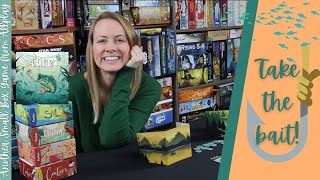
Lure has quietly become a gem in the light games community, prized for delivering a genuine fishing adventure in a quick sitting. Channels like Good Time Society and Our Family Plays Games highlight the game's elegant pairing of theme and mechanism, where the tension of catching fish emerges naturally from the decision-making rather than feeling tacked on. The compact format and short playtime make it an ideal opener for a gaming session or a breather between heavier titles.
Core Mechanics That Define Lure
Dice Selection and Bluffing
At its heart, Lure is a push-your-luck dice game wrapped in a hidden-information layer. Each turn, players secretly select how many dice they wish to roll and whether to deploy a lure card. The player who commits the fewest dice goes first to attempt a catch. This mechanic creates an elegant tension: roll more dice for a higher total, but risk giving an opponent first crack at the most lucrative fish. The secrecy of dice selection means every round includes a mind game about what your opponent is planning.
Lures as Tactical Tools
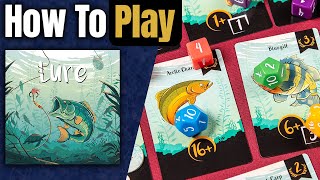
Lures are the game's signature tactical element. These cards provide diverse advantages: some function as virtual dice that add fixed numbers to your roll, others modify existing dice by adding or subtracting a point, and a Boost lure grants bonus points when you successfully land a fish. Each lure is different, and using one commits you to its benefit or consequence. Failing to catch a fish when you have played a lure means it is discarded, so every lure deployment is a calculated gamble.
The Lure Experience
Quick and Rhythmic Gameplay
The game moves briskly from turn to turn. Fish are revealed to form a small market of targets. Players roll their selected dice, often with dramatic flair, totals are compared, and whoever lands the fish keeps it as points. Fresh fish are added to the market as the game progresses, maintaining pressure. Reviewers note the game holds its energy throughout without overstaying its welcome, delivering the feeling of a complete fishing expedition without the hours of actual waiting.
Thematic Immersion in a Compact Box
The smallest touches reinforce the fishing theme. Fish carry authentic names, and the lure cards represent real fishing lures with distinct properties. The result is a game that feels fully thematic despite its lightweight mechanics, fulfilling the fantasy of an angler making split-second decisions on the water. Published by AllPlay, the small-box format keeps the whole experience portable and quick to set up.
What Makes Lure Stand Out
Elegant Simplicity With Meaningful Decisions
Lure avoids rules bloat while remaining tactically rich. The core decision loop is transparent: choose a dice count, optionally deploy a lure, roll, and attempt to catch available fish. Yet within this simplicity sits genuine strategy. Do you go aggressive with more dice, or conservative to lock in first choice? Which lure synergizes with your dice count? The absence of fiddly subsystems lets players focus on these trade-offs. Reviewers repeatedly note that the simultaneous, secret commitment of dice is what gives a featherweight game real bite, since you are always trying to read whether a rival is going big for a trophy fish or hanging back to grab first pick of the easier catch.
Perfect Gateway Appeal
The game's compact box, short playtime, and intuitive theme make it an ideal introduction to modern board games. Non-gamers grasp the fishing premise immediately. Experienced gamers find legitimate tactical depth in dice selection and lure deployment. This dual accessibility explains its growing presence in collections of players who value efficiency and quick-to-table options.
Potential Drawbacks
Dice Variance Wins Games
As a dice game, Lure is subject to runs of luck. A strong string of high rolls can overwhelm tactical lure play. Players seeking games where skill decisively determines outcomes may find Lure too reliant on the roll. However, this same variance creates the dramatic tension many reviewers celebrate, since near-misses and lucky catches feel earned within the fishing context rather than frustrating.
Limited Depth for Extended Play
The short playtime is a feature, but it also limits strategic development. Players do not build toward long-term synergies or combos across a session. Those accustomed to tactical engine-building or catch-up mechanisms may find individual rounds feel somewhat isolated. The game is designed as a series of decisive moments rather than an arc of advantage accumulation, which suits its filler role but limits its ceiling.
If You Enjoy Lure
If you appreciate Lure's push-your-luck core, explore other quick AllPlay small-box titles that pair a clean rule set with tense decisions. Dandelions offers similar light, fast play with a clever spatial twist. For more push-your-luck dice tension, Cant Stop remains the genre benchmark, rewarding the same press-or-bank instinct. And for a slightly meatier fishing-and-nature experience, Calico provides thematic depth and rewards careful planning while keeping the cozy tone that makes Lure approachable.
What Reviewers Are Saying
"This is a fishing game, and it's one of the most relaxing things you can do. We have this from AllPlay, they used to be boardgametables.com. They're doing these little games now that play in about 15 to 30 minutes and fit in a little box."
— Good Time Society
"Some of the lures are going to be virtual dice. You have a plus one, a minus one, where you can add one or subtract one from your die. So when you choose dice, at that time you're deciding: am I going to use a lure or not?"
— Good Time Society
"We played Lure and that was a wonderful game. It was wonderful, and guess who won? She won, and I did terribly."
— Our Family Plays Games