/pic665651.jpg)
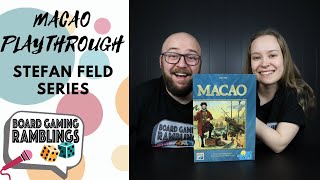
At the end of the 17th century, Macao – the mysterious port city on the southern coast of China – is a Portuguese trading post in the Far East. The players take on the role of energetic and daring adventurers. Many exciting tasks and challenges await the players, whether they are a captain, governor, craftsman, or scholar. Those who chose the wisest course of action and have the best overall strategy will earn the most prestige at the end.
Macao lasts twelve rounds, and in each round players select one new card from a display specific to that round, two of which were revealed at the start of the game and others that were revealed only at the start of the round. The deck of 96 cards includes all sorts of special abilities, with the more powerful actions costing more resources to put into play.
One player rolls six different-colored dice, then each player selects two of those dice (possibly the same ones chosen by opponents), then places cubes equal to the number and color of the two dice on a personalized "ship's wheel." For example, if a player chooses the blue die that shows a 5, he places five blue cubes on the ship's wheel position five spots away from the current round. (A player can never claim more cubes than the number of remaining rounds).
Players rotate their ship's wheels each round, then use the cubes available to them in that round to perform various actions: activating cards selected in that round or earlier rounds, buying city quarters and collecting the goods located there, moving that player's ship around Europe to deliver those goods, acquiring gold coins, taking special actions with card previously activated, and advancing on a turn order track.
Players score points by delivering goods, paying gold coins, using the powers on their cards, and building in Macao. Whoever has the most points at the end of twelve rounds wins.
Macao is number 13 in the alea big box series, with an estimated difficulty on the alea scale of 6/10.

Macao Playthrough (Stefan Feld Series)

Mechanics (from transcript analysis)
Video topics + discussion points
Quotes (from this video)
- it's really good
- public service announcement to do your due diligence
- the biggest news of the whole convention season
References (from this video)

Mechanics (from transcript analysis)
Video topics + discussion points
Quotes (from this video)
- I am definitely interested in learning more about this.
- I like Roland Wright style games.
References (from this video)

Mechanics (from transcript analysis)
Video topics + discussion points
Quotes (from this video)
- beyond the sun is such a good game
- i am loving that game
- i would definitely not mind having a copy of kingdom
- it's a wonderful world expansion ... corruption and ascension
References (from this video)

- Storytelling
- Card-based storytelling where players fill in the blanks.
Mechanics (from transcript analysis)
- Storytelling — Laying these cards out and trying to fill in the blanks and tell stories.
Video topics + discussion points
Quotes (from this video)
- So, I'm not going to share much more.
- Again, I'm I'm actually really optimistic about it.
- I've not played it yet.
- It could be good when it's got the uh the good doctor's name on the box.
- It sounds like it's flimsy to say the least, but hey, it could be fun for one or two plays.
- I think it's absolutely fantastic.
- Um, but intrigued to see what this one has to offer.
- Uh, and if it's as good as people say it is.
- Fascinating design.
- So, you got to be quite careful with that.
- And probably I think well spoiler alert it's probably going to be one of the big hits of the year.
References (from this video)

- Reasonably big faller
Mechanics (from transcript analysis)
Video topics + discussion points
Quotes (from this video)
- Baron strong debut at number 77 as well.
- Floriferous has actually been in my collection for many years, but year after year it does nudge up and up and up, which goes to show it strength because of course we play more games each year, which naturally makes things fall down. But the fact this has gone from number um 98 to number 78 and it's a new best foriferous 2.
- kind of a passive rise for underwater cities. It's such a quality little engine building game from back onto the list from number 107 up to number 83.
- NAR as well has actually again been in my collection for a couple of years now, but last year in its debut year, it came in at number 124. So, it's pushed onto my top 100 for the first time at number 85.
- Get on board has come back into the top 100 as well, going from number 110 up to number 89.
- another debut with Toy Battle at number 90.
- Far Away, come back onto the top 100 from number 116 up to number 91.
- The same goes with QE went from 120 up to number 92 because I did play that one recently and obviously enjoyed it.
- other than that, we had a bit of a fall for games like Gold West, a bit of a fall for games like Mexico.
- Even brass fell a little bit, just hanging on to my top at 100, going from number 78 down to 96. Now, I really like brass, but I don't really play it too often um anymore.
- No Thanks, the classic little bidding or anti bidding game goes from a 104 up to number 97 back onto the list.
- interestingly, um Subastral and Stellar, two card games I recommended. They've always kind of just held on onto my top 100. Um they are now at number 98 and number 100. Um which was slightly down from number 95, 96 last year.
- the last kind of debut taunt game onto my top 100 is Tag Team. Um, a game I've reviewed recently uh on the channel.
- So, those are all the new games this year.
- So that's kind of why I didn't want to do the whole top 100 again because I thought, you know, it's going to be quite similar to last year's with a few jiggles up and down.
- a lot of these more unique games are going up. card game seem to be climbing for me quite a bit and those euros may be holding their place or slightly falling but the great euros of course I'm anchoring themselves at the top of my of my top 100.
References (from this video)
- storytelling
Mechanics (from transcript analysis)
Video topics + discussion points
Quotes (from this video)
References (from this video)
- expands an existing system with new content
- beautiful terrain and expansions
- complex rules may be a barrier
- dark fantasy with druid/bard options
- D&D-style fantasy dungeon crawl
- expansive, modular
- Descent: Legends of the Dark
Mechanics (from transcript analysis)
- dungeon exploration and modular terrain — expands on an existing system with new characters and rooms
Video topics + discussion points
Quotes (from this video)
- There was no logic to it. And why not just stop it from going to New York?
- Laugh people. It cures everything.
- There's a druid character.
- It’s like battleship with dungeons.
- There you go.
References (from this video)

- This was special.
- Might have been a few ties at the top.
- Absolutely brilliant.
- Can't wait for this one to be a thing.
- Fantastic teach
- Conflict between North Vietnamese and US/Allied forces
- Vietnam, 1966
- Coastwatchers
- Draken
Mechanics (from transcript analysis)
- fog of war — Models ambiguity, uncertainty, and fog of war.
- Recon — Features search and recon mechanics integrated with combat.
Video topics + discussion points
Quotes (from this video)
- There's a lot of designers and company representatives that are there, like GMT Games is there, uh Uwe from Sound of Drums was there coming in from Europe.
- So, if you're looking at a chance to play up-and-coming games with some of the designers that are designing on them, it's quite an experience.
- You really get some insight into the design process, into how historical board games are created as you're playing them and giving feedback to the designers.
- In this game, you take on the role of companies that are trying to win military contracts uh from the US
References (from this video)
- Highly acclaimed Stefan Feld game.
- Provides context for discussing Stefan Feld's design work.
- Bruges
- Bora Bora
- The Oracle of Deli
- Aquasphere
Mechanics (from transcript analysis)
Video topics + discussion points
Quotes (from this video)
- The scoring in The Princess of Florence is really unique and it's one of the main draws for me.
- Pax Pamir is just such a masterclass in creating a really tense and dynamic political game.
- Catacombs is such a fun dexterity game. The flicking mechanic is just so satisfying.
- Root is a prime example of an asymmetric game done right. Every faction feels so different.
References (from this video)

Mechanics (from transcript analysis)
- casting spells — Players cast spells, such as 'blasphemous act'.
- Combat — Involves attacking and defending with creatures.
- Counters — Used to track game state, like creature power and toughness.
- Damage — Players take damage, with commander damage being a specific type.
Video topics + discussion points
Quotes (from this video)
- Zabaz is now a 1515. That's a big bub.
- That was insane.
References (from this video)

- Enjoyable once learned
- Interesting tension from round end trigger
- Clever card design
- Dual tracks provide variety
- Difficult to learn initially
- Ocean and Jungle
- Great Western Trail
Mechanics (from transcript analysis)
- Multiple tracks — There's a track where you're moving around the ocean on a boat. Um, and each stop will allow you to do different things. Um, and then there's an additional track at the bottom there with the uh jungle space looking stuff where you have your explorer moving as well.
- One-way track movement — that one is, I guess, more technically the one-way track that you were looking at because you can only go one way through that jungle.
- Round end trigger — There is a very specific round end and whoever starts to trigger that first, it gives it you can do one more move action and then the round is done.
- worker movement — It's a little bit like a worker placement game but it's worker movement in a specific direction.
Video topics + discussion points
Quotes (from this video)
- For me it's no longer eligible for my list since it is a game that we published took Tokaido Duo and soon this year Namiji.
- the track changes almost every round because all of your everybody's generally building buildings as you go through that track.
- This is kind of a masterpiece of of oneway action tracks.
- It uses this mechanism three times throughout the game in really three different ways. So, I guess three different one-way action selection tracks.
- My first thought when I think of one oneway track are all of the kids games of like um life and Monopoly and Shoots and Ladders and Candyland and stuff.
References (from this video)

- Tense theme and mechanics
- Variety of missions
- Feels bigger than the box suggests
- Paths getting blocked can be punishing
- Resistance with a tactical twist
- WWII France; freedom fighters vs police disruptions
- Historical, tense
Mechanics (from transcript analysis)
- Push Your Luck — Ensure crews can return safely; misrouting can cause arrest and loss.
- Push-your-luck and safe-house routing — Ensure crews can return safely; misrouting can cause arrest and loss.
- Worker Placement — Place meeples to gain resources and actions while police block or disrupt.
- Worker placement with police interference — Place meeples to gain resources and actions while police block or disrupt.
Video topics + discussion points
Quotes (from this video)
- Mini Rogue is a very simple and streamlined dungeon crawl game.
- I think this one is my favorite.
- This is the followup to a game called Resist.
- Friday is just one of the most innovative deck building games of all time in my opinion.
- There's just no other game that quite feels like Coffee Roaster.
References (from this video)

Mechanics (from transcript analysis)
Video topics + discussion points
Quotes (from this video)
- this video is about the games that we have gotten since Spiel
- it's about dogs in a home
- Simo is a great game one that I highly recommend
- this is a story storytelling puzzle game about Mary Shelly the creator of Frankenstein
- it's a pure negotiation game
- I love the Euros I love all of that but I really enjoy sitting that playing a fun story-driven game
References (from this video)
- Innovative action-cube and dice-tower mechanic creates deep planning and tension
- Strong 2-player interaction potential; decisions feel meaningful even in two players
- Clear, explicit scoring paths and tangible progression as you build toward goals
- Heavy reliance on randomness from dice and card draws, which can be punishing
- Steep learning curve and planning ahead requirement; mistakes early can compound
- Two-player pacing may feel less dynamic than multiplayer experiences
- trade, city-building, and engine-building through action-cube mechanisms
- historical European port trading network; moves between Hamburg, Amsterdam, and London corridors
- abstract; thematic flavor is minimal and mechanics-driven
- Arena Roma
- Luma
- Amsterdam (Stephenville City Series)
- Macao (two-player print)
Mechanics (from transcript analysis)
- action_cube_mechanism — Dice-derived action cubes are rolled and then assigned to color-coded rounds; players must place cubes to activate actions across rounds, with the round track moving and misalignment causing penalties.
- Card Drafting — Players draft office/power cards that influence income, scoring, and available actions; card choice shapes strategy each round.
- card_drafting_and_card_placement — Players draft office/power cards that influence income, scoring, and available actions; card choice shapes strategy each round.
- dice_tower_and_resource_allocation — A folded-space dice tower generates the initial set of cubes each round, providing a tactile, dynamic resource pool that drives early decisions.
- Pick-Up and Deliver — Players collect color-coded goods and sell or deliver them to cities for points and money, balancing growth with the need to fill available slots.
- point_buy_and_end_game_scoring — Money can be spent to buy points; end-game scoring is triggered by tile completion and final positioning, with ongoing scoring opportunities throughout the round sequence.
- set_collection_and_delivery — Players collect color-coded goods and sell or deliver them to cities for points and money, balancing growth with the need to fill available slots.
Video topics + discussion points
Quotes (from this video)
- this is one of those games where you can very much plan ahead if you want to
- it's a hard game
- the multiplayer game has a lot more going for it
- this is really clever
- I like the game
References (from this video)

- One of the most novel mechanisms in board games
- Deep engine-building with clear path to victory
- High replay potential and strategic depth
- Can be dense and heavy for some players
- economic engine-building and resource management
- Macau's casino economy with wind-rose dice mechanics
- deliberate, strategic tableau with engineered rhythm
Mechanics (from transcript analysis)
- Dice Drafting — Players select dice to gain cubes equal to the die's value, used as action points.
- Engine Building — Cards and actions create a cascading engine of income and points.
- wind rose — Beginning of round, dice are rolled and colored cubes are allocated by color/value with delayed availability.
Video topics + discussion points
Quotes (from this video)
- On your turn you just roll your two dice and then you're gonna use those dice values to draft tiles onto your board.
- this game is simply a trick taking game but cooperative and I remember when I first heard that concept... in practice it feels so amazing
- the theme is just so fantastic I love this idea of being a gallery owner
- it's a great little puzzle
- this is essentially a reinvention of air hockey but just better in every single way
- you can use opponent's dice you just have to pay them for it
- the reward is huge for this one
References (from this video)

- beautiful art
- accessible and cute
- likely abstract and may be short
- macaron/raccoon motif with cute visuals
- abstract, whimsical theme about waffles and raccoons
- quirky and light
- Wafer- or waffle-themed abstracts
Mechanics (from transcript analysis)
- abstract card-driven — clear cards with light strategy
Video topics + discussion points
Quotes (from this video)
- You've got a legally distinct predator in there.
- Wishland the card game as opposed to the original Wishland.
- Endearment is exciting... the achievement thing doesn't do anything for me.