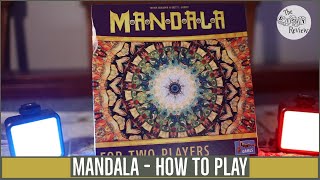































Mandala box art

Mandala

Game ID: GID0200812
Game Info
Year
2019
Players
2
Age
10+
Playtime
30 min
Collection
Rating
Mechanic profile
Not enough video data yet
Vibe profile
How this game feels to play
Description

The Mandala: the symbol of an ancient and sacred ritual. Colored sand is laid to create a symbolic map of the world before the pattern is ceremonially destroyed and the sand cast into the river.

In the two-player game Mandala, you are trying to score more than your opponent by collecting valuable cards — but you won't know which cards are valuable until well into the game! Over the course of the game, players play their colored cards into the two mandalas, building the central shared mountains and laying cards into their own fields. As soon as a mandala has all six colors, the players take turns choosing the colors in the mountain and adding those cards to their "river" and "cup". At the end of the game, the cards in your cup are worth points based on the position of their colors in that player's river. The player whose cup is worth more points wins.

The linen playmat shows two circular mandalas, with each being divided by a horizontal space (the mountain) to create one "field" for each player. The playmat has seven spaces in front of each player to hold their river of single face-up cards and their cup: the stack of face-down cards which they score at the end of the game.

To begin, each player receives a hand of six cards. Each player receives two random cards face down in their cup, then two random cards are dealt face up into the central mountain strip of each mandala.

On your turn, you may play either a single card into one of mountains, or one or more matching cards into one of your fields. All cards played into a mandala must follow the "Rule of Color": Once a color has been played into one of the three areas of a mandala, then later cards of the same color can be played only into that same area. Thus, once your opponent has played red cards into their field, then you can't play red cards in your field, and neither you nor your opponent can play red cards into the central mountain. If you played a card into a mountain, draw three new cards from the deck at the end of your turn; if you played cards into one of your fields, do not draw new cards.

A mandala is completed once it contains all six colors of cards. When this happens, the players "destroy" the mandala, taking turns to choose a color present in the mountain and claim all cards of that color. Whoever played more cards in their field chooses first; if tied, the player who did not complete the mandala chooses first. The first time you claim cards of a specific color, lay one of these cards in the lowest-valued empty space in your river, then place the rest into your cup. The spaces in your river are valued 1-6 in order, so cards of the first color you claim will be worth 1 point each, cards of the second color you claim worth 2 points each, and so on.

Once a mandala has been destroyed and all the colors in the mountain claimed, cards played in the fields are discarded, two new cards are dealt face up into the mountain, and the game continues.

The end of the game is triggered either when the deck is exhausted or when one player adds a sixth color to their river. Both players then tally the value of all the cards in their cup, based on the position of the colors in their river, and whoever has the higher score wins!

Contents:

1 linen playmat
108 mandala cards (18 in each of 6 colours)
2 reference cards

Description

The Mandala: the symbol of an ancient and sacred ritual. Colored sand is laid to create a symbolic map of the world before the pattern is ceremonially destroyed and the sand cast into the river.

In the two-player game Mandala, you are trying to score more than your opponent by collecting valuable cards — but you won't know which cards are valuable until well into the game! Over the course of the game, players play their colored cards into the two mandalas, building the central shared mountains and laying cards into their own fields. As soon as a mandala has all six colors, the players take turns choosing the colors in the mountain and adding those cards to their "river" and "cup". At the end of the game, the cards in your cup are worth points based on the position of their colors in that player's river. The player whose cup is worth more points wins.

The linen playmat shows two circular mandalas, with each being divided by a horizontal space (the mountain) to create one "field" for each player. The playmat has seven spaces in front of each player to hold their river of single face-up cards and their cup: the stack of face-down cards which they score at the end of the game.

To begin, each player receives a hand of six cards. Each player receives two random cards face down in their cup, then two random cards are dealt face up into the central mountain strip of each mandala.

On your turn, you may play either a single card into one of mountains, or one or more matching cards into one of your fields. All cards played into a mandala must follow the "Rule of Color": Once a color has been played into one of the three areas of a mandala, then later cards of the same color can be played only into that same area. Thus, once your opponent has played red cards into their field, then you can't play red cards in your field, and neither you nor your opponent can play red cards into the central mountain. If you played a card into a mountain, draw three new cards from the deck at the end of your turn; if you played cards into one of your fields, do not draw new cards.

A mandala is completed once it contains all six colors of cards. When this happens, the players "destroy" the mandala, taking turns to choose a color present in the mountain and claim all cards of that color. Whoever played more cards in their field chooses first; if tied, the player who did not complete the mandala chooses first. The first time you claim cards of a specific color, lay one of these cards in the lowest-valued empty space in your river, then place the rest into your cup. The spaces in your river are valued 1-6 in order, so cards of the first color you claim will be worth 1 point each, cards of the second color you claim worth 2 points each, and so on.

Once a mandala has been destroyed and all the colors in the mountain claimed, cards played in the fields are discarded, two new cards are dealt face up into the mountain, and the game continues.

The end of the game is triggered either when the deck is exhausted or when one player adds a sixth color to their river. Both players then tally the value of all the cards in their cup, based on the position of the colors in their river, and whoever has the higher score wins!

Contents:

1 linen playmat
108 mandala cards (18 in each of 6 colours)
2 reference cards

Ask a Rules Question
All mentions
Browse transcript mentions, sentiments, pros/cons, mechanics, topics, quotes, and references.
Total mentions: 17
This page: 17
Sentiment: pos 13 · mix 4 · neu 0 · neg 0
Mentions per page
Showing 1–17 of 17
Video k3rFpn55H0U Top List at 2:50 sentiment: positive
video_pk 69369 · mention_pk 165839
Mandala video thumbnail
Click to watch at 2:50 · YouTube ↗
Overall sentiment (raw)
positive
Pros
  • One of the best two-player games
  • Interesting scoring system
Cons
none
Thematic elements
Comparison games
none
Mechanics (from transcript analysis)
  • Area Control (implied) — Playing cards into one of two mandalas, with restrictions on card types per mandala.
  • Card Drafting (implied) — Players choose which cards to play.
  • set collection — Collecting sets of cards where the order and value increase.
  • Tableau Building (implied) — Building up cards in the middle to draw more cards.
Video topics + discussion points
No key topics recorded for this video.
Quotes (from this video)
  • hey everybody and welcome back to my top 100 board games of all time
  • This is the 2024 into 2025 edition of the list and we are continuing today by counting through games 40 up to number 31
  • I have a strong feeling that next year this game could break the top 20 because it is so unique and it's just kind of a masterpiece of design
  • so that is the veil of Eternity at number 31
  • if you have enjoyed the video please be sure to hit like And subscribe to the channel and check on my other content too
References (from this video)
No references stored for this video.
Video JOgl6gemk-s Board Game Buzz Discussion at 34:21 sentiment: positive
video_pk 66427 · mention_pk 161782
Board Game Buzz - Mandala video thumbnail
Click to watch at 34:21 · YouTube ↗
Overall sentiment (raw)
positive
Pros
  • Two-player Wonderlands War flavor
  • Compact and quick
Cons
  • May require familiarity with Wonderlands War to fully enjoy
Thematic elements
  • Array
  • Wonderland's War universe
  • Two-player abstract-mancala style with thematic ties
Comparison games
  • Wonderlands War
  • Mad Kala (within same universe)
Mechanics (from transcript analysis)
  • Mancala — Shards are collected and placed in a mancala-like sequence to unlock moves and scoring opportunities.
  • Mancala-inspired — Shards are collected and placed in a mancala-like sequence to unlock moves and scoring opportunities.
  • Two-player design — A two-player variant designed to capture the Wonderlands War feel in a compact format.
Video topics + discussion points
No key topics recorded for this video.
Quotes (from this video)
  • I'm so sad about it, but unfortunately I will not be at PAX unplugged this year.
  • Aren't we in a great hobby and great? We're in the golden age of gaming, right?
  • I love just getting excited over new board games. It makes my heart happy.
  • We're in the golden age of gaming, right? Where we have so many great games that are coming out all the time.
  • I need this game. I need it to complete my Formage collection.
References (from this video)
No references stored for this video.
Video UDOlnlkBm7o Unknown Top 10 List at 3:36 sentiment: positive
video_pk 66190 · mention_pk 160884
Unknown - Mandala video thumbnail
Click to watch at 3:36 · YouTube ↗
Overall sentiment (raw)
positive
Pros
none
Cons
none
Thematic elements
Comparison games
none
Mechanics (from transcript analysis)
  • mod calling — picking up stones, moving, dropping, activating abilities
Video topics + discussion points
No key topics recorded for this video.
Quotes (from this video)
  • There is a chance to get these two exclusive pins which are also going to be so so hot.
  • I got my one ring pin last year. Everybody wants to trade for it.
  • I definitely want to get these two tower pins if I can.
  • This is a huge thing.
  • I'm really, really, really excited for this one.
  • Sunday from 11 till 2, you'll be able to get your picture taken with Santa and you'll be able to see Holiday Hills.
References (from this video)
No references stored for this video.
Video 5a1UAThQKKo All You Can Board Crowdfunding Preview at 0:46 sentiment: mixed
video_pk 66026 · mention_pk 160454
All You Can Board - Mandala video thumbnail
Click to watch at 0:46 · YouTube ↗
Overall sentiment (raw)
mixed
Pros
  • Quick play (10-15 minutes)
  • Small box card game
  • Two-player option
  • First-time designer who also did the artwork
Cons
  • Shipping costs, high for some regions
Thematic elements
  • Bird attraction and scoring through card actions and dice
  • Bird photography theme with dice manipulation and card drafting
Comparison games
  • One Deck Dungeon
  • Sprawlopolis
Mechanics (from transcript analysis)
  • Card actions + scoring conditions — Actions on drafted cards manipulate dice and score per conditions
  • card drafting — Drafting one of three bird cards each turn
  • dice manipulation — Manipulating dice rolled from a pool based on drafted cards
Video topics + discussion points
No key topics recorded for this video.
Quotes (from this video)
  • i'm really intrigued by bandata i'm just
  • it's visually really stunning game
  • not coming to retail this is a kickstarter exclusive
References (from this video)
No references stored for this video.
Video Z52a9Yx70Zw Getting Games Top List at 11:18 sentiment: positive
video_pk 63415 · mention_pk 156810
Getting Games - Mandala video thumbnail
Click to watch at 11:18 · YouTube ↗
Overall sentiment (raw)
positive
Pros
  • tight, elegant two-player puzzle
  • strong mind-games and interaction
  • compact playtime with deep decisions
Cons
  • as with any two-player abstract, some players may want more variability
Thematic elements
  • color matching and strategic card play
  • two-player abstract puzzle with color cards
Comparison games
none
Mechanics (from transcript analysis)
  • mind games — cards played influence not only your own options but constrain the opponent as well
  • two-player only card puzzle — square-shaped color cards in six colors played to create patterns and gain points
Video topics + discussion points
No key topics recorded for this video.
Quotes (from this video)
  • I think that the Anno system is brilliant
  • the systems are just so simple there's not that many rules it's very elegant
  • I can teach in like 15 minutes
  • the fun value has been so high
  • I have loved playing Beyond the Sun this year
  • the technologies themselves really do shift the pattern of the game
  • these technologies fit in with various other technologies and make one game so different from the other
  • I will never be playing this game without the snake board again
  • it's an amazing package, it's gorgeous
  • the snake board is a much more balanced and far more fascinating experience
  • this is a heavy gaming experience it's not crazy heavy but it leans on the heavy gaming experience
  • this expansion has you throwing away the old board and adding a bunch of new mechanics and tokens
  • I think the game is great overall
  • it's a joy of a game to play
  • the highs have been the highest out of any game that I've played this year
References (from this video)
No references stored for this video.
Video BG9XvnqQko0 All You Can Board Discussion at 5:36 sentiment: mixed
video_pk 62455 · mention_pk 154980
All You Can Board - Mandala video thumbnail
Click to watch at 5:36 · YouTube ↗
Overall sentiment (raw)
mixed
Pros
  • Visually appealing with vibrant mandalas
  • Strong tactical interaction and opponent-contested space
  • Compact 2-player experience with depth
Cons
  • Competes with other tactical abstracts and may not stand out visually
  • May be less accessible to players new to abstract games
Thematic elements
  • color blocking and strategic color placement to block the opponent
  • abstract two-player mandala boards with colors in two mandalas
  • tactical, short-term focus with long-term planning
Comparison games
  • Patterns
Mechanics (from transcript analysis)
  • color placement into mandalas — Players place colors into either the mountain or field mandalas; only one of each color per mandala.
  • color-based blocking — Placing a color can prevent the opponent from placing that color elsewhere in the same mandala.
  • reactive strategy — You respond to the opponent's setup and adjust to prevent escalation or to open opportunities.
Video topics + discussion points
No key topics recorded for this video.
Quotes (from this video)
  • Iliad's one of those games.
  • these are the kind of decisions you're making constantly in Iliad
  • it's a 30-minute game
  • There are trade-offs everywhere
  • the overwhelm for me dissipated really quickly
  • Patterns is the more strategical game.
  • Patterns is the one that makes me feel like I want to play another game immediately and consistently gives me those feelings.
  • Ultimately I am keeping Patterns
References (from this video)
No references stored for this video.
Video m8yQRODoH1U The Dice Tower Discussion at 0:25 sentiment: mixed
video_pk 42333 · mention_pk 128446
The Dice Tower - Mandala video thumbnail
Click to watch at 0:25 · YouTube ↗
Overall sentiment (raw)
mixed
Pros
  • Distinct Mancala-inspired mechanism integrated with direct combat
  • Strong design of character differentiation and asymmetry
  • High production value and art
  • Good replayability with multiple characters and expansions
Cons
  • Rulebook lacks thorough explanations; edge cases require FAQ
  • Box size and playmat packaging feel awkward
  • Can feel too close to a TCG for some players
  • Potential balance issues and lack of per-card FAQs
Thematic elements
  • whimsical combat with asymmetric powers in a Wonderland setting
  • Alice in Wonderland universe; duel at a tea party using magical tokens and mischief
  • fantasy whimsy with a competitive duel
Comparison games
  • Wonderlands War
  • Crusaders
  • AIA
  • Traan
  • Manala
Mechanics (from transcript analysis)
  • asymmetric player powers — Each character (Red Queen, Jabberwocki, Alice, White Rabbit, Mad Hatter) has a unique ability and piece interactions.
  • Card-driven bonus actions — Commoner cards provide bonus actions; cards have costs in shards and can be unflipped to reuse.
  • Character asymmetry and unique powers — Each character (Red Queen, Jabberwocki, Alice, White Rabbit, Mad Hatter) has a unique ability and piece interactions.
  • Combat: Damage Based — Characters have health; dealing damage reduces health until zero.
  • Health-tracking and direct damage — Characters have health; dealing damage reduces health until zero.
  • Mancala — Players move tokens along plates clockwise, collecting from one plate and dropping on others, with options to take actions and possibly use a 'doubler' chip to repeat an action.
  • Mancala-style resource movement — Players move tokens along plates clockwise, collecting from one plate and dropping on others, with options to take actions and possibly use a 'doubler' chip to repeat an action.
  • Per-card restrictions and flip mechanics — Most cards are used once and flipped; to reuse you must unflip or reset.
  • Resource management — Shards are spent to activate plus-one cards or other effects; shards are reclaimed by gameplay.
  • Rulebook and edge-case handling (rulebook issues) — Layout and coverage of edge cases are weak; players often need a FAQ or online reference.
  • Shard/resource management — Shards are spent to activate plus-one cards or other effects; shards are reclaimed by gameplay.
  • Tile/actions interaction with board layout (MONCALA-like) — The middle board works like a Mancala track (mcala) where you place tokens and trigger actions.
  • Turn structure with action selection — On your turn you select a plate, collect, distribute, and resolve, with the option to use actions on opponent’s side and to perform double actions with doubler chips.
Video topics + discussion points
No key topics recorded for this video.
Quotes (from this video)
  • The box size is irksome, but I really do appreciate that the mat fits in it.
  • The rules are not particularly strong. They're not thorough.
  • This game is all about mana—do you like mana? Because this game is all about that mana.
  • I love dual games in general and I like Malawa and that's just a great combo.
  • There's a barrier to entry with the rule book; after first play it can feel like you need to cool down and learn more.
  • I really like the movement of the mcala pieces; it’s satisfying.
  • The characters are very different; it's not that complex, once you learn your opponent's character.
References (from this video)
No references stored for this video.
Video fJcZ9rbIuxE The Dice Tower Analysis at 0:00 sentiment: mixed
video_pk 41117 · mention_pk 124746
The Dice Tower - Mandala video thumbnail
Click to watch at 0:00 · YouTube ↗
Overall sentiment (raw)
mixed
Pros
  • The game presents a strong thematic fit with a mana/energy flavor and clear poison/shard motifs, giving players a cohesive flavor experience.
  • The card-flip and interruption mechanics create a tense, decision-heavy space that rewards timing, bluffing, and counterplay.
  • Token placement adds depth and variability, enabling diverse strategic paths across play sessions.
  • The blend of TCG-like feel within a board-game framework can appeal to players who enjoy direct interaction and dynamic turns.
  • Health and shard mechanics give a tangible sense of progression and risk management throughout a match.
  • The emergent narrative potential comes from how players interact with each other through effects, rather than a scripted storyline.
Cons
  • Rule clarity and resolution timing may be challenging, especially for new players, given the multiple interacting effects (flips, tokens, poison, shard removal).
  • Balancing the interplay between health, shards, and status effects requires careful design; misbalance could lead to frustrating or opaque games.
  • Downtime could increase if players wait on complex interactions or if turns become lengthy due to chain reactions.
  • The abstract setting may be less appealing to players who prefer concrete thematic worlds or highly narrative experiences.
  • The comparison to TCGs might set up expectations that aren’t fully aligned with the actual game pace or deck-building aspects, leading to mismatch in audience.
Thematic elements
  • Resource denial, direct disruption, and tactical confrontation framed by a mana/energy motif that emphasizes risk, timing, and counterplay.
  • A compact, abstract battleground where players bend the flow of combat through card-driven effects, health manipulation, shard removal, and status conditions like poison.
  • Emergent and player-driven, driven by interactive card plays and token effects rather than a fixed storyline.
Comparison games
  • Generic deck-building/TCG-inspired games
  • Other card-driven confrontation games
Mechanics (from transcript analysis)
  • Action Interruption — Powers that allow players to interrupt or stop opponents’ actions introduce tension and counterplay, ensuring that aggressive moves face potential pushback and that timing is crucial.
  • Card flipping as action — Players flip or reveal cards to trigger effects, altering information asymmetry and enabling strategic timing and bluffing. This mechanic drives direct clash and counterplay, as flips can be intercepted or negated by opponents.
  • Direct interruption and denial — Powers that allow players to interrupt or stop opponents’ actions introduce tension and counterplay, ensuring that aggressive moves face potential pushback and that timing is crucial.
  • Dynamic board state (shard removal) — The board state evolves as shards are removed, forcing players to adapt to a changing playfield. This can amplify late-game volatility and reward players who anticipate shifts in the board.
  • Health/shard economy — A health pool is modified by effects, and shards are a secondary resource that can be removed from the board to hinder opponents. This creates a visible, trackable economy that players must manage across the game.
  • Player Board | Main Board — The board state evolves as shards are removed, forcing players to adapt to a changing playfield. This can amplify late-game volatility and reward players who anticipate shifts in the board.
  • Status effects (poison) — Status effects such as poison introduce ongoing penalties that influence decision-making and risk assessment. Players must consider whether to push for a payoff now or endure a slower burn to secure longer-term advantages.
  • Token placement and effects — Tokens are deployed to modify future turns, grant advantages, or impose penalties. Tokens interact with other mechanics (like flips or card effects) to shape the strategic landscape and create potential for strong combos or disruptive plays.
Video topics + discussion points
No key topics recorded for this video.
Quotes (from this video)
  • The game itself, whether you like it or not, I'm taking away your health. I'm making your shards come off the board.
  • I'm flipping your card or stopping you from flipping a card.
  • Now you're poisoned. You have to know that going in.
  • Do you like Manala? Because this game is all about that.
  • To me, the game feels like you're playing a TCG, but instead of the TCG card play, you're playing Manala instead.
References (from this video)
No references stored for this video.
Video 3dGZTX_OyGE Chairman of the Board Discussion at 5:55 sentiment: positive
video_pk 11314 · mention_pk 33248
Chairman of the Board - Mandala video thumbnail
Click to watch at 5:55 · YouTube ↗
Overall sentiment (raw)
positive
Pros
  • One of the best two-player experiences
  • Highly replayable with strong balance
Cons
  • Not every player will enjoy the abstract mechanics
Thematic elements
  • Pattern matching and scoring rhythm
  • Pattern drafting and color card management
  • Abstract/analytic
Comparison games
none
Mechanics (from transcript analysis)
  • pattern/hand management — collect and play cards to achieve mandala patterns
Video topics + discussion points
No key topics recorded for this video.
Quotes (from this video)
  • mandala still utterly fantastic
  • one of the best two player games i've made
  • it's so so good and repeated plays are not changing that at all
  • my god is this game fantastic even better than i remembered it
  • it's got that real novelty factor and that physicality to a party game that does make people remember it
  • the scoring does feel a bit too tight
References (from this video)
No references stored for this video.
Video zJqdKED3NmM Chairman of the Board Discussion at 15:14 sentiment: positive
video_pk 8380 · mention_pk 24681
Chairman of the Board - Mandala video thumbnail
Click to watch at 15:14 · YouTube ↗
Overall sentiment (raw)
positive
Pros
  • Smooth as silk
  • Tough decisions in a light framework
Cons
none
Thematic elements
  • Aesthetic card arrangement and placement
  • Two-player set collection/mandala framework
  • Tight, elegant abstract-like experience
Comparison games
  • Delicious
  • Floriferous
Mechanics (from transcript analysis)
  • set collection / mandalas — Draft and place cards into mandalas to maximize points
Video topics + discussion points
No key topics recorded for this video.
Quotes (from this video)
  • one of the coolest initiative mechanisms that I've ever seen
  • this is like an essential because it is that good
  • an absolute blast playing these couple of games
  • the two-player card game on the market
  • Mandala is absolutely smooth as silk
References (from this video)
No references stored for this video.
Video lBIo3mE_yLM Chairman of the Board Top List at 15:31 sentiment: positive
video_pk 8272 · mention_pk 24249
Chairman of the Board - Mandala video thumbnail
Click to watch at 15:31 · YouTube ↗
Overall sentiment (raw)
positive
Pros
  • Deep decisions for a two-player game
  • Flows well and remains engaging from start to finish
Cons
  • Rules can feel subtle; learning curve is modest
  • May be too lightweight for some heavy euro players
Thematic elements
  • Pattern collection and strategic card play
  • Two-player abstract duel
  • Elegant, color-coded strategy
Comparison games
none
Mechanics (from transcript analysis)
  • center-card drafting — Place cards into the center for later collection by both players
  • hand management — Manage and time card plays for future rounds
  • scoring by collected varieties — First card values and later cards gain value depending on type collected
Video topics + discussion points
No key topics recorded for this video.
Quotes (from this video)
  • it's a very smooth game and very little complication
  • it's a lovely example of catering to a wide and versatile audience
  • it's a fantastic example of a bidding game and a racing game
  • this game is one of the most tense games I've ever played
  • I cannot praise this game enough it's amongst my favorite games of all time
References (from this video)
No references stored for this video.
Video VF2_KIaKRaI Chairman of the Board Top 10 List at 20:06 sentiment: positive
video_pk 7640 · mention_pk 22632
Chairman of the Board - Mandala video thumbnail
Click to watch at 20:06 · YouTube ↗
Overall sentiment (raw)
positive
Pros
  • Deep and balanced card drafting with flexible paths to victory
  • Dynamic hand management and bidding creates tension
  • The two-mandala mechanic adds layer and depth
Cons
  • Production aesthetics may polarize; board feels like a tea towel
Thematic elements
  • card-driven, color-based market with two mandalas
  • Cultural/artistic theme focused on mandalas and color-driven bidding
Comparison games
none
Mechanics (from transcript analysis)
  • Bid for cards via color groups — Two mandalas where players bid to acquire cards; first choice affects future availability
  • Two mandalas in play — Balance two scoring tracks with cascading values; restrict opponent access
Video topics + discussion points
No key topics recorded for this video.
Quotes (from this video)
  • the tension from start to finish is fantastic
  • i love the plate spinning aspect
  • one player is going to be the editor of the kind of free press and one person is going to be president nixon
  • the split you choose mechanism as you take cards from your hand
  • loads of different ways you can win this game
  • the thing i love the most about this game on top of all that really cool manipulation and card play
References (from this video)
No references stored for this video.
Video EIiUSBj15xE Getting Games Discussion at 32:24 sentiment: positive
video_pk 5382 · mention_pk 16011
Getting Games - Mandala video thumbnail
Click to watch at 32:24 · YouTube ↗
Overall sentiment (raw)
positive
Pros
  • Strong abstract puzzle
  • Accessible to many players
Cons
  • Abstract may not appeal to all
Thematic elements
  • Colorful pattern building / pattern intersection
  • Abstract strategy
  • Abstract
Comparison games
none
Mechanics (from transcript analysis)
  • Pattern Building — Players draft and create patterns for scoring
  • Pattern drafting / mosaic-style placement — Players draft and create patterns for scoring
Video topics + discussion points
No key topics recorded for this video.
Quotes (from this video)
  • it's a euro style game that plays up to six
  • it's fully simultaneous
  • Concordia Venus ... brings in team play and that lets you play two on two which is a four player game and it also lets you play two versus two which is a six player game
  • not a euro game really it's more of a deduction style game where it's one versus many
  • I started to work on that video and I'm hoping to make it happen
  • Miniatures don't do anything for me
References (from this video)
No references stored for this video.
Video zgPVVoQl_VU Chairman of the Board Analysis at 1:41 sentiment: positive
video_pk 5259 · mention_pk 15549
Chairman of the Board - Mandala video thumbnail
Click to watch at 1:41 · YouTube ↗
Overall sentiment (raw)
positive
Pros
  • simple, card-driven abstract that yields deep strategic tension
  • early vs late card collection creates interesting scoring trajectories
Cons
none
Thematic elements
Comparison games
none
Mechanics (from transcript analysis)
Mechanics unknown.
Video topics + discussion points
No key topics recorded for this video.
Quotes (from this video)
  • Mandala blew me away this year
  • Chinatown is the best negotiation game out there
  • barrage is a 10 out of 10 game for me
References (from this video)
No references stored for this video.
Video clf0DGfjWW4 Chairman of the Board Discussion at 6:44 sentiment: positive
video_pk 3172 · mention_pk 9333
Chairman of the Board - Mandala video thumbnail
Click to watch at 6:44 · YouTube ↗
Overall sentiment (raw)
positive
Pros
  • fantastic two-player puzzle
  • highly regarded by the reviewer
Cons
  • thinkier for casual players
Thematic elements
  • artistic mandalas and bidding
  • two-player bidding and set-collection
Comparison games
none
Mechanics (from transcript analysis)
  • Auction / Bidding — players bid on center-drawn cards to claim sets
  • bidding — players bid on center-drawn cards to claim sets
  • set collection — collect cards to form sets with point values
  • shared card pool — cards are drawn from a common pool, affecting both players
Video topics + discussion points
No key topics recorded for this video.
Quotes (from this video)
  • this is definitely one of those games with a bit of laborious start but great payoff after you get your head around it
  • it's a wonderful family-friendly filler, a puzzly style game
  • one of my favorite games that i played last year
  • it's essential if you like your two-player games
References (from this video)
No references stored for this video.
Video zAVCQ8r3BlI Chairman of the Board Discussion at 10:52 sentiment: positive
video_pk 947 · mention_pk 2672
Chairman of the Board - Mandala video thumbnail
Click to watch at 10:52 · YouTube ↗
Overall sentiment (raw)
positive
Pros
  • fast play, interesting end-game triggers
  • tight competition despite light components
Cons
  • the pacing can feel abrupt for some players
Thematic elements
  • color and shape collection with set collection
  • two-player abstract card drafting game
  • fast, strategic, and occasionally tactical
Comparison games
  • Jaipur
  • Twilight Struggle (via drafting pacing)
Mechanics (from transcript analysis)
  • set collection — collecting different card types to complete objectives
  • two-player dynamics — tight interaction and strategic sequencing
Video topics + discussion points
No key topics recorded for this video.
Quotes (from this video)
  • this game is a masterpiece
  • infinitely replayable
  • an absolute Masterpiece
  • this is such a cool game
  • an absolute joy to play
  • seven and a half out of ten
References (from this video)
No references stored for this video.
Video IszlYvzL5TI Chairman of the Board Review at 4:08 sentiment: positive
video_pk 111 · mention_pk 268
Chairman of the Board - Mandala video thumbnail
Click to watch at 4:08 · YouTube ↗
Overall sentiment (raw)
positive
Pros
  • tight two-player experience
  • clear, elegant bidding dynamics
Cons
  • may require practice to optimize bidding
  • some players may prefer more interaction
Thematic elements
  • bid for central cards to maximize points across rounds
  • two-player card bidding within a card-drafting framework
  • slick, classic card game feel
Comparison games
  • Mandala: The following patterns (sequel)
Mechanics (from transcript analysis)
  • bidding / auction — bid for cards in the center to determine next picks
  • set collection / card order — the order in which you collect cards impacts points
Video topics + discussion points
No key topics recorded for this video.
Quotes (from this video)
  • it's such a wonderfully implemented tug-of-war game, and I love the way you do not have to focus 100% on the tug-of-war
  • the replayability and just the elegance of this brilliant dice-driven Euro
  • this is Mandala, the original one here
  • it's so quick and it's just a delight to play
  • Captain Flip, evergreen family style game
References (from this video)
No references stored for this video.
Transcript Navigation
Top
Showing 1–17 of 17
View on BoardGameGeek