/pic3573055.png)
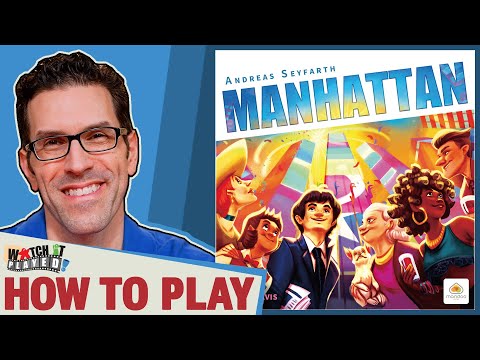






Manhattan Deep Dive
What the Community Thinks About Manhattan
Manhattan is a beloved classic that has persisted in gamer collections for three decades. While it may not receive the same attention as contemporary gateway games, it occupies a treasured place among those who appreciate elegant design and tight mechanical clarity. Channels like The Dice Tower, Adam in Wales, and Chairman of the Board return to it fondly, and the game's longevity speaks volumes: reviewers who encountered it upon its original release continue to rank it among their personal favorites, even as thousands of new titles arrive each year.
Core Mechanics That Define Manhattan
Card-Driven Placement and Control
At its heart, Manhattan is refreshingly straightforward. Each turn, you play a single card that dictates where on the shared board you may place one of your building blocks. The elegance lies in how this simple action generates meaningful decisions. You select from different city quadrants, and your choices shape the urban landscape emerging before all players. This streamlined card mechanism keeps the game moving while ensuring that every decision carries weight.
Stacking and Area Majority
What transforms Manhattan from a basic placement game into something more engaging is the vertical dimension. You can build atop your opponents' buildings, claiming a tower for yourself. Whoever places the top block of a tower controls it, and controlling the tallest buildings in each district scores points. The ability to overturn an opponent's fortunes with a single well-placed block creates moments of drama and tension that feel satisfying without requiring complex rule interactions.
The Manhattan Experience
Table Presence and Visual Appeal
The brightly colored plastic pieces that comprise Manhattan's components contribute significantly to its appeal. The physical act of stacking these blocks builds a concrete, three-dimensional representation of competitive city-building. Unlike games where scoring happens invisibly or on a distant track, Manhattan's board tells the story of the game as it unfolds, and the growing skyline gives the table genuine presence.
Accessibility Meets Competitive Bite
Manhattan occupies a sweet spot between accessibility and genuine competitive tension. New players grasp the rules within minutes: play a card, place a block, resolve control. Yet the game never feels trivial once play begins. The area-control theme combined with block-placement mechanics creates situations where players can meaningfully interfere with one another. While some may find this direct conflict uncomfortable in a casual family setting, others appreciate the light, in-your-face interaction that never devolves into kingmaking or frustrating alliance dynamics.
What Makes Manhattan Stand Out
Elegant Simplicity from a Master Designer
Manhattan carries the signature of Andreas Seyfarth, who would later design the acclaimed Puerto Rico. The design philosophy evident here values clarity over complexity. Despite its accessibility, the game contains real strategic depth. Players must balance the immediate pleasure of claiming districts with long-term positioning, managing their hand awareness and anticipating opponent moves. The game earned the Spiel des Jahres in 1994, a testament to how cleanly it delivers its experience. Reviewers consistently point out that this pedigree shows in how little explanation the game needs while still producing genuine table-talk and rivalry over the tallest towers.
Gateway Game with an Edge
Manhattan functions superbly as a gateway to modern board gaming, yet retains enough edge to keep experienced players engaged. It teaches fundamental concepts like area control and majority scoring without overwhelming newcomers. The game scales across player counts and experience levels, though its competitive directness means some players may find it too cutthroat for casual play with very new audiences.
Potential Drawbacks
Luck in Card Draw
The cards you draw determine where you can build, and occasionally a bad run of draws can leave you unable to pursue your intended strategy. While skilled players mitigate this through hand management and flexibility, it remains a source of occasional frustration. Some games, especially early ones while you learn optimal play, may feel decided by fortunate or unfortunate card distribution rather than decisions alone.
Limited Depth for Heavy Strategy Players
Experienced euro gamers seeking intricate economic systems, supply chains, or multi-layered scoring may find Manhattan's elegance leans toward simplicity. The core game, while satisfying to many, can be mastered relatively quickly. Those drawn to games like Food Chain Magnate seeking hours of decision-space exploration may feel the game runs its course before reaching deeper mechanical richness.
If You Enjoy Manhattan
Consider exploring El Grande, a masterwork of area-control design that shares Manhattan's focus on spatial majority but adds elaborate card-driven action selection. Tikal offers another avenue into area control with gorgeous production and an action-point system, rewarding both careful planning and adaptability. Torres, from the same design tradition, builds on area-control principles with added complexity in movement and tower-building. For those who appreciate gateway-level accessibility paired with light competitive tension, Ticket to Ride shares that same elegant ruleset-to-engagement ratio, though its mechanics operate on network-building rather than spatial control.
What Reviewers Are Saying
"Very simple gameplay. All you're doing is playing one of these cards which shows whereabouts on one of these grids you can place your buildings. You can overlap or build on top of other people's buildings and claim them for yourself, which is quite a cool thing."
— Chairman of the Board
"It's a really good gateway style game. This is Ticket to Ride level, very competitive, quite in your face, trying to take majorities and control different areas of the board, but with very simple mechanisms and really nice table presence."
— Adam in Wales
"I really like this one. The newest version of this is the game that I have. This was my number 60, and it lasted on my top 100 till 2015 where it was 90. Even in 2021 it was 274, and it would probably still be in my top 300 now."
— The Dice Tower