/pic7144309.jpg)







































Marrakesh Deep Dive
What the Community Thinks About Marrakesh
Marrakesh has established itself as one of Stefan Feld's most intriguing designs, a Euro that draws consistent praise from strategic gamers despite its unconventional presentation. The game's blend of satisfying mechanical interactions and escalating player power creates an experience that resonates particularly well with experienced players who appreciate games where decision-making compounds throughout play. While the cube tower mechanism initially catches eyes, it's the underlying systems of track advancement and personal engine-building that generate genuine enthusiasm.
Core Mechanics That Define Marrakesh
Cube Tower and Simultaneous Action Selection
The cube tower; that physical, tactile centerpiece; serves as both focal point and functional randomizer. Players secretly select colored cubes and drop them into the tower; whatever emerges from the bottom becomes the shared drafting pool. This mechanism elegantly creates tension between what you hoped would come out and what actually does. Rather than serving as mere chrome, the tower forces genuine strategic adaptation. Players must anticipate the unpredictable output while planning their own cube investments, creating a dynamic drafting environment where no two rounds play identically. The randomness feels integrated rather than intrusive, providing variety without overwhelming the decision space.
Track Advancement and Escalating Momentum
Marrakesh constructs its core tension around climbing multiple advancement tracks. Players place their personal cubes on a player board, and each cube added strengthens them across different scoring categories and abilities. This creates cascading momentum; early investments yield exponential returns as players move along tracks and unlock increasingly powerful actions. The psychological satisfaction of watching your engine accelerate proves fundamental to the experience. Unlike games where catch-up mechanics flatten the curve, Marrakesh rewards strategic investment and forward-thinking positioning. Players constantly face the agonizing choice between advancing a track immediately or saving resources for future turns when their powers compound.
The Marrakesh Experience
Lavish, Purposeful Presentation
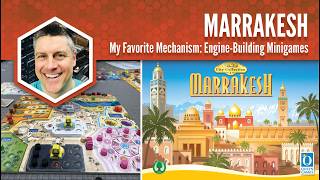
The game arrives with components that justify its Euro-weight aesthetic. The board radiates visual clarity; wooden cubes feel satisfying in hand; the overall presentation avoids the drab beige that plagues heavier strategy games. Production choices serve function; the color palette reads cleanly from across the table, tracking multiple player boards remains intuitive despite complexity, and the cube tower provides unmistakable focus for group attention. This isn't fussy componentization for its own sake; instead, it reflects thoughtful design committed to making a medium-heavy game feel welcoming and tactilely pleasant.
Crunchy Yet Elegant Decision-Making
The game delivers what experienced gamers crave: meaningful decisions that matter, but without overwhelming complexity. Teaching the rules takes perhaps 15 minutes, yet subsequent plays reveal layers of strategic interaction that reward study. Players constantly balance competing priorities; do you advance your strongest track or spread investments for flexibility? Do you draft what you need now or build toward explosive future turns? The absence of dominant strategies means wildly different approaches can succeed. One player focuses purely on track advancement while another pursues majority control through careful placement. These divergent paths create rich player interaction rather than enforcing rigid optimal lines.
What Makes Marrakesh Stand Out
Stefan Feld's Design Mastery
Marrakesh exemplifies what Feld does better than perhaps any living designer; creating games where mechanical interlocking produces emergent complexity. The cube tower could function as mere ornament, yet Feld threads it through the game's strategic core. Track advancement feels standard in isolation but generates unexpected depth when intertwined with uncertain cube availability. Players must constantly evaluate not just their own engine-building but how the shared tower output disrupts or enables opponent plans. The design avoids bloat; every element serves purpose. At two hours, Marrakesh demands focus but respects player time, delivering a satisfying arc of escalation without padding.
Multiple Viable Victory Paths
Victory doesn't channel through narrow corridors. Players can pursue aggressive track-climbing, build for majority control, or create economic engines through careful cube placement. The winning player might have excelled at reading tower output, anticipated cascading bonuses, or simply maintained flexibility while opponents committed to narrow strategies. This breadth means groups can return repeatedly without solving the game. Veterans notice fresh interactions emerging from familiar mechanisms. Newcomers find their learning games genuinely competitive rather than dominated by experienced players executing known sequences.
Potential Drawbacks
Teaching and Weight Investment
Marrakesh doesn't function as a gateway game, though it tempts new players with beautiful components. The cube tower provides immediate visual interest, but grasping how track advancement compounds with drafting timing requires mental effort. New players frequently undervalue early positioning, leading to mid-game frustration when opponents' momentum becomes overwhelming. Groups accustomed to lighter games may find the 90-120 minute runtime demanding, particularly during the crucial early rounds where understanding core interactions remains incomplete.
Tower Chaos as Double-Edged Sword
The randomness that creates variety occasionally generates frustrating outcomes. A string of unhelpful cube releases can derail carefully constructed plans. While typically such variance balances across rounds, individual games sometimes feature distribution patterns that benefit certain players. Strategic newcomers may attribute losses to bad luck rather than inferior decision-making, potentially limiting replay enthusiasm. Experienced players adapt readily, but the tower's unpredictability occasionally feels at odds with the rest of the game's elegant mechanical infrastructure.
If You Enjoy Marrakesh
Fans of Marrakesh should explore other Stefan Feld designs with similar escalating power dynamics, particularly those in the City Collection like Hamburg and Amsterdam. Games emphasizing track advancement alongside spatial control; Trajan, Notre-Dame, and Bora Bora; offer spiritual kinship. Players attracted to cube tower mechanisms might investigate Amerigo or Formula D, though Marrakesh handles randomization more elegantly. Those who appreciate multiple strategic paths should experience Wallenstein, Caverna, and El Grande. For a lighter entry to Feld's design philosophy, Grand Austria Hotel and Castles of Burgundy provide accessible alternatives.
What Reviewers Are Saying
"I love the different things you're trying to do here, you're climbing tracks, um you're revealing and then committing to these endgame objectives. Um I love the way there's always um a four momentum here where you're constantly adding cashews to your personal player board making you stronger in all of those different departments on the main board."
— Chairman of the Board
"It's definitely um you know a step apart from the Thematic ties it's a very dry mechanical game but what else do you really expect from a Feld design. I really like this one it's a little bit longer than I would like it to be um but that is a very minor criticism because I do think that the the two-hour play time does warrant uh the gameplay."
— The Broken Meeple
"I think it might be my first, second, or third favorite Stefan Feld game. I don't quite know exactly where I sit with them, but it is in my top three Stefenfeld games, but I haven't played any of the first expansion yet. And there's a second expansion, so I'm not going to say no."
— Gaming Rules