/pic4711280.jpg)
Microgame #3 in the Metagaming Microgames series is a board game of pre-gunpowder individual combat. On a hex map representing an arena, players fight it out with cardboard counters. Fighters are rated for Strength and Dexterity and can carry weapons and armors of various advantages and disadvantages.
Included a 32-page booklet (4¼" by 7", or half-legal size), with a hex map (8½" by 14", or "legal" size) and counter sheet.
Melee was released with three different covers, the first two both appearing in 1977 and the third in 1979. All were released in plastic ziplock bags. In 1981 there was a fourth edition which was boxed with a cover almost identical to the second edition (lettering changed from red to white).
This system was later developed into Advanced Melee, one of the three books of the The Fantasy Trip role-playing system.
After Steve Jackson and Metagaming had parted he lost control of his creation. He responded to this by adapting the basic rules into a new system: GURPS, the Generic and Universal Role Playing System.
Steve Jackson has reacquired rights to TFT and is publishing the Legacy version. More information can be found here...
https://rpggeek.com/rpgitem/256884/fantasy-trip-legacy-editi...
Integrates with:
Wizard
Reimplemented by:
Legends of the Ancient World (RPG)
Heroes & Other Worlds (RPG)

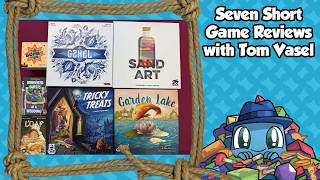
- Beautiful components; interesting two-board dynamic; tactile stamping
- Hard to plan; visual/readability issues; color readability and colorblind concerns
- tile rearrangement; abstract pattern building
- abstract depiction of blue flowering vessels; inspired by blue-and-white ceramic art
- abstract
Mechanics (from transcript analysis)
- color/flower matching scoring — Scoring depends on matching flowers to board shapes and completing patterns.
- flip-tile mechanic — Tiles are double-sided; flowers on one side, lily pads on the other; flipping reveals options.
- Pattern Building — Scoring depends on matching flowers to board shapes and completing patterns.
- stamp-on-back ownership — Blue stamps on back identify ownership; stamps can alter tile choices.
- Tile/Map Shifting — Tiles are double-sided; flowers on one side, lily pads on the other; flipping reveals options.
- two-board layout (diamond and circle) — On each board you place tiles and stamps to match scoring patterns.
Video topics + discussion points
Quotes (from this video)
- This is a very, very simple deduction game.
- This is an amusing game. I like the theme of it.
- The theme here is actually pretty strong.
- It's an assault on the eyes.
- I thought this was just okay.
References (from this video)
- clean scoring choices
- tight tile-placement puzzle
- theme is weak for some
- art and components not standout
- pattern scoring with tiles
- scoring-driven abstract
Mechanics (from transcript analysis)
- tile manipulation / scoring optimization — players select and lay tiles to maximize scoring patterns
Video topics + discussion points
Quotes (from this video)
- I hate this game so much.
- The theme definitely is carrying the game but I really like the mechanisms too.
- It's a nice back and forth two-player game trying to outguess the other person.
- This is basically Scrabble with pictures.