/pic4975740.jpg)
As in the original Minecraft digital game, in Minecraft: Builders & Biomes players explore the Overworld, build structures, and mine resources, earning points for structures and the largest connected biomes of forest, desert, mountain, or snowy tundra spaces on their player boards.
Familiar foes like Endermen, Creepers, and other mobs also appear throughout the game, and they need to be defeated using weapons collected from the board. Defeating mobs earn players points in addition to granting additional awards. Game scoring occurs as the resource cube's layers are depleted. As soon as the third layer runs out, the adventure comes to an end, and the builder with the most points wins.
Scoring takes place three times during the game, specifically after the final block is removed from the first, second, and third level of the building block cube. In the first round, you choose one of the four biomes (forest, desert, mountains, or snowy tundra) and score for the largest connected area of this biome on your personal building board. The board comes pre-printed with biome spaces, and as you place buildings on this board, you can alter the biome of a space. In the second round, you choose one of three materials (wood, sand, stone, or obsidian) and score for the largest connected group of structures on your personal building board that are made of this material. In the third round, you score for the largest contiguous group of structures (decoration, dwelling, animal house, or bridge) of your choice on your board. After scoring in the third round, tally bonus points from the mobs you've collected.


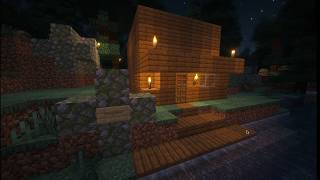
- Engaging exploration with a clear goal (treasure map).
- Satisfying puzzle-solving elements, especially the underwater treasure hunt.
- Sense of accomplishment upon finding the treasure.
- The game offers a good mix of danger and reward.
- Provides opportunities for learning and experimentation.
- Can be difficult to navigate and locate objectives.
- Frustrating at times due to mechanics like running out of air or getting stuck.
- Steep learning curve for new players.
- Enemy encounters can be challenging.
- Carelessness can lead to failure, as shown by the host's final demise.
- Survival and exploration in a blocky, procedurally generated world.
Mechanics (from transcript analysis)
- building — The host constructs structures, such as upgrading tools and weapons, putting in doors, and later building a protective box underwater.
- Combat — The host encounters and fights various enemies like Endermen, zombies, and skeletons, and discusses upgrading armor and weapons.
- crafting — The host crafts various items, including doors, an iron pickaxe, sticks, and a bundle, demonstrating the core crafting system.
- exploration — The host uses a boat and plans to use a horse for exploration, actively seeking out new islands and points of interest like a light and a treasure map.
- Item Management — The host organizes inventory, storing items like doors and timber, and using a 'bundle' for carrying more items.
- Navigation — The host uses a map, compass directions (north, south, east, west), and torches to orient themselves and find their way.
- Resource gathering — Collecting wood (birch and oak), iron, sticks, coal, food, and prismarine crystals is essential for survival and progression.
Video topics + discussion points
Quotes (from this video)
- I've got a buried treasure map.
- This is the thing. Sometimes with this game, you can not know enough to realize that you've just destroyed something valuable.
- It's always carelessness that gets you in this game. Always. Without doubt.
- That was harder than I thought. I just couldn't locate it. I just could not locate that chest.
- We have found it. Miracle.
References (from this video)
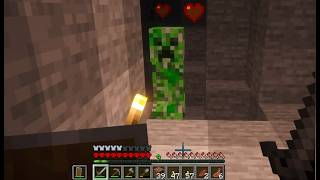
- Fascinating for board game designers due to emergent behavior and risk/reward elements.
- Player agency in setting goals and shaping the experience.
- Intuitive controls make it easy to pick up and play.
- Vast sandbox with enormous variety.
- High stakes in hardcore mode create adrenaline.
- The 'journey, not the destination' aspect is compelling.
- Can be overwhelming without objectives if not for the advancements system.
- Losing progress in hardcore mode can be devastating.
- Survival and exploration in a blocky, procedurally generated world.
- Derail Valley
Mechanics (from transcript analysis)
- Advancements/Tech Tree — A system of objectives and unlockable skills that provides direction and progression for players.
- Building/Construction — Players can construct shelters and bases to protect themselves from threats and store resources.
- Combat — Players must defend themselves against hostile creatures like skeletons, creepers, and spiders.
- crafting — Players gather resources to create tools, items, and structures necessary for survival and progression.
- exploration — Players venture out into the procedurally generated world to discover new biomes, caves, and structures.
- Permadeath (Hardcore Mode) — In hardcore mode, death is permanent, meaning the player loses all progress and must start over.
- Resource gathering — Players collect various materials like wood, coal, and iron from the environment to use in crafting and building.
- Survival — Players must manage hunger, health, and environmental hazards to stay alive.
Video topics + discussion points
Quotes (from this video)
- The beauty of Minecraft is that exactly. You see how that jeopardy of losing everything and losing the game and ending everything.
- It's about risk versus reward. And if I fail, and when I fail, which inevitably I will, I will tell myself it's because I took an unnecessary risk.
- The simplicity of its controls. I mean, it uses the traditional WD controls which are kind of mirror the arrow the arrow keys just shifted over to the left.
- It's the journey, not the destination.
- The world is predetermined. So whether I turn left or whether I turn right, the game has already decided what's going to be there and what my fate is.
- Unless unless some some some reason you you know you kind of telegraph that threat that I didn't have to turn over that card. I've taken a measured risk and I was given the opportunity to avoid it but didn't.
- I mean that sounds like something could be fun. kind of like the idea of this husbandry line.
- I don't think there's anything out here. I'm coming up iron short, people.
- But what I want is a deep mine of some kind. where I can potentially find some diamonds and the danger gets a little bit too high.
References (from this video)
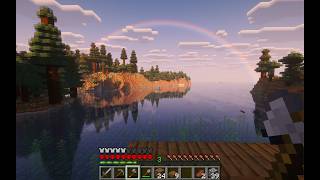
- The sandbox nature allows for relaxation and clearing the mind.
- The game provides a sense of accomplishment upon finding valuable resources like iron.
- The visual elements, like the night sky, are appreciated.
- Finding iron is a significant milestone, enabling the creation of a shield.
- The small house can feel claustrophobic.
- Unexpected dangers like Endermen can be startling.
- It can be easy to get lost without proper navigation aids.
- Survival and building in a blocky, procedurally generated world.
- Derail (train game)
Mechanics (from transcript analysis)
- building — The host actively works on constructing and improving their log cabin, adding a roof, expanding it, and eventually adding windows.
- Combat — The host engages in combat with zombies and skeletons, and discusses strategies for dealing with them, such as using a shield.
- crafting — The host crafts tools such as a pickaxe, shovel, and a shield, and also makes torches.
- day/night cycle — The host notes the progression of time, mentioning day, night, dusk, and sunrise, and how it impacts gameplay and safety.
- exploration — The host takes a boat out to explore the coastline in search of coal and iron.
- Farming/Cooking — The host cooks beef and discusses the efficiency of fuel sources for cooking.
- Resource gathering — The host actively collects wood, coal, and iron, discussing their uses and importance for progression.
- Survival — The host manages hunger, avoids dangers in darkness, and emphasizes the need for safety due to the hardcore nature of the game.
Video topics + discussion points
Quotes (from this video)
- So, I'm using this this as a kind of a place where to explore the ideas that video games might bring into the board game world, particularly in that sound sandbox world.
- It's bizarre because it's a digital world, but you can still have real physical emotions in a way.
- This is hardcore survival. I can't afford to take these risks.
- We're entering the Iron Age, people.
References (from this video)
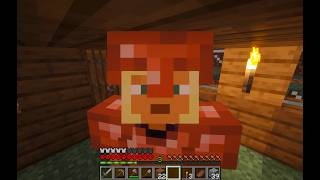
- Wonderfully addictive experience
- Big sandbox open world where you can make it what you want
- Enjoying the survival element
- Jeopardy of losing everything is strangely addictive
- Found the game to be pretty strategic
- Minecraft music is quite chill
- Beautiful spot for a base
- Cozy home established
- Squeaky chair noise
- Building stuff and then it gets destroyed
- Lack of initial knowledge for certain crafting recipes (e.g., torches)
- Difficulties with inventory management and remembering crafted items
- Running out of materials
- Axes breaking
- Uncertainty about the use of experience points
- Not knowing how to change character appearance
- crafting and surviving
- Elite
Mechanics (from transcript analysis)
- Armor crafting — The host focuses on crafting copper armor, noting its defensive value.
- Boats — The host expresses a desire to 'build a boat' and uses it for exploration.
- building — The host discusses building a 'dirt house' and later a more permanent 'little cabin by the shore'.
- Combat — The host mentions the threat of 'creepers' and 'skeletons' and the need for armor and weapons.
- crafting — The host mentions learning 'how to craft stuff' and needing to craft wooden tools, a pickaxe, and torches.
- Farming — The host mentions learning 'how to farm'.
- Furnace — The host aims to 'get a furnace' and uses it to cook copper and wood.
- Hardcore mode — The host chooses to play in 'hardcore game' mode and discusses the associated 'jeopardy of losing everything'.
- Inventory management — The host utilizes chests to organize items like food, wood, tools, and materials.
- Redstone mechanics — The host identifies 'redstone' as being like 'electricity in this game' and notes its use in operating levers.
- Resource gathering — The host is shown gathering wood, stone, wool, copper, and logs.
- Survival — The core gameplay loop is described as 'crafting and surviving' and the host prioritizes 'how to survive a first night'.
- Tool crafting — The host crafts wooden and stone tools, including axes and pickaxes.
Video topics + discussion points
Quotes (from this video)
- So, I think Minecraft can be what you want it to be. It's this big sandbox um open world where you can make it what you want really.
- Well, I like the jeopardy. It's the jeopardy of losing everything. It's just it was just strangely addictive.
- Redstone is kind of like electricity in this game.
- My fox friend is saying, 'Get out of there, Ricky.'
References (from this video)

- fit what minecraft does
- very playable across multiple levels of expertise
- melded the IP and a very good game nicely
- Minecraft IP
Mechanics (from transcript analysis)
Video topics + discussion points
Quotes (from this video)
- it's fairly thematic I think so you work together you try to get like their different scenarios and different boxes top boxes that you can open like once you finish this next move the next one
- I really like that game like we play that true in a row and that's usually pretty rare for games that lets play two in a row
- I would put it as the best crunchy heavy type game of the year
- one of my favorite mechanics is a little bit like Concordia where your action is car driven so that's makes the game the whole games more streamlined
- I really like how how much market speculation and manipulation oh yeah you can make that whole game almost if you want to
- I always get suspected that's the thing I always get suspect because I'll draw this like scribble that actually silhouettes something that's oblique ley related to it and that's how I like to plan I'm always in trouble for it
- the tricky bit is that each people personality has got different things that they do for example the Jack pushes what to me pulls away or something like that
- that's why I preferred this than that one is because this is cooperative
References (from this video)

- extensive player agency and ownership of creations
- open-ended play
- potential lack of defined endgame without boards/games
- depends on social creativity
- world-building and experimentation
- sandbox/creative worlds
- emergent storytelling
- Lego
- Roller Coaster Tycoon
Mechanics (from transcript analysis)
- Resource gathering and crafting — Amass tools and materials to build structures and machines
Video topics + discussion points
Quotes (from this video)
- I think player agency is basically when players make meaningful choices in the game based on the game state.
- Chance often takes the power away from making really big meaningful decisions.
- The illusion of choice can often creep into games, and maybe the designer has already pre-planned all the pathways.
- Spirit Island has such high player agency because there is no way a designer can sit there and go, 'Oh, if that person did that move...'
- you take ownership over your creature spirit and how you actually play them.
- The sense of player agency is heightened by the social level of interaction.
References (from this video)

Mechanics (from transcript analysis)
Video topics + discussion points
Quotes (from this video)
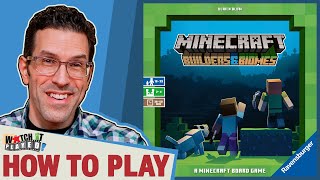
- the rules of Minecraft builders and biomes a game by Ori bloom published by Ravensburger
- you will take two actions one after the other there are five different actions that are available for you to take and you must take two different actions on your turn you may not repeat the same action twice
- explore and this is a two-step process first you'll move your standee between 0 and 2 spaces around the board
- you will be exploring this overworld collecting weapons and building resources fighting mobs and building buildings
- three scoring rounds during a game of Minecraft and each is triggered by one layer of this cube of blocks being depleted
- emerald can substitute for any other color block
- the highest score wins
- tie: whoever has the most blocks left over as the winner
References (from this video)
- Explicit rule descriptions and step-by-step actions tied to specific game components
- Building, exploration, and combat
- Overworld of Minecraft
Mechanics (from transcript analysis)
- Block extraction from a cube based on surface visibility — First action lets you take two blocks from a cube with visible surfaces; blocks are taken one at a time.
- Bonus actions from mobs — Certain mobs allow discarding the mob tile for an additional action, potentially multiple times on a turn.
- Collect weapon — Pick up an adjacent face-up weapon tile and add it to your weapons pile.
- Compound Scoring — Three scoring phases score biomes, materials, then building types; triggered as layers of the building cube are depleted.
- Construct buildings by spending blocks — Choose a face-up building adjacent to you; spend blocks matching icons; emerald substitutes allowed; place on your player board.
- Emerald substitution — Emerald blocks can substitute for any other color block when building.
- Explore action to reveal tiles — Move, then flip top tiles adjacent to your location; can reveal buildings, mobs, or weapons; tiles must be face-up to interact.
- Fight a mob with hearts and weapon tiles — Choose a face-up mob adjacent to you; draw three weapon tiles; the number of hearts needed is the mob's bottom-left value; defeat if hearts drawn meet or exceed it.
- I Cut, You Choose — If tied, the winner is the one with the most blocks left; if still tied, victory is shared.
- Simultaneous Actions — On a player's turn you take two actions in sequence and cannot repeat the same action.
- Three-stage scoring rounds — Three scoring phases score biomes, materials, then building types; triggered as layers of the building cube are depleted.
- tie-breaker rule — If tied, the winner is the one with the most blocks left; if still tied, victory is shared.
- Tile/Map Shifting — Move, then flip top tiles adjacent to your location; can reveal buildings, mobs, or weapons; tiles must be face-up to interact.
- Two actions per turn, must be different actions — On a player's turn you take two actions in sequence and cannot repeat the same action.
Video topics + discussion points
Quotes (from this video)
- the rules of Minecraft builders and biomes a game by Ori bloom published by Ravensburger
- you will take two actions one after the other there are five different actions that are available for you to take and you must take two different actions on your turn you may not repeat the same action twice
- explore and this is a two-step process first you'll move your standee between 0 and 2 spaces around the board
- you will be exploring this overworld collecting weapons and building resources fighting mobs and building buildings
- three scoring rounds during a game of Minecraft and each is triggered by one layer of this cube of blocks being depleted
- emerald can substitute for any other color block
- the highest score wins
- tie: whoever has the most blocks left over as the winner
References (from this video)
Mechanics (from transcript analysis)
Video topics + discussion points
Quotes (from this video)
- If you're familiar with the Minecraft video game, then you know, it allows you to build world's limited only by your imagination
- but it can also be a dangerous place full of zombies skeletons and exploding creepers here. You'll play out your own adventures
- Your completed buildings and the monsters you defeat will gain you experience points and the player with the most by the end of the game wins
- On your turn you'll take exactly two actions
- There are five different actions to choose from and you must pick two different ones to perform on your turn
- green emerald blocks are special Because they can be used as any other kind of block
- Monsters known in the game as mobs and if you're in a space next to one you can use an action to fight them
- Any showing this symbol can be discarded after you perform your two actions during a turn to gain an additional Action
- During the game. There will be three scoring rounds where you'll gain experience based on the way You've added buildings to your board
- the player who removes a block causing a scoring round to happen first Completely finishes their turn before any scoring is done
- Those spaces do not have to be connected. For example, this mob gives me two points for every forest biome I have and I have three of them for total of six points
References (from this video)
- Allows players to build worlds limited only by their imagination.
- Offers adventure with building, including fighting monsters.
- Completed buildings and defeated monsters gain experience points.
- Variant for beginners or young children simplifies scoring rounds.
- Building worlds with limited imagination, but also danger from zombies, skeletons, and exploding creepers. Playing out adventures in board game form.
- Minecraft
Mechanics (from transcript analysis)
- action selection — On your turn, you take exactly two actions, choosing from five different options, and must pick two different ones.
- End game scoring — The game has three scoring rounds based on biomes, materials used in buildings, and types of dwellings.
- Modular Board — The game uses a grid of tile stacks and weapon tokens, and players move their character on spaces where paths cross.
- Pattern Building — Players build structures by spending blocks and placing the building tile on their player board.
- Push Your Luck — When fighting mobs, players reveal weapon tokens, and the total hearts must be equal to or higher than the mob's hearts to defeat it.
- Resource gathering — Players collect blocks (wood, sand, stone, obsidian, emerald) from a central cube.
- Set Collection — Scoring involves identifying groups of connected biomes or buildings made from chosen resources, or types of dwellings.
- Variable player powers — Weapon tokens can provide additional abilities during a fight, such as drawing extra tokens, gaining experience, or dealing extra damage.
Video topics + discussion points
Quotes (from this video)
- If you're familiar with the Minecraft video game, then you know, it allows you to build world's limited only by your imagination
- but it can also be a dangerous place full of zombies skeletons and exploding creepers here. You'll play out your own adventures
- Your completed buildings and the monsters you defeat will gain you experience points and the player with the most by the end of the game wins
- On your turn you'll take exactly two actions
- There are five different actions to choose from and you must pick two different ones to perform on your turn
- green emerald blocks are special Because they can be used as any other kind of block
- Monsters known in the game as mobs and if you're in a space next to one you can use an action to fight them
- Any showing this symbol can be discarded after you perform your two actions during a turn to gain an additional Action
- During the game. There will be three scoring rounds where you'll gain experience based on the way You've added buildings to your board
- the player who removes a block causing a scoring round to happen first Completely finishes their turn before any scoring is done
- Those spaces do not have to be connected. For example, this mob gives me two points for every forest biome I have and I have three of them for total of six points
References (from this video)
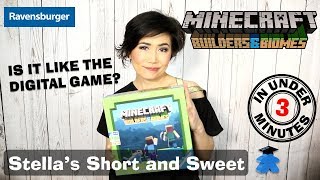
- well-designed
- easy to learn
- family-friendly
- wooden blocks are awesome
- captures the Minecraft feel on a board
- tiles feel not the best; cupboards are pretty thin
- building structures, gathering resources, and fighting mobs
- Minecraft Overworld
- app-like feel of Minecraft with a simplified board game world
Mechanics (from transcript analysis)
- Area Movement — players move on a 4x4 grid-based board with tiles
- area_movement — players move on a 4x4 grid-based board with tiles
- combat_against_mobs — fighting mobs using weapons
- Compound Scoring — scoring occurs across three rounds
- Push Your Luck — risk/reward elements tied to collecting materials and weapons
- push_your_luck — risk/reward elements tied to collecting materials and weapons
- Resource Management — managing materials to build structures and fight mobs
- resource_blocks — 64 material blocks on the board and a 4x4 grid of tiles
- resource_management — managing materials to build structures and fight mobs
- scoring_rounds — scoring occurs across three rounds
- structure_building — building structures using collected materials
- Tile Placement — collecting materials by moving tiles to your own board
- tile_placement_and_collection — collecting materials by moving tiles to your own board
- weapon_tile_collection — outer edge tiles provide weapon tiles you can collect
Video topics + discussion points
Quotes (from this video)
- Minecraft board game is made for family so there is no lost of life of food like in the digital game and simplify the world of Minecraft
- it has the feel of digital app with smaller map
- overall it's a really nice well-designed game that is easy to play multiple times
- the wooden blocks are awesome
References (from this video)
- Surprising fun
- Interesting mechanics
- Block building and exploration
- Minecraft world
Mechanics (from transcript analysis)
- Block Placement — Taking blocks from a central block and placing them on a personal board
Video topics + discussion points
Quotes (from this video)
- Dare I say it dumbs down the video game... I mean, simplifies the video game
- Star Wars in a box