/pic4975740.jpg)
As in the original Minecraft digital game, in Minecraft: Builders & Biomes players explore the Overworld, build structures, and mine resources, earning points for structures and the largest connected biomes of forest, desert, mountain, or snowy tundra spaces on their player boards.
Familiar foes like Endermen, Creepers, and other mobs also appear throughout the game, and they need to be defeated using weapons collected from the board. Defeating mobs earn players points in addition to granting additional awards. Game scoring occurs as the resource cube's layers are depleted. As soon as the third layer runs out, the adventure comes to an end, and the builder with the most points wins.
Scoring takes place three times during the game, specifically after the final block is removed from the first, second, and third level of the building block cube. In the first round, you choose one of the four biomes (forest, desert, mountains, or snowy tundra) and score for the largest connected area of this biome on your personal building board. The board comes pre-printed with biome spaces, and as you place buildings on this board, you can alter the biome of a space. In the second round, you choose one of three materials (wood, sand, stone, or obsidian) and score for the largest connected group of structures on your personal building board that are made of this material. In the third round, you score for the largest contiguous group of structures (decoration, dwelling, animal house, or bridge) of your choice on your board. After scoring in the third round, tally bonus points from the mobs you've collected.

Minecraft: Builders & Biomes - How To Play

- fit what minecraft does
- very playable across multiple levels of expertise
- melded the IP and a very good game nicely
- Minecraft IP
Mechanics (from transcript analysis)
Video topics + discussion points
Quotes (from this video)
- it's fairly thematic I think so you work together you try to get like their different scenarios and different boxes top boxes that you can open like once you finish this next move the next one
- I really like that game like we play that true in a row and that's usually pretty rare for games that lets play two in a row
- I would put it as the best crunchy heavy type game of the year
- one of my favorite mechanics is a little bit like Concordia where your action is car driven so that's makes the game the whole games more streamlined
- I really like how how much market speculation and manipulation oh yeah you can make that whole game almost if you want to
- I always get suspected that's the thing I always get suspect because I'll draw this like scribble that actually silhouettes something that's oblique ley related to it and that's how I like to plan I'm always in trouble for it
- the tricky bit is that each people personality has got different things that they do for example the Jack pushes what to me pulls away or something like that
- that's why I preferred this than that one is because this is cooperative
References (from this video)

- extensive player agency and ownership of creations
- open-ended play
- potential lack of defined endgame without boards/games
- depends on social creativity
- world-building and experimentation
- sandbox/creative worlds
- emergent storytelling
- Lego
- Roller Coaster Tycoon
Mechanics (from transcript analysis)
- Resource gathering and crafting — Amass tools and materials to build structures and machines
Video topics + discussion points
Quotes (from this video)
- I think player agency is basically when players make meaningful choices in the game based on the game state.
- Chance often takes the power away from making really big meaningful decisions.
- The illusion of choice can often creep into games, and maybe the designer has already pre-planned all the pathways.
- Spirit Island has such high player agency because there is no way a designer can sit there and go, 'Oh, if that person did that move...'
- you take ownership over your creature spirit and how you actually play them.
- The sense of player agency is heightened by the social level of interaction.
References (from this video)

Mechanics (from transcript analysis)
Video topics + discussion points
Quotes (from this video)
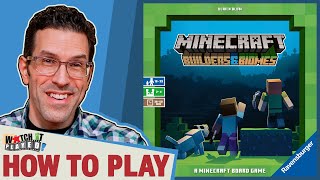
- the rules of Minecraft builders and biomes a game by Ori bloom published by Ravensburger
- you will take two actions one after the other there are five different actions that are available for you to take and you must take two different actions on your turn you may not repeat the same action twice
- explore and this is a two-step process first you'll move your standee between 0 and 2 spaces around the board
- you will be exploring this overworld collecting weapons and building resources fighting mobs and building buildings
- three scoring rounds during a game of Minecraft and each is triggered by one layer of this cube of blocks being depleted
- emerald can substitute for any other color block
- the highest score wins
- tie: whoever has the most blocks left over as the winner
References (from this video)
- Explicit rule descriptions and step-by-step actions tied to specific game components
- Building, exploration, and combat
- Overworld of Minecraft
Mechanics (from transcript analysis)
- Block extraction from a cube based on surface visibility — First action lets you take two blocks from a cube with visible surfaces; blocks are taken one at a time.
- Bonus actions from mobs — Certain mobs allow discarding the mob tile for an additional action, potentially multiple times on a turn.
- Collect weapon — Pick up an adjacent face-up weapon tile and add it to your weapons pile.
- Compound Scoring — Three scoring phases score biomes, materials, then building types; triggered as layers of the building cube are depleted.
- Construct buildings by spending blocks — Choose a face-up building adjacent to you; spend blocks matching icons; emerald substitutes allowed; place on your player board.
- Emerald substitution — Emerald blocks can substitute for any other color block when building.
- Explore action to reveal tiles — Move, then flip top tiles adjacent to your location; can reveal buildings, mobs, or weapons; tiles must be face-up to interact.
- Fight a mob with hearts and weapon tiles — Choose a face-up mob adjacent to you; draw three weapon tiles; the number of hearts needed is the mob's bottom-left value; defeat if hearts drawn meet or exceed it.
- I Cut, You Choose — If tied, the winner is the one with the most blocks left; if still tied, victory is shared.
- Simultaneous Actions — On a player's turn you take two actions in sequence and cannot repeat the same action.
- Three-stage scoring rounds — Three scoring phases score biomes, materials, then building types; triggered as layers of the building cube are depleted.
- tie-breaker rule — If tied, the winner is the one with the most blocks left; if still tied, victory is shared.
- Tile/Map Shifting — Move, then flip top tiles adjacent to your location; can reveal buildings, mobs, or weapons; tiles must be face-up to interact.
- Two actions per turn, must be different actions — On a player's turn you take two actions in sequence and cannot repeat the same action.
Video topics + discussion points
Quotes (from this video)
- the rules of Minecraft builders and biomes a game by Ori bloom published by Ravensburger
- you will take two actions one after the other there are five different actions that are available for you to take and you must take two different actions on your turn you may not repeat the same action twice
- explore and this is a two-step process first you'll move your standee between 0 and 2 spaces around the board
- you will be exploring this overworld collecting weapons and building resources fighting mobs and building buildings
- three scoring rounds during a game of Minecraft and each is triggered by one layer of this cube of blocks being depleted
- emerald can substitute for any other color block
- the highest score wins
- tie: whoever has the most blocks left over as the winner
References (from this video)
Mechanics (from transcript analysis)
Video topics + discussion points
Quotes (from this video)
- If you're familiar with the Minecraft video game, then you know, it allows you to build world's limited only by your imagination
- but it can also be a dangerous place full of zombies skeletons and exploding creepers here. You'll play out your own adventures
- Your completed buildings and the monsters you defeat will gain you experience points and the player with the most by the end of the game wins
- On your turn you'll take exactly two actions
- There are five different actions to choose from and you must pick two different ones to perform on your turn
- green emerald blocks are special Because they can be used as any other kind of block
- Monsters known in the game as mobs and if you're in a space next to one you can use an action to fight them
- Any showing this symbol can be discarded after you perform your two actions during a turn to gain an additional Action
- During the game. There will be three scoring rounds where you'll gain experience based on the way You've added buildings to your board
- the player who removes a block causing a scoring round to happen first Completely finishes their turn before any scoring is done
- Those spaces do not have to be connected. For example, this mob gives me two points for every forest biome I have and I have three of them for total of six points
References (from this video)
- Allows players to build worlds limited only by their imagination.
- Offers adventure with building, including fighting monsters.
- Completed buildings and defeated monsters gain experience points.
- Variant for beginners or young children simplifies scoring rounds.
- Building worlds with limited imagination, but also danger from zombies, skeletons, and exploding creepers. Playing out adventures in board game form.
- Minecraft
Mechanics (from transcript analysis)
- action selection — On your turn, you take exactly two actions, choosing from five different options, and must pick two different ones.
- End game scoring — The game has three scoring rounds based on biomes, materials used in buildings, and types of dwellings.
- Modular Board — The game uses a grid of tile stacks and weapon tokens, and players move their character on spaces where paths cross.
- Pattern Building — Players build structures by spending blocks and placing the building tile on their player board.
- Push Your Luck — When fighting mobs, players reveal weapon tokens, and the total hearts must be equal to or higher than the mob's hearts to defeat it.
- Resource gathering — Players collect blocks (wood, sand, stone, obsidian, emerald) from a central cube.
- Set Collection — Scoring involves identifying groups of connected biomes or buildings made from chosen resources, or types of dwellings.
- Variable player powers — Weapon tokens can provide additional abilities during a fight, such as drawing extra tokens, gaining experience, or dealing extra damage.
Video topics + discussion points
Quotes (from this video)
- If you're familiar with the Minecraft video game, then you know, it allows you to build world's limited only by your imagination
- but it can also be a dangerous place full of zombies skeletons and exploding creepers here. You'll play out your own adventures
- Your completed buildings and the monsters you defeat will gain you experience points and the player with the most by the end of the game wins
- On your turn you'll take exactly two actions
- There are five different actions to choose from and you must pick two different ones to perform on your turn
- green emerald blocks are special Because they can be used as any other kind of block
- Monsters known in the game as mobs and if you're in a space next to one you can use an action to fight them
- Any showing this symbol can be discarded after you perform your two actions during a turn to gain an additional Action
- During the game. There will be three scoring rounds where you'll gain experience based on the way You've added buildings to your board
- the player who removes a block causing a scoring round to happen first Completely finishes their turn before any scoring is done
- Those spaces do not have to be connected. For example, this mob gives me two points for every forest biome I have and I have three of them for total of six points
References (from this video)
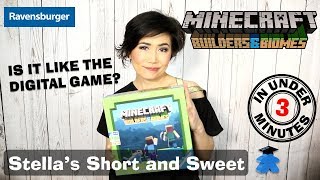
- well-designed
- easy to learn
- family-friendly
- wooden blocks are awesome
- captures the Minecraft feel on a board
- tiles feel not the best; cupboards are pretty thin
- building structures, gathering resources, and fighting mobs
- Minecraft Overworld
- app-like feel of Minecraft with a simplified board game world
Mechanics (from transcript analysis)
- Area Movement — players move on a 4x4 grid-based board with tiles
- area_movement — players move on a 4x4 grid-based board with tiles
- combat_against_mobs — fighting mobs using weapons
- Compound Scoring — scoring occurs across three rounds
- Push Your Luck — risk/reward elements tied to collecting materials and weapons
- push_your_luck — risk/reward elements tied to collecting materials and weapons
- Resource Management — managing materials to build structures and fight mobs
- resource_blocks — 64 material blocks on the board and a 4x4 grid of tiles
- resource_management — managing materials to build structures and fight mobs
- scoring_rounds — scoring occurs across three rounds
- structure_building — building structures using collected materials
- Tile Placement — collecting materials by moving tiles to your own board
- tile_placement_and_collection — collecting materials by moving tiles to your own board
- weapon_tile_collection — outer edge tiles provide weapon tiles you can collect
Video topics + discussion points
Quotes (from this video)
- Minecraft board game is made for family so there is no lost of life of food like in the digital game and simplify the world of Minecraft
- it has the feel of digital app with smaller map
- overall it's a really nice well-designed game that is easy to play multiple times
- the wooden blocks are awesome