
















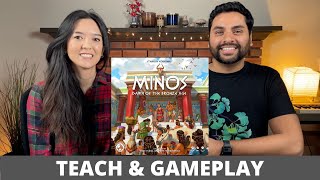





Minos: Dawn of the Bronze Age Deep Dive
What the Community Thinks About Minos: Dawn of the Bronze Age
Minos: Dawn of the Bronze Age has captured the enthusiasm of board game reviewers across multiple channels with its blend of elegant dice mechanics and satisfying engine-building gameplay. Reviewers consistently praise its innovative dice drafting system and the thematic journey of building a Minoan civilization. The game has earned recognition among 2024 releases, landing on several "favorites of the year" lists and standing out for delivering complex, crunchy decision space wrapped in Mediterranean history.
Core Mechanics That Define Minos: Dawn of the Bronze Age
Dice Drafting and Color Summation
At the heart of Minos lies a refreshingly original take on dice mechanics. Each round, players draft dice in four colors (red, yellow, blue, and gray wild) and place them into one of five action spaces. The genius lies in what happens next: when colored dice totals reach a threshold (typically eight or nine), players advance a corresponding track, unlocking ongoing abilities and income bonuses. This simultaneous color summation creates meaningful strategic tension. Players must weigh the immediate benefit of placing a die for an action against accumulating the right colors to trigger track bonuses. The placement matters too. Lower pip dice secure stronger action positions, but higher pip dice contribute more to color sums. Reviewers called this dice mechanism "so cool" and noted how it shines in this game's implementation.
Action Programming Through Activation Order
Once dice are placed, players must execute their chosen actions in strict order from highest to lowest pip value on their dice. This creates an elegant puzzle: players must anticipate what they need from one action to fuel another. Playing a decree card might grant instant rewards and bonuses; tucking it under the board for ongoing abilities requires sequencing future actions to best leverage those powers. One reviewer described experiencing "a long satisfying chain of actions if things go your way." This programming element ensures that turn order and action sequence matter as much as which dice were drafted, rewarding players who think several actions ahead.
The Minos: Dawn of the Bronze Age Experience
Building Your Civilization Through Tableau and Tracks
Players experience Minos as a satisfying climb up three progress tracks while simultaneously building tableau layers with multi-use decree cards. Each card offers an immediate benefit when played (like gaining resources or advancing builders), then slides under the player board for an ongoing ability tied to specific die numbers. The tracks themselves are visually and mechanically interesting. Advancing the blue track grants warriors for map placement; yellow and red tracks unlock other core actions. The interplay between building cards and track advancement creates multiple vectors for scoring and strategic specialization. Over four rounds, players invest early-game resources into engines that pay dividends by game end, encouraging both immediate puzzle-solving and long-term vision.
Area Majority and Historical Flavor
A map of Crete sits at the table's center. Players place their warriors to claim areas, fighting off "sea peoples" (pirates) through combat actions and vying for area majority at round-end and game-end. While some reviewers felt the area majority element was less innovative than the dice system, others appreciated how it breaks up turns and adds interactive tension to what could otherwise be a solitary optimization puzzle. The sea peoples combat forces allocation of weapon tokens alongside other resource management, weaving conflict into the civilization-building theme.
What Makes Minos: Dawn of the Bronze Age Stand Out
Innovative Dice System Meets Satisfying Complexity
In a landscape where dice drafting permeates many 2024 releases, Minos distinguishes itself through the color-summation mechanic combined with action programming. Reviewers noted that games using traditional dice placement (where each die triggers a single action) felt constraining by comparison. Here, every die serves dual purposes: it marks an action space and contributes to advancement tracks. Multiple reviewers independently highlighted this as remarkable, with one noting that the dice mechanism "really shines" and reflects thoughtful design. The result feels like a Rubik's Cube of decisions rather than a simple action-selection game.
Strong Designer Pedigree and Production Quality
Stan Cordoni's design resume includes Endless Winter, Dice Hospital, Lockup: A Roll Tail Tale, Nova Roma, and Resurgence. Reviewers consistently referenced his track record when evaluating Minos, building credibility for the game's mechanical cohesion. Board and Dice's production brings this aesthetic vision to life with a colorful, organized player board layout and thematic visual identity that evokes ancient Crete without heavy ornamentation. The game's presentation reinforces rather than distracts from its systems.
Potential Drawbacks
Complexity and Learning Curve
This is a medium-heavy to heavy game. Teaching requires careful explanation of the five actions, the color-summation mechanic, track effects, decree card tucking, area majority, and combat resolution. New players may struggle to see how dice color selection impacts track advancement without multiple plays. Reviewers acknowledged this is "a lot going on" and suggested the game rewards mastery through repeated play rather than immediate gratification. First plays can feel overwhelming for groups unaccustomed to systems-heavy designs.
Area Majority as Secondary System
While the dice and action programming mechanics drew universal praise, the area majority system received more mixed commentary. Some felt it was competent but less memorable than the core engines. The map interactions, warrior placement, and sea peoples combat add theme and player interaction but don't elevate beyond conventional area control. For players deeply engaged with the dice puzzle, the area majority elements may feel like a distraction rather than an integrated pillar of the experience.
If You Enjoy Minos: Dawn of the Bronze Age
Try Coimbra, another dice-drafting civilization builder with track advancement and multi-use cards. Both reward careful sequencing and long-term planning. Endless Winter, designed by the same creator, shares the medium-heavy weight and satisfying engine-building core. For fans of action programming and puzzle-like turns, Nova Roma and Resurgence deliver similar decision density. If the map play resonated, Dice Hospital scratches that itch with a different theme. Reviewers who loved Minos frequently mentioned these comparisons in the context of Cordoni's broader design style: games that layer multiple systems into cohesive, crunchy experiences.
What Reviewers Are Saying
"The dice mechanism in this game is so cool, and I absolutely love that part of the game. The main part of this game that I absolutely love is the dice mechanism. You are going to be dice drafting, and there are four different colors of dice. If you are able to get dice to add up to a certain number, that color will allow you to bump up on different tracks, which will give you rewards."
— The Board Game Garden
"There is just this long satisfying chain of actions if things go your way. You're not limited for the cards you tuck under your board, so go crazy. There are always competing priorities, and towards the end of the game, you may want to specialize on other things. There are only four rounds."
— Meeple University
"This is a game with dice, which I absolutely love games with dice, and I think the kind of dice drafting worker placement is one of my favorite things about this game. It really shines in this game. There's a lot of stuff in this game. I could talk about this game for so long. Absolutely love that part of the game."
— The Board Game Garden