/pic8290518.png)











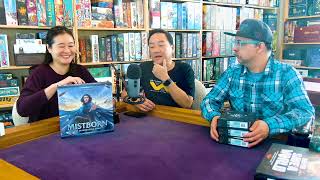

Mistborn: The Deckbuilding Game Deep Dive
What the Community Thinks About Mistborn: The Deckbuilding Game
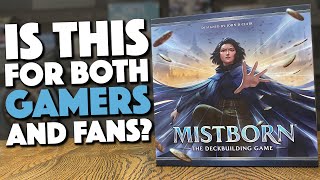
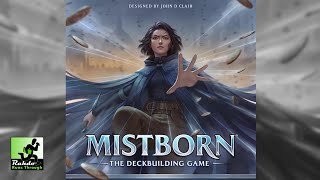
Coverage of Mistborn: The Deckbuilding Game leans strongly positive, and the recurring praise is the same across formats: designer John D Clair's decision to build the deckbuilding engine directly out of Brandon Sanderson's Allomancy magic system. Man vs Meeple ran a live head-to-head duel between two of the game's Mistborn characters and kept returning to how tightly the metal-burning system ties into the source material. Getting Games covered the title before playing it, on a segment built around games caught their attention after finishing the first Mistborn trilogy, and came away curious to see specific book moments show up on cards. Rolling Dice & Taking Names, who received their copy from publisher Brotherwise Games after previewing the game at Gen Con, ran a full four-player teach and gave the most detailed account of how a session actually plays out. Rahdo Runs Through reviewed the game as part of a monthly roundup and offered the most mixed take of the group.
The disagreement in the coverage centers on which mode the game is built for. Rahdo Runs Through is explicit that Mistborn: The Deckbuilding Game is at its best played competitively and that the co-op mode, while functional, is not the reason to buy it. Rolling Dice & Taking Names focused entirely on the four-player competitive game and came away wondering if a smaller player count would actually serve the design better, since the four-player session ran long and introduced targeting frustrations that a head-to-head match would not have. Man vs Meeple, playing two-player, did not run into either issue and instead spent its session enjoying the deckbuilding puzzle itself.
Core Mechanics That Define Mistborn: The Deckbuilding Game
Burning and Flaring Metals to Activate Cards
Every player starts with access to the same eight base metals, and cards are not simply played, they have to be activated by burning a matching metal. Rolling Dice & Taking Names walked through the system in detail: burning a metal means placing that metal token on the card to show it has been used, and a player can normally only burn one metal at a time early in the game. To activate a second card in the same turn, a metal has to be "flared," flipped to its reverse side, which takes it out of play until it is refreshed by playing another card of that same metal type. Getting Games described the same idea from the market side, noting that many cards are multi-use: a card can either be played for its printed effect or tucked under another card to represent the metal type it needs to burn. Man vs Meeple added that the design rewards spreading burns across different metals rather than leaning on just one, since running out of a single metal locks a player out of every card that depends on it.
Deck Building Through the Market and Two Paths to Victory
Beyond the metal system, the game runs on a standard shared market: players buy cards with coins earned from their deck and add them to their discard pile, cycling through a growing deck the way most deckbuilders do. Rahdo Runs Through compared the base structure to Dominion, and separately compared the way unused metal-generating cards can be discarded to power other cards to Race for the Galaxy's system of spending cards as resources. Rolling Dice & Taking Names laid out the two ways to actually win: complete all three of a player's mission tracks first, or reduce every other hero's hit points to zero. Missions and combat pull in different directions, since cards that push toward a mission track are not always the same ones that deal damage, and Rolling Dice & Taking Names noted this creates real decisions about which track a deck is actually building toward.
The Mistborn: The Deckbuilding Game Experience
Head-to-Head Duels
Rahdo Runs Through described the competitive mode as a dueling wizard game where everybody is trying to knock out everyone else, and argued the control and depth of that dueling system is more engaging than Magic: The Gathering's, calling Mistborn: The Deckbuilding Game vastly superior for that kind of head-to-head play. Rolling Dice & Taking Names, coming at it from the four-player side, arrived at a similar conclusion from the opposite direction: the four-player game ran long at ninety minutes and introduced a targeting system where only the player currently holding the "bullseye" token can be attacked directly, which meant not always being able to hit the player who actually needed to be stopped. That frustration led Rolling Dice & Taking Names to wonder whether two-player, which removes the targeting restriction entirely, might be the format the design was really built for.
Solo and Co-op Play Against the Lord Ruler
Man vs Meeple called out a robust solo mode that pits a single player against an automated deck for the Lord Ruler, the setting's central villain. Rolling Dice & Taking Names explained how that same mode scales into co-op: the Lord Ruler starts with roughly 48 health, and players draw from a dedicated deck each turn that either strengthens the Lord Ruler through edict cards or spawns an adversary that has to be dealt with before the group can keep attacking the boss. Rahdo Runs Through played the co-op mode directly with a spouse and said it plays well, but felt every turn that the same system would be more interesting if played as a duel instead, and found the automated villain less compelling than the villains in Aeon's End or Marvel Champions.
What Makes Mistborn: The Deckbuilding Game Stand Out
Metal Magic Woven Into Every Mechanic
The metals themselves come in paired sets, push and pull, and Man vs Meeple pointed out that a true Mistborn character in the game can use every metal, unlike the other playable characters who are each limited to a narrower set of abilities. Rolling Dice & Taking Names noted that allies bought from the market are named after their abilities, such as a copper-using ally called the smoker, and that certain allies act as defenders that block damage the way a ship can block an attack in Star Realms.
Multiple Ways to Win and High Replayability
Rolling Dice & Taking Names singled out the dual mission-track and combat win conditions, plus the separate solo and co-op modes against the Lord Ruler, as the source of a lot of replay value beyond a typical deckbuilder. Getting Games was drawn in for a different reason: after finishing the Mistborn book trilogy, they described the excitement of spotting specific characters and moments, like the invasion of Luthadel, translated directly onto cards.
Potential Drawbacks
Easy to Forget the Power Track
Rahdo Runs Through's biggest complaint was mechanical rather than thematic: the game asks players to bump a personal power track up one level at the very start of every turn, before doing anything else, and found that placement made it constantly forgettable. Man vs Meeple ran into the same issue during its own session, repeatedly forgetting to advance the training track at the start of a turn for the same reason, since the start of a turn is when a player is focused on the hand of cards rather than housekeeping.
Four-Player Length and Targeting Frustrations
Rolling Dice & Taking Names felt four players pushed the game to around ninety minutes, longer than they wanted for this style of deckbuilder, and that the single-target combat rule sometimes prevented dealing damage to the player who was actually closest to winning. They also flagged a smaller component gripe: the mission track cubes are not locked in place, so a bump from a neighboring player can knock a cube loose and make it unclear what level a player was actually on.
If You Enjoy Mistborn: The Deckbuilding Game
Rahdo Runs Through described the core deckbuilding loop as similar to Dominion, and separately compared the way spare metal-generating cards get discarded to power other cards to Race for the Galaxy. For the dueling, head-to-head feel, Rahdo Runs Through pointed directly at Magic: The Gathering, arguing Mistborn: The Deckbuilding Game handles that kind of one-on-one combat better. Rolling Dice & Taking Names drew a separate comparison to Star Realms, pointing to the way defender-type allies block incoming damage the same way ships can in that game.
What Reviewers Are Saying
"You can only burn so much of each metal, and this is all going to make sense as we play. You're kind of limited: you want to play a variety of different metals, because if you just play all the same one, you're going to run out of that metal, which is very very very thematic to the game."
— Man vs Meeple
"There is another metal. It's in the game. It's called Atium. It's in this game and it acts as a wild metal, and that is not how it works in the books. I got really, I was a little disappointed."
— Getting Games
"One negative for me is four players is 90 minutes, and that's too long for this type of deck builder. Three players would be shorter, but I'm honestly wondering if two-player might be the sweet spot for this game for me, cuz it gets rid of the target."
— Rolling Dice & Taking Names