
















Mistwind Deep Dive
What the Community Thinks About Mistwind
Reviewers generally describe Mistwind as a compact, tactile route-building game with a sharp worker placement core. The title comes from First Fish Games, and Board Game Spotlight noted that the design team behind Sagrada, Daryl Andrews and Adrien Adamescu, returned with it. Their two-player playthrough treated the game as a likely breakout for a publisher stepping up to its first large box, praising both the gameplay and the artwork.
The strongest praise centers on how much decision-making fits into a short game. Reviewers repeatedly point to the four-round structure, the limited actions, and the feeling that every turn matters. Meeple University placed Mistwind among its favorites of the month, and returned to it in its year-end picks, where the hosts argued that its combination of pickup and delivery with worker placement is unusually successful. The Board Gaming Doctor came to it as a preview title and expressed interest in how its numbered discs tweak a familiar formula.
Opinions diverge mainly on taste rather than quality. Sam and JT of The Flip Side admired the action selection but said they are not fans of the pickup and delivery core. Board Games for One was intrigued by the game's many scoring paths and its solo mode, but was undecided about buying a copy at the Kickstarter price. Across these perspectives, reviewers agree that Mistwind is more interactive and more thoughtful than its box art suggests.
Core Mechanics That Define Mistwind
Worker Placement With Numbered Discs
Worker placement is the mechanic reviewers return to most often. Each player holds a set of numbered discs, and at the start of every round each player secretly discards one. The board is split into four zones, each with spaces numbered one through five, and a disc can only be placed on a space that matches its number. Only one disc may occupy each space, so a claimed spot is blocked for everyone else until the round ends.
That discard step is what reviewers find most distinctive. Meeple University singled it out as the feature they love most, because the discarded disc creates a lingering mystery: "there's always one mystery of what that player is going to play." Players can read the board to infer which numbers opponents still hold, which turns each placement into a small deduction. The Board Gaming Doctor saw the same idea as a variation on classic worker placement, where differing strengths on the tokens make every placement more difficult to judge. Designers Adrien Adamescu and Daryl Andrews built this system into a game published by First Fish Games.
Pickup and Delivery Built on Networks
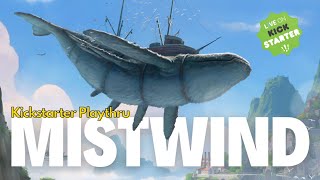
The second defining system is pickup and delivery, which reviewers consistently describe as the game's engine. Players build outposts that form a permanent network, and place transport whales that carry goods between territories. Whales can be moved at the end of a turn, and movement along your own outposts and existing whales is free, while leaving an unconnected port costs resources. Building an efficient network therefore lowers the cost of every later delivery.
Meeple University argued that this is difficult to get right in a Euro context, and felt Mistwind succeeds because of the way the whales serve two roles at once: "you can take actions to build outposts, which form a permanent network, and you can take actions to place transports, which are these floating whales who carry stuff." Meeple University made a similar point in its 2024 list, noting that the whales are part of the network itself and can count toward network cards even while they are delivering goods. Secret objectives and achievements, such as connecting specific ports or holding outposts in a region, reward players who plan these routes early.
The Mistwind Experience
Brisk, Interactive Tension
Playing Mistwind feels fast and a little combative. Board Game Spotlight described the turns as "quick" and "snappy," even though the overall game remains substantial. The game uses a third, automated player in two-player games to block spaces, and the hosts found that it simulated a real opponent well with very little bookkeeping. When a key space is taken, players must immediately rethink their plan, and the reviewers often voiced frustration or amusement at being blocked. The pressure never fully relaxes, because each placement can change what every other player can do on the next turn.
Playful Charm Under Tight Planning
Against that tactical pressure, reviewers highlighted a warm, whimsical tone. Board Game Spotlight delighted in the transport whales and little cargo pieces, describing the prototype components as "very cute." Board Games for One mentioned the painted miniature option, which suggests how much the game's presentation invites attention. The result is a feeling of building a charming trade network, where the cute tokens soften a planning process that can otherwise feel like a spreadsheet.
What Makes Mistwind Stand Out
Pickup and Delivery That Works in a Euro Frame
Reviewers were especially impressed that Mistwind makes pickup and delivery feel fair and strategic rather than dependent on luck. Meeple University described the balance between placing permanent outposts and placing transports, and how the cost of each move depends on whether it runs through your existing network. This design lets players plan ahead rather than gamble on movement rolls, which the hosts noted is a common complaint about similar games. Because so many systems meet inside the same action, the game rewards careful sequencing rather than raw efficiency.
Component Quality and Artwork
Presentation comes up in nearly every review. Board Game Spotlight praised the "gorgeous artwork" and the design of the components, and The Flip Side described the miniature whales as attractive, high-quality pieces. Reviewers see the physical production as part of the game's appeal, not an afterthought, and the visual identity makes the trade routes easy to read on the table.
Potential Drawbacks
Pickup and Delivery Is Not for Every Player
The most direct criticism comes from players who simply do not enjoy the core delivery system. Sam and JT of The Flip Side said they "don't like pick up and deliver" and found it dominated the rest of the game, even though they liked the action selection on the four-sided board. They suggested that the disc-based action system could fit into a different game entirely. Players who prefer lighter, more abstract engines or who dislike route-based planning may find Mistwind's network focus less satisfying than its worker placement.
Rules Questions and Heavy Iconography
Mistwind rewards careful reading, and some reviewers found that the rules took time to internalize. During Board Game Spotlight's playthrough, the players stopped repeatedly to confirm details, such as whether a whale could unload at a port or only at a territory, and they relied on the glossary to resolve questions about symbols. Board Games for One also noted the game's price, with the Kickstarter edition around the high seventies in US dollars and the painted miniature edition costing considerably more. Both points suggest that new players should plan for a teaching session and a moderate investment.
If You Enjoy Mistwind
Players who enjoy Mistwind's numbered worker placement will find a similar sense of competition in Dune: Imperium, where shared placement spaces and turn order shape each decision. Players who enjoy the network of outposts and whales will appreciate the "ticket to ride" feeling that Meeple University associated with Mistwind, which makes Ticket to Ride a natural companion for route-building fans. Players drawn to Mistwind's blocking tension and the cute, tactile components may also enjoy Sagrada, the design team's earlier game, which shares a focus on careful placement under limited options. For players who want more depth and commitment than Mistwind's four rounds provide, Gloomhaven offers a much longer, heavier experience. Finally, Board Games for One compared Mistwind's trading premise to Islebound, where merchants build cities through trade, which may appeal to players who like economic route-building.
What Reviewers Are Saying
"The game is so much thinkier than you suspect when you look at it. It's pretty, there's, there's a lot of awesome stuff happening."
— Board Game Spotlight
"It's hard to get pick up and deliver in particular into a Euro kind of context, and I think Mistwind has done it really well, because you can take actions to build outposts which form a permanent network, and you can take actions to place transports out, which are these floating whales who carry stuff."
— Meeple University
"What interested me about this game is it's very similar in the that the worker placement is handled by these tiles that have different strengths on them. Knowing that they have different numbers on them and different abilities and strengths makes that decision even tougher to know where they, they should be placed."
— The Board Gaming Doctor