/pic8419925.jpg)


































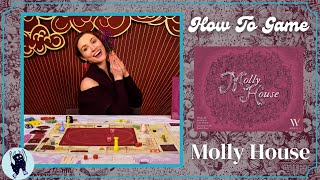


Molly House Deep Dive
What the Community Thinks About Molly House
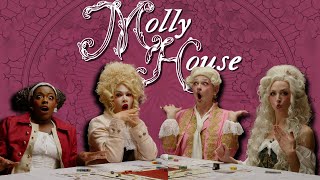
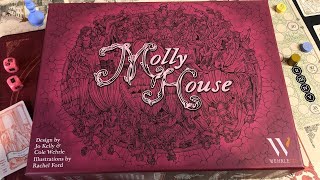
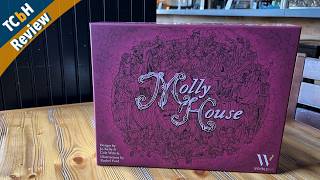
Molly House has captivated reviewers as a refreshing experience in modern board gaming, praised for its bold thematic integration and emotional weight. The game celebrates queer community and camaraderie in 18th century London while delivering a sophisticated mechanical experience. Community feedback emphasizes that Molly House succeeds not by doing anything mechanically revolutionary, but by how seamlessly its theme and mechanics interweave to create genuinely memorable table moments. Reviewers consistently highlight how the game makes players feel something while playing, transforming a semi-cooperative struggle into a meaningful exploration of joy, loyalty, and collective survival.
Core Mechanics That Define Molly House
Card Drafting and Negotiation
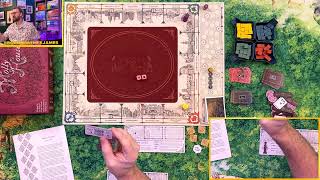
Players navigate early 18th century London by moving around the board to collect vice cards, desires, mollies, and threats, then deploying them at festivities or using them to build reputation. The game's card economy creates meaningful negotiation opportunities as players can offer shared resources, strike binding deals through promises, and trade cards strategically. This negotiation layer gives the game its conversational, table-present quality; players aren't just executing turns in isolation but actively discussing what kind of party to throw, which threats to manage, and how to balance personal joy against community welfare.
Festivity System as Core Gameplay
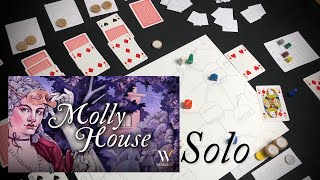
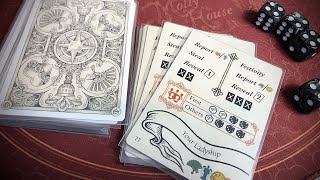
The heart of Molly House lies in throwing festivities, thematic gatherings where players collectively attempt to form poker-hand combinations to score joy. Each party requires players to decide which cards to play over two or three rounds, with the best hand selected to score points. Players can contribute desire cards, special molly cards that grant bonuses, rogues seeking only fun without loyalty, and unfortunate threats that must be managed. Successfully throwing a christening (queen plus three matching values), a dance (jack plus three in sequence), or surprise ball (four-card flush) generates joy for both the player whose cards were selected and the broader community. When no valid hand forms, a quiet gathering occurs where everyone loses, a thematic representation of a failed night out.
The Molly House Experience
Narrative-Driven and Chaotic
Molly House creates stories at the table through its semi-cooperative structure and the unpredictability of party outcomes. The game genuinely feels chaotic in the best sense: constables arrive unexpectedly through random card draws, the community may show up with their own contributions to parties, informers silently plot betrayal, and the Society for the Reformation of Manners gradually gathers evidence to raid houses. This chaos is thematic rather than punishing, it mirrors the historical reality of queer community members navigating a hostile society while trying to celebrate together. Reviewers consistently report that Molly House creates moments of genuine narrative emergence where the mechanical systems generate human drama and emotional investment.
Experiential and Emotionally Resonant
The game's greatest achievement is making mechanics deeply meaningful through context. Rolling dice to move around London feels risky because constables hunt players. Throwing a party becomes genuinely joyful because joy is literally the victory point. The indictment cards, charging players with historically accurate crimes punishable by death in that era, carry weight because they reference real persecution. Players report that the game forces them to confront ethical choices about loyalty, complicity, and compromise in ways that board games rarely accomplish. The distinction between collaborative survival (community joy reaching 35), individual victory (most personal joy while community survives), complete failure (community atrophy after five weeks), or infiltration (houses raided, forcing informer mechanics) means every game carries genuine stakes.
What Makes Molly House Stand Out
Thematic Mechanics Integration
Molly House demonstrates masterful design where every rule serves the theme. The arrest mechanic where players draw indictment cards based on their standing in a given house naturally models social vulnerability. The informer token hidden in each player's encounter set creates the possibility of betrayal without requiring anyone to actually betray, the mechanic itself generates tension about whether loyalty can be trusted. Cruising sites offer more joy but greater risk of arrest, modeling the danger inherent in living openly. Shared resources and trading agreements mirror how real communities build trust and interdependence. Reviewers praise how Molly House never feels like theme pasted over arbitrary mechanics; instead, the rules naturally express what it means to be part of a marginalized community seeking joy and safety.
Semi-Cooperative Flexibility
The game's semi-cooperative structure works because victory is tied to community survival first. While individual victory is possible if the community reaches 35 joy, most players report treating it as collaborative, if the community wins, everyone celebrates. The option to become an informer exists but carries moral weight that makes it feel genuinely transgressive rather than tactically optimal. This flexibility means Molly House plays extremely well for groups who want pure cooperation (just ignore the individual scoring) while still offering meaningful divergence for groups who want that semi-competitive tension. The game trusts players to calibrate their own experience rather than forcing a single competitive-cooperation ratio.
Potential Drawbacks
Roll and Move Mechanic
Molly House includes a roll-and-move system for pawn movement, a mechanic that fell out of favor decades ago for good reason. However, reviewers note the game mitigates this through mitigation options: two dice offer flexibility in choosing which die to use or combining them, players can sometimes move zero spaces, and the market discard icons can allow carriage movement to any site. While some players wish for a fully modernized movement system, the mechanic ultimately serves its purpose, movement is abstracted, relatively quick, and the real game happens at action selection and party management, not in navigation. The roll-and-move adds a luck element that thematically represents the unpredictability of staying safe in a hostile society.
Heavy Ruleset and Complexity Ceiling
Molly House carries significant mechanical complexity despite elegant thematic presentation. The indictment system, reputation tracking across multiple houses, the gossip pile mechanics, the market discard versus safe pile distinction, and exposure triggers for threat cards create a steep learning curve. The festivity poker-hand ranking system requires players to think in abstract combinations rather than thematic logic. Early plays often involve someone second-guessing rule interactions or exploring the implications of sharing resources. Reviewers emphasize this isn't a bad thing, the game rewards learning and engagement, but groups expecting a breezy, light experience will find themselves in a medium-to-heavy strategic game that demands attention and bookkeeping.
If You Enjoy Molly House
Players who connect with Molly House often appreciate John Company (Second Edition) and Infamous Traffic, both from the same publisher and designer network, which combine historical settings with semi-cooperative negotiation. The negotiation and shared-resource elements appeal to fans of Marvel Legendary played cooperatively. The traitor potential and social deduction echoes One Night Ultimate Werewolf, Battlestar Galactica, and The Resistance, though Molly House integrates it far more subtly. The festivity system's card combination focus resembles Poker variants and trick-taking games like those found in Dixit. The historical setting and thematic weight connect to games exploring real communities like Dead of Winter, while the push-your-luck around arrests mirrors mechanics in The Mind. Those drawn to Oath's asymmetric, politically charged gameplay will find Molly House equally compelling, though less mechanically revolutionary. For groups seeking Old King's Crown's complex asymmetry or Poker's bluffing and hand management, Molly House offers a middle ground: sophisticated without being opaque, thematic without being shallow.
What Reviewers Are Saying
"It managed to create stories around the table. Um absolutely fantastic. It's a game that I would say to everyone to give it a go and give it a try. Um might be not the the game for you in terms of like might not be your favorite game ever. Yeah. But definitely gives you an experience and uh makes you see things under a different eyes."
— Board Stupid
"The whole aspect of it of just the folks trying to just be you know who they are in society in a society that wants to put them to death or arrest them you know at the least um really comes through here and that sort of semi-cooperative thing whereas like we're all kind of in this and we're all trying to just do our thing uh but there's all these sort of forces sort of uh trying to get in the way of that and it just made the game that much more uh engrossing."
— Drive Thru Games
"It's a really interesting game because there's that co-op stuff. There's tons of cross talk because you really have to talk about what's going on. There's like constables and stuff that are like messing you up because then this is a dangerous time. Um there's tons of interesting stuff in this game and I'm really excited to play it more."
— The Brothers Murph