/pic2611318.jpg)
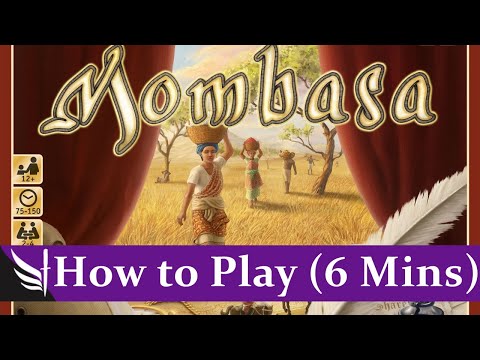
























Mombasa Deep Dive
What the Community Thinks About Mombasa
Mombasa stands as one of Alexander Pfister's signature designs, a heavy economic euro-style game that challenges players to build wealth across a fictional Africa-inspired landscape. Reviewers consistently describe it as a cerebral, serious engagement where players spend most of the game in contemplative focus, carefully analyzing board states and hand management. The game demands significant strategic thinking around shared company investment, a unique mechanism where no single player owns any of the four chartered companies outright.
Core Mechanics That Define Mombasa
The Revolutionary Card Hand Management System
What truly distinguishes Mombasa is its remarkable card cycling mechanism. Players begin with identical hands and must plan which cards to place in face-down action slots each round. After revealing their selections, cards migrate upward into separate resting decks by column. At round's end, each player retrieves all cards from a single resting deck of their choice, forcing a deliberate balance between powerful card combinations and deck dilution. Reviewers highlight this as both the game's greatest innovation and its primary source of mental engagement. The mechanism creates what one reviewer called "fascinating" planning: spending time getting specific cards into your hand means accepting they'll later become scattered across different discard piles. This forces players to curate future hand options while maintaining efficient current actions, a puzzle that sits at the heart of the experience.
Shared Company Expansion and Stock Investment
Players expand four chartered companies across the African continent by placing trading posts, but neither owns these companies exclusively. Instead, players acquire shares through track advancement and card purchases. At game end, they multiply their shares by the number of revealed coin values on each company's home region, a number determined entirely by which trading posts other players chose to place. This creates indirect player interaction where expanding a company helps everyone invested in it, but also reveals valuable coin values that multiply everyone's holdings. Reviewers note this tension between cooperation and competition as central to the game's appeal, particularly the ability to affect opponents' final scoring by strategically placing or removing trading posts.
The Mombasa Experience
A Game That Demands Silence and Thought
Multiple reviewers emphasize that Mombasa plays heavy. One described a three-hour, three-player game where most interaction consisted of "staring at their area and staring at the board and looking back and forth." This isn't a game for casual table conversation. Players manage simultaneously: goods to spend, expansion points to commit (all at once, unlike goods), bookkeeping points for a complex track-building subsystem, and diamond advancement for additional points. The cognitive load is substantial, yet reviewers appreciate the payoff. One player noted feeling "great about" their resulting stone garden at game end, Mombasa creates this ownership sensation despite the shared company structure.
Three Parallel Economic Engines
Beyond the card and company mechanisms, Mombasa layers two additional point tracks: a diamond track advanced through special merchant cards, and a bookkeeping track where players construct paths from book tiles purchased with special points. The bookkeeping system, described as "tough" by multiple players, requires fulfilling tile requirements with cards currently in hand. This creates interesting moments where players must decide whether investing early in the bookkeeping path pays off, or whether the simpler tracks provide clearer paths to victory. The three scoring systems ensure no single strategy dominates.
What Makes Mombasa Stand Out
Strategic Depth Through Hand Curation
Reviewers consistently return to the card mechanism as the primary draw. One reviewer observed that "every time I play this game, this mechanism just fascinates me" because of how the cycling creates long-term planning challenges. You want specific cards together for powerful combinations, but gathering them means they'll separate. This isn't randomness, it's pure strategic hand-building where your planning decisions lock in future constraints.
Economic Tightness and Multiplier Scoring
The game rewards understanding market flow. Players compete for companies' revealed coin values, which determine how valuable each share becomes at game end. This creates what one designer-focused analysis described as a "great economic engine where money is so so important." The multiplier scoring, shares times revealed coins, means that early positioning in a company can compound dramatically if other players continue expanding it.
Potential Drawbacks
Heavy Rules and Setup Complexity
The bookkeeping track in particular confuses new players. Its requirement-matching system, while elegant, requires careful explanation. One reviewer mentioned discovering only after initial plays that understanding "which tracks you want to go up" was itself a strategic choice deserving of deliberate planning. Setup also involves variable track configurations, meaning no two games are identical even in their economic structure.
Requires Full Table Engagement
Mombasa isn't conducive to simultaneous multiplayer casual play. The game punishes distraction and rewards analysis, which can create uneven play experiences if some players optimize while others move casually. One player came in "third" despite enjoying the experience, having "went out on my own too much" with company investment strategy, failing to "piggyback with what the other people are doing." This game reveals strategic mistakes clearly, which some groups may find frustrating.
If You Enjoy Mombasa
Fans of Mombasa should explore other Alexander Pfister designs featuring similar economic engines and tight decision-making: Isle of Skye for lighter tile-drafting with variable scoring, or Great Western Trail for area-control investment mechanics. Players who love stock holding and company control should investigate Concordia for its god-card multiplier system, and those drawn to the card-cycling mechanism might explore Concordia or Newton for alternative hand management approaches.
What Reviewers Are Saying
"Every time I play this game, this mechanism just fascinates me. You may spend time getting, let's say, all the pith helmets into your hand. You can have a really big action, but then you have to spread all those pith helmets amongst all your resting spots at the end of the round. The cycling of cards is enjoyable."
— The Dice Tower
"I enjoyed the game even though I came in last. It's about kind of getting influence in four different companies, and I went out on my own too much. I think you need to do some piggybacking with what the other people are doing."
— Getting Games
"This has a very cool almost like a stock investment mechanism in the game where you invest in different companies based on their coverage on the board and the higher you get up on these tracks by investing in them, you're going to get better multipliers. It's just another brilliant game by Alexander Pfister."
— Chairman of the Board