/pic6346032.png)






































Monikers Deep Dive
What the Community Thinks About Monikers
Among party games discussed across the board game community, Monikers earns a reputation that is unusually consistent: reviewers who love it tend to love it without qualification, placing it at the top of their party game lists and returning to it season after season. BoardGameBollocks called it "the greatest party game ever made," placing it at number four on an all-time top 100 list dominated by heavy strategy games. Banter and Boards gave it their number one party game slot outright. All You Can Board keeps it as a personal top 10 game year after year, describing it as a game they never say no to.
The enthusiasm across channels is grounded in a shared observation: Monikers is not a game people play to win. It is a game people play to generate moments. Ryan and Bethany captured this sentiment directly, noting that they could not remember who won any of their sessions, but could vividly recall specific clues, specific acting moments, and specific bursts of laughter. That pattern, where the scoreboard fades and the memories remain, comes up as the defining quality of what makes Monikers work at the table.
The game is also recognized as a polished commercial edition of a public domain format, sometimes called Celebrities or Celebrity, where players write names on slips of paper and play through the same three-round structure without any components at all. Multiple reviewers point this out, not as a criticism, but as evidence of the game's staying power. The underlying design is so strong that it has circulated informally for decades. What Monikers adds is a curated, well-crafted deck with point values, content ratings for adult cards, and a portable format that makes it significantly easier to get to the table.
Core Mechanics That Define Monikers
The Three-Round Escalation
The central design of Monikers is its three-round escalation structure, and nearly every reviewer points to this as the source of the game's magic. Players begin by building a shared deck from cards dealt at the start, each choosing which ones to include based on what they feel they can describe or guess. This drafting step gives each player partial knowledge of the deck before the first round begins.
In round one, the clue-giver may say anything except the words printed on the card, making it a fast-paced verbal description game similar to Articulate or Taboo. In round two, that same deck is used again, but the clue-giver is limited to a single word. In round three, the same deck is used once more, but now in pure charades, with no words allowed at all.
The genius of this structure, as All You Can Board explains it, is that the game becomes easier as the restrictions tighten. After two full passes through the deck, every player has heard each card described multiple times and seen others guess it. When round three arrives and a clue-giver mimes something wordlessly, the audience is not starting from scratch. They are recalling connections already made. A single gesture can trigger the memory of a description from round one, and the whole table erupts. No Rolls Barred's playthrough demonstrates this in real time, where one-word clues in round two land instantly because they echo phrasing from round one, and the charades round turns into barely-contained laughter as increasingly obscure cards get acted out by people who already know the answer.
The Curated Deck and Card Variety
One of the ways Monikers distinguishes itself from its informal celebrity-hat predecessors is the quality and variety of its card pool. The cards span a wide range of difficulty, each carrying a point value that reflects how hard it is to convey. Simple references earn fewer points while absurdist, niche, or difficult-to-mime entries earn more. Gaming with Edo and Jessica notes that this point-value system creates a layer of choice: players must weigh whether to tackle a high-value card they might struggle with or move quickly through easier ones.
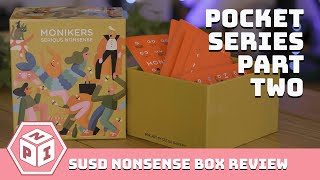
Ryan and Bethany point out a thoughtful design detail that helps Monikers reach diverse audiences: cards carry small NSFW indicators that allow groups to remove risque entries before playing with family or children. This means the same box works equally well at a family holiday gathering and a late-night session with close friends. The deck also includes brief descriptions for every card, so players unfamiliar with a reference can still participate without being completely lost. This is an advantage the curated deck holds over the informal write-your-own-names version, where an unfamiliar celebrity can leave a clue-giver completely stuck with no context at all.
The Monikers Experience
A Better Charades
One of the most consistent arguments reviewers make for Monikers is that it fixes what people dislike about charades. All You Can Board puts this plainly: charades is "very overwhelming" and "anxiety-inducing," especially for players who do not consider themselves performers. Standing in front of a group and miming something cold, with everyone watching and nothing established in common, is genuinely uncomfortable for many people.
Monikers solves this by building context before it demands performance. By the time players reach round three and must rely entirely on acting, they have already spent two full rounds developing shared references with their team. When someone now has to mime something, they and their teammates both know what to expect. All You Can Board describes experiencing this firsthand: even players with social anxiety who would normally dread charades find that Monikers removes the pressure, because the acting round arrives after two rounds of calibration rather than as a cold start. The game earns the charade round rather than demanding it upfront.
Shared Memory and Inside Jokes
What reviewers describe experiencing in Monikers is something closer to a shared joke economy than a competition. All You Can Board describes the second round's magic: you say one word, like "duck," and your teammate immediately responds with the right answer because you made that particular connection in round one and now it belongs to both of you for the rest of the session. These micro-connections accumulate across the game until the table has developed a kind of shorthand that barely existed an hour before.
BoardGameBollocks describes playing it over the Christmas period and laughing until physical control becomes a question. No Rolls Barred's playthrough captures this arc in real time, where the energy in the room climbs visibly from round to round as clues get faster, guesses more automatic, and the laughter harder to contain. The moments people remember are never the final scores. They are specific words, specific gestures, specific incorrect guesses that somehow still worked. This is the experience that Monikers reliably produces and why reviewers across the community consistently recommend it as a staple for any gathering.
What Makes Monikers Stand Out
Accessibility Across Groups
Party games face a persistent tension: the games that work best with a dozen players are often too chaotic for four, and the ones that shine with close friends fall flat with strangers. Monikers consistently gets praised for dissolving that tension. All You Can Board names it specifically as the choice for when you like to perform but hate charades, while also describing it as the option that works for people who do not want to perform at all, since guessing is just as central to the fun as clue-giving. You can be the person who never acts and still be fully engaged.
The game also scales broadly on player count, accommodating groups from four up to sixteen, and the deck-drafting at the start means the content is always shaped by the people in the room. If a group skews toward niche internet culture, those cards make the deck. If a group wants to insert their own inside jokes, blank cards let them do that. This self-selection mechanism is one of the features All You Can Board specifically praises, noting that it ensures the deck will generate laughs rather than blank stares.
No Setup, Fast Teach, Immediate Fun
Monikers is described by multiple reviewers as one of the fastest games to teach. Shelfside notes it takes about thirty seconds to explain to someone who already knows Taboo or charades, and Ryan and Bethany emphasize that turns are "lightning fast," with each round moving quickly enough that momentum never stalls. The game does not ask players to absorb a rulebook before they can participate. The first round's structure is intuitive enough that new players learn it by playing, and by round two they are already invested in the deck they helped build.
For players like All You Can Board's Dylan, who describes himself as someone who does not gravitate toward party games but always regrets not having good options when gatherings happen, Monikers is exactly the kind of game that bridges the gap: low barrier to entry, high ceiling for fun, and replay value that comes from people rather than from systems. Every group creates a different experience, which means the game does not wear out.
Potential Drawbacks
Cultural Reference Dependency
The most substantive criticism of Monikers across the reviews centers on the card content and who it was designed for. Shelfside raises this concern directly: the base card pool is heavily skewed toward pop culture references from a specific generational window, roughly the 1990s through the mid-2000s. Reviewers who fall outside that window report that a significant portion of the deck becomes guesswork at best and memorization at worst. Shelfside describes one reviewer who did not recognize enough cards to connect with the game's spirit, finding himself mechanically reciting words rather than genuinely engaging with the references.
This generational sensitivity matters for mixed-age groups in particular. The NSFW filtering helps with content appropriateness, but there is no equivalent mechanism for cultural unfamiliarity. Gaming with Edo and Jessica notes that the game functions well for adults with broad pop culture exposure, but cautions that younger players or those outside the cultural frame of reference may feel excluded. The game's solution, a brief description printed on each card, helps but does not fully solve the problem. Knowing what something is from reading a sentence is not the same as genuinely recognizing it.
The Tension Between Memorization and Comprehension
A related criticism raised in the Shelfside review concerns the later rounds and what happens when players do not fully understand the cards in their deck. The single-word round and the charades round both depend on players having internalized the deck's content from round one. If someone spent round one memorizing which one-word summary was used for an unfamiliar card rather than actually understanding who or what the card represents, rounds two and three become a rote recall exercise rather than a genuine act of creative connection.
Shelfside describes this as going against the spirit of the game, where the intent is that players are making real associative leaps based on shared cultural knowledge. A player who has to memorize rather than comprehend is technically still playing, but the experience is thinner. This is worth considering when introducing Monikers to groups where the card content may be unfamiliar to some players, or when deciding whether the expansion content better matches your group's references.
If You Enjoy Monikers
Reviewers frequently mention Times Up! as the closest relative to Monikers, using the same three-round structure with similar restrictions. It is the game most often named as an alternative when players cannot access Monikers itself. Charades and the informal game known as Celebrity share the same DNA, with Celebrity being the hat-and-paper version that Monikers formalizes and expands. For players who love the communication and clue-giving angle without the acting component, Articulate delivers a similar verbal-description experience in a more structured race format.
Players who gravitate to the social dynamics and shared-knowledge aspect of Monikers often also enjoy Heads Up!, which captures some of the same fast-paced guessing energy in an app-driven format that works well for spontaneous gatherings. Cebu adds a competitive layer to the social guessing space that appeals to groups who want more tension built into the scoring. Whatever draws you to Monikers, whether the escalating pressure, the shared laughs, or the way it brings groups together without requiring any gaming background, there are games nearby that capture a piece of it, though reviewers are consistent that Monikers occupies its own particular place.
What Reviewers Are Saying
"Monikers never fails to impress. Always makes me laugh to the point where a little bit of wee comes out. It is the greatest party game ever made. The beauty being that you don't even have to buy anything. Just make it up on your own, cuz I just told you how to play it."
— BoardGameBollocks
"The reason this is better than charades is there's way less pressure. After that first round, the first round is more sort of like a learning of what's in this deck and ways to get people to guess stuff. But after that, it's also a memory game. And especially around your friends playing monikers, it doesn't seem to affect the same way. It's a way easier game to get into and it's inclusive of everybody."
— All You Can Board
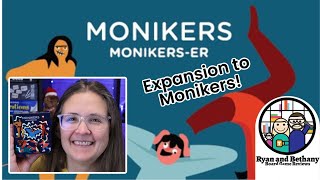
"The laughter never stops in this game. That is the number one most hilarious thing about this game. The best part of this game is the laughter. The points, I mean, I played this game a ton of times and I don't think I've ever like cared about the points. I don't remember who won. What you do remember is the laughing."
— Ryan and Bethany Board Game Reviews