/pic8445137.png)























Monkey Palace Deep Dive
What the Community Thinks About Monkey Palace
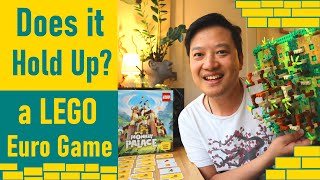
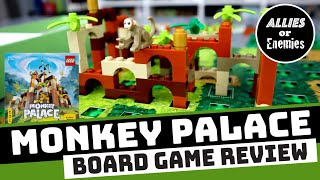
Monkey Palace represents LEGO's successful return to board gaming after previous missteps in the space. Reviewers across Watch It Played, Let's Table It, Going Analog, and Our Family Plays Games have praised the game as a genuine, strategy-rich experience that transcends its physical novelty. Rather than being a gimmick that exploits LEGO nostalgia, Monkey Palace delivers solid gameplay mechanics wrapped in a satisfying building experience. The consensus is strong: this is a well-designed game that happens to use LEGO pieces, not merely a vehicle for LEGO pieces.
Core Mechanics That Define Monkey Palace
Engine Building with Income Generation
Monkey Palace presents a sophisticated engine-building system where players invest in cards that provide both immediate benefits and ongoing resource generation. Each turn, players select cards to add to their tableau, which then generate specific building elements (arches, bricks, columns) every subsequent turn. This escalating income loop creates satisfying momentum as early-game investments pay dividends throughout the match. Reviewers noted the elegant flow of this system: players must balance acquiring cards that fuel near-term building with cards that score high victory points near the game's end.
Staircase Construction with Spatial Rewards
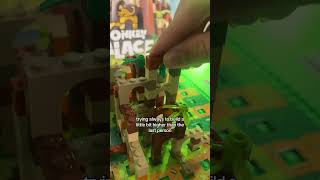
The core action involves building staircases from LEGO pieces on a shared board, with strict rules around height, connectivity, and direction. Players earn monkey credits based on the number of arches they place and bonus credits if their decorative brick is the tallest of its color anywhere on the board. What makes this mechanic shine is how it incentivizes both personal strategy and awareness of the developing structure. You must consider not just your own score but also the topology of what's been built, because your choices affect what heights are achievable and which colors matter most for future contributions.
The Monkey Palace Experience
Lavish, Tactile Building Satisfaction
Every reviewer emphasized the kinetic joy of physically assembling the palace with LEGO bricks. The production quality is evident: the components feel solid, the bricks lock together smoothly, and watching the structure grow turn-by-turn creates a shared aesthetic accomplishment. This tactile element transforms what could have been a purely abstract economic game into something with real presence at the table. Families reported laughing and celebrating as the palace took unexpected shapes, and even experienced gamers found themselves charmed by the process of construction.
Collaborative Beauty, Competitive Gameplay
A memorable observation from the Going Analog podcast noted that regardless of who wins or loses, the palace emerges as beautiful because everyone builds it together. This dual nature, where the board state is a shared aesthetic creation yet victory goes to a single player, gives the game an unusual emotional tone. Players can appreciate the collaborative artistry while maintaining real competitive tension over resources, placement strategy, and score. The game does not ask players to sacrifice one element for the other; both coexist throughout.
What Makes Monkey Palace Stand Out
LEGO as Meaningful Gameplay Component, Not Decoration
Reviewers stressed that the LEGO pieces directly drive core mechanics and scoring. They are not afterthoughts or production flourishes; height matters mechanically, color triggers specific card purchases, and the physical building contributes to income generation. This integration prevents Monkey Palace from feeling like a standard euro game with LEGO slapped on. Instead, the building is the game, creating a cohesive experience where theme and mechanics reinforce each other.
Accessible Depth with Multiple Decision Points
The game welcomes newer players through straightforward turn structure and clear rules, yet offers meaningful strategic decisions at every step. Players must decide when to prioritize staircase height, which colors to target, which cards to purchase at what cost, and how much to invest in engine building versus end-game scoring. Reviewers noted that casual players enjoy the satisfying building loop while serious strategists find room for optimization and forward planning. This accessibility-with-depth balance is rare in modern board games.
Potential Drawbacks
Card Availability and Luck Variance
One recurring observation concerned card availability during drafting. Some players noted that getting locked into specific colors or unable to access certain income-producing cards created frustration, particularly in four-player games. The available cards shift as other players make purchases, and unlucky timing can force suboptimal choices. While reviewers accepted this as part of the design, they acknowledged it introduces luck elements that some strategists find unsatisfying, particularly in longer plays where the compounded effect of weak card access becomes pronounced.
Limited Interaction and Potential for Solitaire Play
Reviewers observed that players can pursue largely independent strategies with minimal direct conflict. Everyone builds on the same shared structure, but your decisions rarely directly block or severely disadvantage opponents. The game rewards focus on your own tableau and card purchases rather than player interaction. While this suits families and casual groups, some competitive players found the experience resembled multiplayer solitaire more than head-to-head confrontation. The asymmetry in goals (personal engine versus public construction) can make the game feel less competitive than traditional euro-games.
If You Enjoy Monkey Palace
Players who appreciate Monkey Palace often gravitate toward Carcassonne for its tile-placement collaborative structure and Engine Building games like Splendor or Calico. Reviewers compared the building satisfaction to MouseTrap, though Monkey Palace delivers far more coherent gameplay alongside its construction appeal. For families seeking accessible strategy with kinetic joy, LEGO-themed games or dexterity/building games like those from the LEGO Games lineup would appeal. The Game Show also referenced the game as proof that LEGO could deliver meaningful board game experiences after the missteps of earlier attempts.
What Reviewers Are Saying
"This is a gorgeous box. It ends up really pretty. Whatever you build, no matter if you win or lose, it looks beautiful because you build it together."
— Going Analog
"Monkey Palace is a total hit at our house, all four of us enjoyed our play and are looking forward to playing again. There is a solid family weight engine building game here, at a perfect weight and play time for gamer families."
— Let's Table It
"Monkey Palace is a Lego board game where you are actually building and constructing pieces of a palace. You end up with this really cool collaborative structure every time you play that is always different. Super cool. It is a great introduction to concepts like engine building and figuring out how you want to set up your cards."
— Going Analog