/pic8273402.png)
The original version of Pecking Order is played with standard cards - one suit for each player and another to represent 13 perches. Players take turns playing a card at a perch; if a card is played where there is an opposing card, the lower card is discarded, with ties going to the defender. Only one of the cards is revealed - if the defender is already revealed the attacker remains hidden, otherwise the attacker is revealed. The only other rule is that the ace beats the king but is otherwise low. The player controlling the greatest total value of perches wins the game.
The boxed versions of the game have a number of changes:
Players have cards numbered 1-12 and a jaguar, which has special rules
There are only ten perches, three of which have special rules
The defending card is always revealed
A game consists of four rounds
In the 2024 version Monstrolicious, players lead teams of hungry monsters with one goal: to conquer the most tempting desserts from a lavish buffet.

- Reprint of Pecking Order with a changed flavor
- Monsters
- Pecking Order
Mechanics (from transcript analysis)
Video topics + discussion points
Quotes (from this video)
- If there was a Mount Rushmore of game designers he'd be on it, Mr. Richard Garfield.
- Well, the uh the original inspiration I was walking uh around Portland and saw some birds uh seagulls jockeying for posts and uh I began to um fantasize that uh that the birds were choosing the better posts and uh acquiring them based on the pecking order because one would fly up and either be pushed off or manage to take the post they were trying to land on.
- And uh I thought it might be an interesting opportunity to make a game like Strateggo, but only one person showed uh showed their piece and the other one said who won, thereby keeping some of the the mystery in the game and uh that's what I applied to this idea of pecking order.
- You kind of like take something that's typically done and you completely turn it on its head.
- I try a lot and uh and uh many many don't make it past uh casual play.
- In my opinion, there's been some recent good examples of what to do with the reprint.
- I don't typically do a lot of negative reviews. That game got a negative review for me.
- I feel like publishers try to do too much. I feel like they don't listen to what the people actually want.
- Old games uh games in general when they reach a certain quality level just stand up to a lifetime of replay and they there's no logical reason why they should expire.
- It's not that I don't care about themes. I do. Um I I don't uh but but I I I want them to resonate with whatever the mechanics are.
- I totally approve of that as a as as a way to play. That's the way I play. I find it very enjoyable to have those deductions on the table rather than to have to memorize them.
- The game the game worked really well, but it was positioned as sort of a heavier game than it should have been. It came in a in a bigger box than it needed to.
- With uh Spyet, I actually presented they they said they wanted to uh with Shadow Blades, they wanted to change the flavor to being uh instead of spies sort of set in a modern context, they changed it to uh Asian warriors uh Korean Asian warriors. And I I actually redesigned the entire game based on that.
- With uh Vanguard Exiles? It's on Steam with uh as in early release, so there's a long way to go, but uh but you can play head-to-head.
- I've tried to make auto battlers myself. Uh and uh they always felt when when I was working on them, they always felt like uh I I I they always stalled at this point where I said, "Oh, this is kind of fun, but you know what? It would be better on computer."
- Recently I played uh zombie kids with uh with my seven-year-old twins. And and this worked this worked really well is getting a legacy experience which was a you know which which worked for that age was marvelous.
References (from this video)
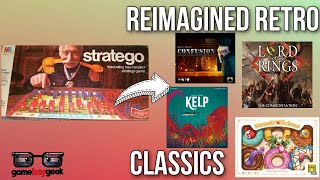
- Inspired by Strateggo
- Lots of bluffing and hidden information
- Monsters
- Strateggo
Mechanics (from transcript analysis)
- Area Control — Scoring is based on the number of points next to a monster at the end of the game.
- bluffing — Players can bluff about the numerical value of their placed tiles.
- Revealing information — Tiles are revealed when an opponent places a tile next to them, or through strategic actions.
- Tile Placement — Players place tiles face down.
Video topics + discussion points
Quotes (from this video)
- This is where we're taking a look at old classic board games, looking at the mechanisms of those games, and then seeing how those have been inspired and re-imagined into newer, more modern board games, sometimes even doing bigger, grandio things with those mechanisms.
- It is very strategike, but in reverse with lots of deduction.
- Strateggo is what pretty much inspired the mechanisms of this game.
- So, there's a lot of strateg strateges mechanisms here.
- So it's almost like Strateggo on steroids.