/pic2270443.jpg)






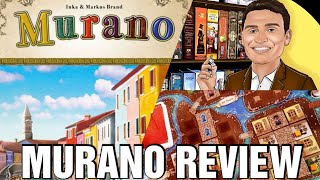


Murano Deep Dive
What the Community Thinks About Murano
Murano divides opinion in interesting ways. Channels like Getting Games and john gets games appreciate its clever shared-rondel system and Venetian setting, while Chairman of the Board ultimately soured on the luck of its objective-card draws. Most who play it recognize the mechanical cleverness of the gondola movement, yet some step away frustrated by card swinginess and board congestion. The result is a game that intrigues euro fans but does not land equally for everyone.
Core Mechanics That Define Murano
The Gondola Rondel System
At Murano's heart sits a shared rondel of neutral gondolas circling the island perimeter. On your turn, you select any gondola and move it forward. Moving one space is free; each additional space costs escalating coins. This creates a central tension: reach a distant action by paying heavily, or settle for a nearby option and preserve your meager budget. Money stays perpetually tight, forcing constant calculation about distance versus affordability. Because no player owns the boats, everyone shares them, which means everyone can block everyone else. When a boat occupies an action, that spot is unavailable until someone moves the boat away, creating natural traffic jams that make progress costly. Designed by Inka and Markus Brand and published by Lookout Games, this shared rondel is the game's signature.
Buildings, Income, and Hidden Objectives
Your core actions involve buying buildings, placing them on islands, and earning income by matching shops to customers on the roads. Glass factories let you draw valuable gem tokens to trade into coins. The true scoring engine, however, lives in hidden objective cards drawn throughout the game. These set goals tied to specific island configurations, and you must place gondoliers on the relevant islands to actually score them. This creates a forward-planning layer: draw cards, identify islands where you can build toward those conditions, and commit your limited gondoliers strategically.
The Murano Experience
Building an Engine Through Constraints
Murano makes you love money management. The income system rewards careful island development: build shops that match the customers already wandering the roads, then harvest coins during the income action. Early turns feel strained as you scrape together coins just to move boats. By mid-game, a well-developed island lets income flow freely, creating natural momentum. Special buildings unlock unique powers that stack satisfyingly, and watching your economy develop from paralyzed poverty to confident cash flow is deeply rewarding.
The Fluid Planning Problem
The game's flexibility cuts both ways. You do not commit your objective cards until the end, so plans can adapt as the board evolves. If one island becomes too crowded for your original strategy, you can pivot your gondoliers elsewhere. This responsiveness is elegant, but it also means constantly juggling scenarios and checking whether board changes break your plans. Even after placing a gondolier to lock in a card, other players can keep building on that island, throwing off the exact numbers you were targeting. The game rewards flexible thinkers and punishes those who overcommit to a single vision.
What Makes Murano Stand Out
A Shared Rondel with Real Interaction
Unlike most rondel games where each player has a personal token, Murano's neutral boats create genuine interaction. You cannot just move your own piece; you move communal boats to access actions. Blocking is built into the system without being explicitly adversarial. When the board gets congested, traffic jams near popular actions, and clearing that jam costs coins. The spatial puzzle of managing the shared boats creates moments where a single placement cascades into consequences for the whole table, keeping everyone engaged on every turn.
Islands as Strategic Playgrounds
The islands matter mechanically, not just thematically. Shops generate coins only when matched with customers, special buildings interact with your objective cards, and glass factories determine your gem-drawing potential. Building on the same island creates synergies, so a completed income engine on one island makes that space valuable for future objective scoring. Over time, your islands develop personalities: one becomes your glass powerhouse, another your shop-income hub. This spatial progression gives the game real board presence and strategic depth.
Potential Drawbacks
The Luck of Card Draws
The game's most persistent criticism centers on objective-card luck. You draw cards and choose among them, which offers some mitigation, but the drawn pool matters hugely. Draw a card that happens to match what you have already built, and you score big with little effort; draw cards that demand a different configuration, and you face painful pivots or wasted work. When a card aligns with your board by accident rather than by design, the satisfaction of earning those points evaporates, and for some players this swinginess undermines the careful planning the rest of the game rewards.
Congestion and the Expense of Movement
As the game progresses, boats cluster near popular actions, so reaching your desired action can suddenly require moving several boats at escalating cost. Early game, one free move plus a paid move usually suffices; mid-to-late game, you may spend many coins just to shuffle boats into position for an action that should be cheap. Some players find this a thematic reflection of Venetian canal traffic; others feel it is busywork that punishes otherwise efficient play.
If You Enjoy Murano
Players drawn to Murano often enjoy The Castles of Burgundy for its tile placement and objective-driven scoring with a gentler luck curve. Le Havre appeals to those who relish tight economic engine-building under constraint. Concordia offers another low-luck euro where positioning and forward planning dominate. And for players specifically drawn to rondel movement, Navegador delivers the classic form of the mechanism with a clean economic loop.
What Reviewers Are Saying
"The main thing I took away from it is that idea of trying to play the board as best as you can and match it with the objective cards you have. I like that you can collect these objective cards, but they're not set in stone, and you're not committing them until the very end."
— Chairman of the Board
"It's swingy and quite luck dependent, because that card mechanism did not do it for me. The swinginess of the cards is ultimately the reason I got rid of it."
— Chairman of the Board
"In Murano we once again have a neutral rondelle situation, much in the way that New York Zoo and Nova Luna did. There are boats going around this island, and they are all neutral, they aren't associated with any one particular player, and on your turn you're going to take one of these boats."
— john gets games