
























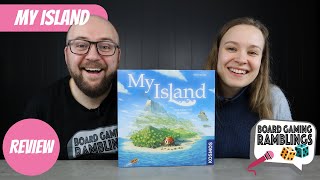










My Island Deep Dive
What the Community Thinks About My Island
My Island stands as a competitive legacy experience that challenges players to build their own unique island across 24 distinct games. Designed by legendary designer Reiner Knizia and published by KOSMOS, this 2023 release reimplements the successful My City franchise with an entirely fresh approach. Rather than placing tetromino-like polyominoes on a city grid, players now arrange connected hexagons across a deserted island. Reviewers consistently note that the game delivers on its promise of a completable, meaningful campaign that brings genuine satisfaction.
Core Mechanics That Define My Island
Polyomino Tile Placement on Personal Islands
At its heart, My Island is a spatial puzzle. Players draw hex-shaped polyominoes and must place them on their individual islands to score points through specific patterns: connecting landmarks, grouping colors, or fulfilling emerging objectives. The shapes themselves are deliberately restrictive. Tiles fit together in ways that create long-term spatial problems, forcing players to weigh immediate points against future board state. This creates the classic tension of legacy games where early decisions reverberate through later sessions in unexpected ways.
The 24-Game Campaign Arc
The campaign's true genius emerges through its structural design. Rather than introducing overwhelming complexity late, My Island gradually layers new rules and variant materials. Early chapters feel light and intuitive, allowing players to develop basic strategy. As the campaign progresses, chapters escalate in difficulty and novelty, keeping even experienced players engaged. The game respects player agency by allowing catch-up mechanics for those falling behind, ensuring that no single player can run away with an insurmountable lead through the full 24-game span.
The My Island Experience
Personal Islands Become Personal Stories
Every decision in My Island leaves a mark. Players permanently modify their islands through stickers, new rules specific to their board, and accumulated changes that stack across games. By the campaign's end, no two islands resemble each other. This system transforms what could be a generic tile-placement game into something deeply personal, where each player's island becomes a record of their strategic choices, lucky draws, and memorable moments. Paula Deming described the placement rules and tile shapes making filling in the map such a puzzle that it becomes genuinely absorbing.
Legacy Mechanics That Feel Natural
Unlike some legacy games that feel forced in their narrative delivery, My Island integrates its evolution seamlessly into the rules themselves. New mechanics don't arrive with heavy story exposition; they emerge because the island itself has changed. Players who engage with the hidden narrative elements will find satisfying discoveries, while those who focus purely on the puzzle will still have a complete and rewarding experience. Interestingly, reviewers have documented playing the entire campaign across distances, with players using separate copies on video calls.
What Makes My Island Stand Out
The Knizia Touch in Modern Legacy Design
Reiner Knizia's design philosophy shines throughout My Island. The game demonstrates elegant constraint where every element exists to serve the core puzzle. Rules clarity improves with each chapter as players grow more competent. The difficulty curve avoids the trap that catches many legacy games: becoming either trivial or impossibly punishing. Instead, My Island maintains a delicate balance where skilled play matters without creating runaway leaders.
Accessibility Without Sacrificing Depth
Each game plays in roughly 30 minutes, making it genuinely completable across a campaign, yet the permanent changes that accumulate ensure no two sessions feel identical. The polyomino-drafting system ensures players must make real choices rather than simply executing predetermined strategies. Before You Play noted that the pieces are all wooden and beautiful, and the campaign gets harder in satisfying ways as it progresses.
Potential Drawbacks
Late Campaign Intensity Spike
The final chapters do escalate in intensity, with new rules and materials that ensure late-game sessions feel quite different from early ones. One reviewer cautioned new players to expect the endgame to ramp up in complexity and number of simultaneous conditions to track. While this scaling feels earned rather than arbitrary, groups seeking consistently light play throughout may find the late campaign demanding.
Comparison to My City
For players familiar with the legacy genre and specifically My City, some reviewers noted that while My Island delivers a genuinely distinct experience rather than a reskin, they preferred the original. The hexagonal grid changes the spatial puzzle meaningfully, but the core loop of "draw tile, place tile, score" remains similar enough that groups who burned out on My City may feel less novelty than expected.
If You Enjoy My Island
Players who love My Island should explore My City, the predecessor that established Knizia's legacy polyomino format. Calico offers comparable spatial puzzle satisfaction without the legacy commitment. Clank Legacy provides a weightier legacy experience with deck-building mechanics. Wayfarers of the South Tigris appeals to those who enjoy campaign-style progression with strategic depth. For families seeking similar accessible legacy play, My City: Roll and Build delivers the same core experience in a roll-and-write format.
What Reviewers Are Saying
"I had such a good time playing this game. The placement rules and the shapes of the tiles make filling in your map such a puzzle."
— Paula Deming
"We've been really enjoying our plays of it. We've now played technically nine of the 24 games. It's getting harder, and it's just so satisfying. The pieces and everything are all wooden, it's so beautiful."
— Before You Play
"I did prefer My City over My Island but it did give similar vibes and the ramp up to the end was quite intense."
— kovray