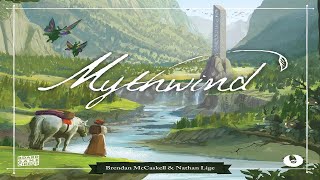









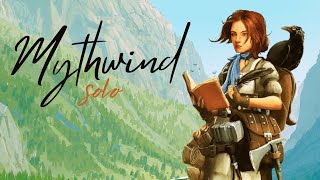


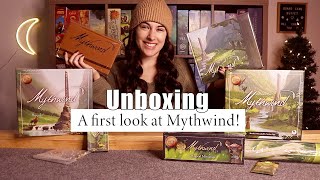
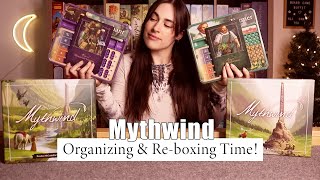
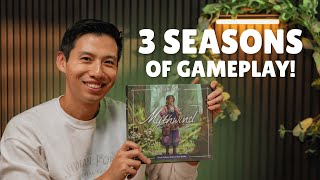

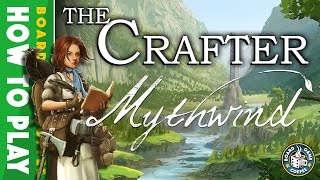

Mythwind is a cooperative & solo "cozy" board game with unique characters, magical sprites, engaging story and an unending adventure.
During the game, the characters are working together to establish and build a new town in the magical Mythwind Valley. They work to achieve various goals by constructing buildings within the town, adventuring throughout the region, navigating relationships with the mysterious sprites who inhabit the valley, and developing their character-specific professions.
As an open-ended game, Mythwind has no distinct conclusion. Although many players may find a natural end point to their game at the conclusion of the story, players can continue to play the game for as long as they would like over as many game sessions as they wish. As players progress through the game, their town will develop and grow, reacting to changing seasons and to the members of the community over time. Progress made can be easily saved using the provided game trays, which offer a quick and easy solution for both tear-down of the current game and setup of future games.
- Rich, cinematic solo playthrough experience with mood-setting visuals (candles, atmosphere)
- Deep, emergent gameplay through exploration, alignment, and building progression
- Varied character actions and the ability to switch characters between seasons encourages experimentation
- Complex rule set and teach-as-you-go approach may overwhelm new players
- Open-ended nature lacks a definitive ending or victory condition, which may be unsatisfying for some players
- Niche pacing requires a substantial time investment and commitment to a longer series
- campaign-style exploration, village-building, and sprite-villager diplomacy within a stylized fantasy setting
- Mythwind Valley, a developing frontier for human settlers guided by Sprite beings
- open-ended, season-based exploration with character-driven progression
- Stardew Valley
Mechanics (from transcript analysis)
- Action Queue — selected buildings enter a queue and advance toward completion to expand the town
- Alignment — choices during adventures and town actions align you with Villagers or Sprites, unlocking different opportunities
- Building queue — selected buildings enter a queue and advance toward completion to expand the town
- Events — weather cards and event cards inject variability that affects exploration and town planning
- Expedition — multi-card, multi-day exploration where inventory, tools, and alignment affect success and rewards
- Resource management — tracks for culture, income, production, and food are managed to enable builds and actions
- Resource tracks — tracks for culture, income, production, and food are managed to enable builds and actions
- Seasonal play — each play cycle (Spring/Summer etc.) consists of Dawn, Town, and Dusk phases with weather and events driving flow
- Stock and inventory — characters carry stock limited by capacity; tools, goods, and die-based actions interplay with expedition outcomes
- Stock holding — characters carry stock limited by capacity; tools, goods, and die-based actions interplay with expedition outcomes
- Weather and events — weather cards and event cards inject variability that affects exploration and town planning
Video topics + discussion points
Quotes (from this video)
- there is no ending to this game there are no victory points in this game you play this game until you don't want to play this game anymore
- the Ranger is the only character out of the four that has an option to not spend their day in town
- I'm going to teach as I go so as we go to each phase
- depending on how many people like this video, comment saying they want to see more and how much positive feedback I get from it
- the closest thing I could equate it to if you have played video games would be Stardew Valley
- it's been sitting on my table throughout the holidays I knew I wanted to wait for my vacation break
References (from this video)
- Two new characters add fresh puzzles and variety
- Puzzles are engaging and more interesting than base game
- High production value and easy setup/tear-down
- Herbalist’s spatial puzzle feels unique and refreshing
- Shepherd offers high complexity and satisfying crunch
- Solid solo-game experience with meaningful new interaction
- Limited multiplayer interaction; primarily a solo experience
- Video uses a prototype copy with non-final components
- Expansion does not drastically alter core mechanics beyond adding characters
- community-building, agriculture, and puzzle-driven progression within a lightly storied fantasy world
- Mythwind Valley, a pastoral fantasy world with seasons and weather influencing crops, livestock, and town development
- story-driven with character-centered threads and world events that unfold over seasons
- Mythwind base game
- Expanded Horizons expansion
Mechanics (from transcript analysis)
- Dawn/Day/Dusk phases — Rounds are divided into dawn, daytime, and dusk phases with phase-specific actions and effects
- Dog worker (shepherd) — The shepherd’s dog acts as a persistent helper with limited rest periods
- Equipment upgrades — Upgrading tools and gear is expensive and unlocks new capabilities
- Herbalist forest board — Forest tiles and a spatial mechanic determine ingredient gathering and backpack management
- Polyomino — Crop placement on personal boards forms growing patterns and unlocks abilities
- Polyomino-like crop placement — Crop placement on personal boards forms growing patterns and unlocks abilities
- Season progression and end condition — The weather deck cycles through seasons, eventually ending a season and advancing play
- Shared market track — A central market area tracks resources and progression for all players
- Tech trees — A building tree with prerequisites governs how towns and capabilities expand
- Town building prerequisites — A building tree with prerequisites governs how towns and capabilities expand
- Unique character boards — Each character has a distinct personal board and action sequence that shapes play
- Variable Phase Order — Rounds are divided into dawn, daytime, and dusk phases with phase-specific actions and effects
- Weather deck and seasonal bonuses — Weather cards set the daily backdrop; matching weather can grant bonuses or trigger events
Video topics + discussion points
Quotes (from this video)
- The Herbalist is genuinely my favorite puzzle out of all of them.
- I love the production value in this game. It's it's just my favorite.
- These two new characters that you can just straight up plug and play into the base game of Mythwind.
References (from this video)
- Calm, relaxing gameplay that rewards thoughtful planning without being punishing.
- Beautiful components and strong production value reinforces the cozy vibe.
- Deep interlocking systems (seasonal rules, building prerequisites, sprite/villager alignment) create meaningful decisions.
- Variety in character options and progression gives a sense of ongoing discovery.
- Can be crunchy for new players; the rule depth and multiple interacting systems may require a learning period.
- Solo playthroughs can feel lengthy as you explore multiple seasons and upgrades.
- Harvest, community-building, exploration, and resource management within a magical setting.
- Fantasy rural world with sprites, villagers, and seasonal cycles.
- Sandbox/engine-driven progression with evolving goals, events, and character choices.
Mechanics (from transcript analysis)
- adventure/scene cards — Adventures and encounters introduce risk and rewards, sometimes altering season goals or triggering special rules.
- alignment system — Player alignment with sprites or villagers influences action order and available options; hiring different dice ties to factions.
- building prerequisites and upgrades — Buildings require prerequisites and upgrade to unlock new actions and benefits; progression shapes player strategy.
- equipment and magic-like bonuses — Equipment upgrades grant new harvesting/planting capabilities and enhance actions, sometimes adjacent to plots.
- Events — Weather cards alter conditions; event cards add town actions, alignment effects, and narrative twists.
- Seasonal play — Seasons drive weather effects, actions, and strategic pacing; summer, spring, etc., influence available actions and events.
- sprite and villager actions — Actions are performed via workers (sprites and villagers) with a dice-based action system that determines available tasks each turn.
- tile/crop management and adjacency — Crops occupy fields and some upgrades affect adjacent crops or tiles; planting and tending must follow proximity rules.
- weather and event cards — Weather cards alter conditions; event cards add town actions, alignment effects, and narrative twists.
Video topics + discussion points
Quotes (from this video)
- Mythwind. Mythwind. I'm so excited.
- incredible game with incredible design, with incredible components
- the game design is so smart
- This is so relaxing. It's so chill.
- I love this game. I can't wait to play more of it
References (from this video)
- Rich, multi-layer engine that rewards planning and long-term progression.
- Clear sense of growth as buildings are built, items crafted, and goals completed.
- The crafter class offers a varied toolkit and interactions distinct from other classes.
- Rule clarifications are occasionally needed (e.g., extra goal draws and goal management mechanics).
- Some turns are densely packed with decisions, which may be daunting for newcomers.
- Reliance on draws can introduce luck components alongside heavy planning.
- Village-building and resource management with dice-driven actions, crafting progression, and quest/adventure elements.
- Fantasy valley with towers, sprites, traders, and seasonal cycles where a crafter character develops their settlement and explores tower-adjacent mysteries.
- Story-forward, light roleplay flavor with in-game events and character-driven dialogue.
Mechanics (from transcript analysis)
- adventure and event cards — Adventures trigger situational cards with choices and consequences, sometimes altering resources or aligning with factions.
- building prerequisites and tile placement — Constructing buildings requires prerequisites and slots; buildings grant income, culture, or other benefits.
- dice drafting — Characters use tiered dice (tower dice) to perform actions; dice values influence available worker actions and outcomes.
- Dice drafting / allocation — Characters use tiered dice (tower dice) to perform actions; dice values influence available worker actions and outcomes.
- dual-action system (character vs worker actions) — Character actions drive refining, crafting, and inventory; worker actions influence production, selling, and upgrading through a separate economy.
- Events — Adventures trigger situational cards with choices and consequences, sometimes altering resources or aligning with factions.
- resource bag and refinement — Materials are drawn from a bag and refined through levels to meet crafting goals and unlock higher-tier items.
- resource exchange / economy management — Resources (culture, food, etc.) can be exchanged or upgraded to meet goals or refine other items.
- Resource management — Resources (culture, food, etc.) can be exchanged or upgraded to meet goals or refine other items.
- seasonal progression and goal fulfillment — Seasons drive available actions and goals; completing goals can upgrade tiles or unlock new capacity.
- tile placement — Constructing buildings requires prerequisites and slots; buildings grant income, culture, or other benefits.
Video topics + discussion points
Quotes (from this video)
- I really want to play Mythwind.
- This tile is really nice. It's really great. I love it.
- Anna just loves to make boots.
- I think I prefer the crafter.
References (from this video)
- cozy fantasy theme
- strong solo-focus design
- innovative tray-based setup
- high production quality and minis
- expansion support and future content
- potentially heavy and lengthy for new players
- solo-focus may reduce interaction in multiplayer
- component complexity could be daunting for beginners
- cooperative village-building and exploration
- a magical valley inhabited by sprites
- story-driven with event and weather cards
- Clank!
- Storyfold the Wildwoods
Mechanics (from transcript analysis)
- Cooperative Game — players work together to build a village and progress through events
- cooperative_play — players work together to build a village and progress through events
- deck_of_event_cards — story elements and choices drive game progression
- Modular board — modular village tiles and locations are placed to form the town
- Resource management — manage crops, money, and goods for village development
- resource_management — manage crops, money, and goods for village development
- solo_play_emphasis — designed for solo play but supports multiplayer with limited interaction
- tile_and_board_construction — modular village tiles and locations are placed to form the town
- Track advancement — individual character trays store setup and progress for quick resume
- tray_based_progress_tracking — individual character trays store setup and progress for quick resume
- weather_cards — weather conditions influence actions and outcomes
Video topics + discussion points
Quotes (from this video)
- Open Owl Studio. They are doing some really cool new stuff.
- I'm going to read the town charter and follow the instructions on page 1 to 12.
- I want to play this right now.
- It's incredible.
- I can't wait to see what else they're going to do.
- This is a huge game.
References (from this video)
- Distinct asymmetrical characters with different play styles
- Excellent components and storage design, easy to pack away
- Strong solo play experience and replay potential via adventures
- Beautiful art, miniatures, and quality components
- Rule book dense with explanations and some repetition
- No explicit win condition may deter players seeking a goal-oriented game
- Some character interactions can slow multiplayer sessions
- Replayability can taper after several plays as adventures repeat
- Cozy, collaborative town growth with asymmetrical character play
- Fantasy forest town-building cooperative adventure
- Light, adventure-card driven progression with seasonal evolution
- Merchant's Cove
- Stardew Valley
- Harvest Moon
- Dorf Romantic
- Gloomhaven
- Root
Mechanics (from transcript analysis)
- Adventure cards — Branching scenarios that reward or penalize based on choices
- asymmetric character actions — Each character has a distinct playstyle shaping different paths to progress
- bag building — Bag-based refinement of goods to fulfill customer requests
- end game bonuses — End-of-season scoring and progress checks without a fixed win condition
- market and trading dynamics — Rival traders and weather influence supply/demand and opportunities
- Market Pricing/Manipulation — Rival traders and weather influence supply/demand and opportunities
- mini bag building — Bag-based refinement of goods to fulfill customer requests
- Narrative choice — Branching scenarios that reward or penalize based on choices
- Polyomino — Crops, tools and materials arranged through polyomino placement
- polyomino puzzle — Crops, tools and materials arranged through polyomino placement
- Resource management — Gaining resources to construct new buildings and upgrade capabilities
- Resource management and building — Gaining resources to construct new buildings and upgrade capabilities
- season-end effects — End-of-season scoring and progress checks without a fixed win condition
- town action selection — Daily actions for developing the town picked by players in unison
Video topics + discussion points
Quotes (from this video)
- this is a game for a specific kind of person
- it's for a very specific audience
- the ease of saving a game makes it really simple to bring out and keep playing
- no win condition; there isn't a win or lose
- the adventure cards are one of the most interesting parts
References (from this video)
- Open-ended solo play that emphasizes exploration, crafting, and atmosphere
- Asymmetric character options create varied play paths and replayability
- Integrated crafting, refinement, and reputation progression adds meaningful depth
- Strong thematic cohesion with sprite tribes, town development, and seasonal cycles
- Accessible at the surface while offering strategic decisions beneath
- Setup can be lengthy and the weather/event deck order is easy to misshuffle (as noted in the video)
- Rule depth and asymmetry may present a learning curve for new players or solo players
- Some turns can feel slow in solo mode due to the number of actions and checks required
- Crafting, community-building, resource refinement, and harmonious coexistence with nature
- A small town and surrounding forest during a seasonal cycle, with mystical sprite inhabitants and artisanal craft culture.
- Cozy, exploratory, non-competitive storytelling with open-ended progression
Mechanics (from transcript analysis)
- Adventures and encounters — Adventuring cards present choices and paths with resource costs and potential rewards, including encounters with sprites and terrain challenges.
- asymmetric character powers — Each character (e.g., crafter, farmer, merchant, ranger) has unique setup, actions, and goals that shape how you collect materials, refine goods, and fulfill requests.
- asymmetric player powers — Each character (e.g., crafter, farmer, merchant, ranger) has unique setup, actions, and goals that shape how you collect materials, refine goods, and fulfill requests.
- Events — A weather deck drives events daily; a spring tile with seasonal patterns can trigger events when patterns match. Weather and events influence available actions and goals.
- Refinement and inventory system — Materials have refinement levels (1–5). Players refine items, place materials into slots, and use refined goods to fulfill customer requests or craft skills. Inventory can hold unlimited materials.
- Resource management — Materials have refinement levels (1–5). Players refine items, place materials into slots, and use refined goods to fulfill customer requests or craft skills. Inventory can hold unlimited materials.
- Town actions and building queue — Players perform town actions to grow resources, discover lands, adventure, construct buildings, or use built structures to gain special actions. Buildings enter a queue before they are constructed.
- Weather, events, and season tiles — A weather deck drives events daily; a spring tile with seasonal patterns can trigger events when patterns match. Weather and events influence available actions and goals.
- Worker dice and action economy — Two types of workers (villagers and sprites) are used to take town actions, perform character actions, and manage resources. Dice sit in spots and represent available labor; players resolve actions by placing dice and triggering corresponding effects.
Video topics + discussion points
Quotes (from this video)
- it's open-ended and has no real conclusion
- it's meant to capture the feeling of those cozy video games
- there really isn't a whole lot of tension
- you just keep going until you feel like stopping
- the quiet, cozy vibe of Myth Wind makes it approachable for solo players
- the rules are taught on the go, which matches the exploratory nature of the game
References (from this video)
- Relaxing solo experience
- weather-driven decisions
- expansion adds social features
- No cons explicitly mentioned in the transcript
- life-simulation with weather effects
- medieval-fantasy farming town-building
- casual, cozy solo play with social expansion via expansion
Mechanics (from transcript analysis)
- production/farming — produce goods to earn money to develop town
- social expansion (expansion content) — new social features like marriage and kids
- Weather effects — weather influences crop tending and movement
Video topics + discussion points
Quotes (from this video)
- "weather in this game affects what you do"
- "Each character plays completely different and has their own unique deck"
- "Character building goes crazy in this game"
- "the rule book is heavy and it's a time investment"
- "The story is dark, but it's really well written and voiced."
References (from this video)
- stunning, high-quality artwork and minis
- deluxe components (metal coins, neoprene mat, velvet bags)
- journal-based open-world storytelling feel
- extensive content and robust expansion roadmap
- good solo and campaign play potential
- steep learning curve and complex rules
- long play sessions typical of campaign-style games
- heavy setup/organization due to many punch-outs
- some rules may require clarification in future expansions
- community growth, exploration, weather and season dynamics
- Open-world, cooperative village-building in a mythical realm
- open-ended, journal-driven world-building with emergent storytelling
- Animal Crossing
- Stardew Valley
- Castles of Burgundy
- Dragon Eclipse
Mechanics (from transcript analysis)
- Cooperative Game — Players work together to develop a village rather than compete.
- cooperative play — Players work together to develop a village rather than compete.
- event/card-driven interaction — Event and Adventure cards, weather tiles, and season tiles drive challenges and opportunities.
- Events — Event and Adventure cards, weather tiles, and season tiles drive challenges and opportunities.
- journal/record-keeping — Character journals capture lore, decisions, and storytelling progress.
- Modular board — Expansion content (Winds of Magic, Inkeeper) adds new buildings, cards and mechanics.
- modular expansions — Expansion content (Winds of Magic, Inkeeper) adds new buildings, cards and mechanics.
- open-world/world-building — Players explore a map and add to the world through actions, events, and weather-driven effects.
- role-based workers — Players assume roles (farmer, merchant, crafter, ranger; inkeeper in Horizons) with distinct actions.
Video topics + discussion points
Quotes (from this video)
- This is an open world game where you're going to be playing as pioneers building up their community.
- Animal Crossing and Stardew Valley vibes in a board game.
- This is like Animal Crossing in a board game.
- The art was amazingly done.
- I am not kidding, these miniatures are stunning.
- I think this would be a great solo game.
References (from this video)
- High satisfaction from a well-thought-out organization scheme; components fit neatly into labeled trays with clear separation by character and function.
- Premium, tactile components (including metal coins) and a color-coded system that visually communicates where each piece belongs, which enhances setup speed and gameplay clarity.
- Character journals and dials feel integral and are designed to minimize setup confusion, helping players focus on planning and strategy rather than rummaging for parts.
- Expansion content is visually and structurally integrated, making it feel like a cohesive ecosystem rather than a separate add-on, provided you have space to store it.
- The video demonstrates a meticulous, methodical approach to punching, sorting, and placing components—an approach many hobbyists will find motivational and educational.
- The host’s enthusiasm and detailed narration provide a motivational framework for players who enjoy deep prep work and immersion prior to gameplay.
- The sheer volume of punch-out components requires a significant upfront time investment to punch, sort, and organize, which may deter casual players.
- Some organizer placements are not immediately obvious; the speaker occasionally experiments and questions where items belong, which could be confusing for first-time organizers.
- There are more organizational slots than colors in some areas, potentially leading to ambiguity about where to place certain tokens until you become familiar with the system.
- When expansions are included, the base box lid lift can become crowded, prompting the need to store expansion contents separately or in a larger container.
- Initial organization can overshadow actual gameplay in a first viewing or session, making the video feel more like an unpack/organize guide than a playthrough.
- Filming constraints (e.g., occasional camera overheating) may interrupt the flow and takeaway from the otherwise detailed organizational content.
- Village-building and community development driven by character stories and evolving town relationships; a solo campaign that potentially supports multiple players jumping in and out.
- A mythical, frontier-like world where a village grows through the efforts of individual characters (Farmer, Merchant, Ranger, Crafter) and the town itself evolves over a campaign.
- Story-forward, character-driven progression with journal entries, events, and world-building cards that shape the ongoing campaign and town history.
- Castles of Burgundy
Mechanics (from transcript analysis)
- Card management and event ecosystem — A large assortment of cards (goods, market upgrades, event cards, gossip, customer and rival cards, expansion-specific cards) must be organized and tracked. These cards drive interactions, provide goals, and influence scoring, requiring careful organization and inventory management.
- Character-driven systems — Each of the four base characters (Farmer, Merchant, Ranger, Crafter) has a distinct board, journal, and set of dials. These components determine available actions, crafting possibilities, and resource flows, creating unique playstyles per character and a modular approach to campaign progression.
- Expansion integration and modular storage — The Winds of Magic expansion adds new buildings, weather tiles, and additional card decks. The design supports modular storage and expansion-compatible organization, enabling future growth without compromising base-game layout.
- Multi-use cards — A large assortment of cards (goods, market upgrades, event cards, gossip, customer and rival cards, expansion-specific cards) must be organized and tracked. These cards drive interactions, provide goals, and influence scoring, requiring careful organization and inventory management.
- resource and currency management — A mix of goods, coins, and resource tokens are tracked across multiple character-specific trays and global communal areas. Players manage these resources to fund crafting, town development, and market actions, with the potential for variable pricing and seasonal demand.
- Resource management — A mix of goods, coins, and resource tokens are tracked across multiple character-specific trays and global communal areas. Players manage these resources to fund crafting, town development, and market actions, with the potential for variable pricing and seasonal demand.
- Season/day cycle — The game references a day-night rhythm (morning, day, dusk) that influences action availability and pacing. This cycle creates natural rhythm for planning and performing actions, adding a tempo to the campaign similar to real-time/turn-based alternation without requiring a strict timer.
- tile placement — Players organize and place town-building components on a central board, using predefined zones and trays to represent different districts, buildings, and town growth. The setup emphasizes spatial planning and future placement options tied to narrative progression.
- Town/tile placement — Players organize and place town-building components on a central board, using predefined zones and trays to represent different districts, buildings, and town growth. The setup emphasizes spatial planning and future placement options tied to narrative progression.
Video topics + discussion points
Quotes (from this video)
- This is one of my favorite things to do with board games.
- I'm very excited to start playing Mythwind.
- Look at how nicely organized this is; this makes me extremely happy.
- The amount of event cards in this game is just astounding to me.
- I'm a huge fan of merchant-themed games.
- I love the color of the inkeeper board as well; it's adorable.
- Remember you are somebody's reason to smile.
References (from this video)
- Deep engine with balanced focus on foraging, upgrading, and town development, offering multiple viable paths to progression.
- Satisfying progression loops from backpack upgrades to powerful potion monetization, with tangible payoff on decision timing.
- Strong thematic cohesion between herbalist goals and greenhouse/resource management, reinforcing the role identity.
- Engaging pacing and tempo driven by season/weather cycles, which creates a rhythm that rewards planning and sequencing.
- Clear, expressive narration by the host that communicates strategy and decisions in a helpful, encouraging manner.
- Prototype charm plus a teaching moment about how the final component set might smooth out perceived rough edges.
- Complexity may be intimidating for newcomers; mastering the full ecosystem likely requires multiple sessions.
- Reliance on random tile draws and weather events introduces stochastic variance that can obscure player skill differences.
- Prototype components and balance appear rough in places; final production may tighten or adjust some interactions.
- Session length and depth could feel heavy for players preferring lighter, quicker playthroughs.
- The engine’s interdependence (e.g., needing both tool upgrades and greenhouse progression) can push players to pursue broad goals rather than specialization.
- Some terminology and rules require careful attention; beginners may need a dedicated tutorial or reference guide.
- Balance between exploration (forest foraging), resource management (production, culture, income), and engine-building (upgrades, items, and buildings) driven by seasonal cycles and weather.
- A mythic valley that cycles through seasons; a village-building sandbox where players forage in the forest, manage a town, and interact with sprites and villagers to upgrade and expand.
- Narrative-driven solo playthrough with light story beats and in-game lore cues, delivered through first-person commentary and descriptive flavor text during events and encounters.
Mechanics (from transcript analysis)
- Engine Building: Efficiency — Research cubes and specific ingredients buy equipment upgrades (e.g., Beginner's Gavvel, backpack, boots) that boost efficiency and unlock new actions.
- Equipment upgrades and research — Research cubes and specific ingredients buy equipment upgrades (e.g., Beginner's Gavvel, backpack, boots) that boost efficiency and unlock new actions.
- Exploration/adventure encounters — Town actions allow adventuring to discover new locations or encounter story prompts (e.g., magical creatures, hidden resources) that reshape goals and provide unexpected rewards.
- Resource economy — A multi-resource economy includes production, income, culture, food, and specialist cubes; upgrades convert smaller resources into high-value outputs, enabling big purchases.
- Resource management — A multi-resource economy includes production, income, culture, food, and specialist cubes; upgrades convert smaller resources into high-value outputs, enabling big purchases.
- Season/weather cycle — Dawn, daytime, dusk, and weather cards drive resource flows, events, and end-of-season cleanup; weather can trigger immediate effects or card-based bonuses.
- Sprite/villager dice mechanics — Dice govern actions; hiring sprites or villagers changes available actions and can grant free actions or improvements to dice values through specific events.
- tile placement — Drawing forest tiles and placing them to unlock ingredients; placement patterns influence which resources become available and how tiles deplete or replenish.
- Tile-drawing and placement in the forest — Drawing forest tiles and placing them to unlock ingredients; placement patterns influence which resources become available and how tiles deplete or replenish.
- Transmogrify and potion economy — Transmogrify allows converting ingredients into higher-value components; potions can be brewed for large coin rewards and research cube gains, creating a money-spike mechanic late-game.
- Village-building queue and construction — Buildings are constructed via a queue; upgrades to the queue reduce costs or unlock new abilities, and some weather effects allow near-instant construction completion.
- Worker/action spaces via forest, town, and mapping steps — Players choose actions across distinct locales to gather ingredients, discover tiles, upgrade gear, and build structures, with seasonal and weather-driven modifiers shaping output.
Video topics + discussion points
Quotes (from this video)
- The herbalist is all about balance.
- I love this engine.
- End of season actions just feel so satisfying when things finally click.
- This is a prototype, so the components you are seeing are early.
- Staying on schedule... the flow is incredibly efficient.
- The greenhouse gives you a lot of power early, but you have to balance it with other goals.
References (from this video)
Mechanics (from transcript analysis)
Video topics + discussion points
Quotes (from this video)
- Stardew Valley the board game can be played solo.
- This is literally the cozy farming game you can find in a board game.
- I 1000% recommend this one.
References (from this video)
- Beautiful presentation and art
- Well put together components
- Packs away quickly
- Lots of content and unlockables
- Tech tree allows unique villages
- Multiple characters to master
- Too slow/glacial pacing for reviewer
- No tension or drama
- Self-contained sterile experience
- Character variety doesn't interact
- Repetitive grind without narrative payoff
- Not for players who don't enjoy cozy games
- Cozy game
- Village building
- Fantasy
- Seasons
- Community
- Stari
- Merchants
Mechanics (from transcript analysis)
- Character development
- event cards
- Events
- Unique player powers
- Variable player powers
- worker placement
Video topics + discussion points
Quotes (from this video)
- This is the Undisputed king of light war games
- The order system Nails this ambiguity perfectly
- Earth is an engine Builder's Delight
- It's a brilliant game for couples
- Cascadia is in many ways a perfect game
- Too comfy for me
- Wormspan is a tight engine building game
- Most delightful and pleasant games available
References (from this video)
- Extensive component variety and tactile appeal (miniatures, coins, art book, journal)
- Solid, attractive storage trays and organization that keep components sorted
- Beautiful art and sculpted minis that fit the theme without immediate painting need
- Open-ended, asymmetric co-op design with distinct character roles and goals
- Expansions like Winds of Magic offer additional content and replayability
- High setup complexity due to many components and multiple boards
- Sleeving cards may require additional storage beyond the core box/ Kickstarter extras
- Rule clarity can be challenging without playing the game (narrator notes learning curves)
- Box space constraint may limit sleeving and future storage without extra boxes or organizers
- adventure, pioneer settlement, cooperative town-building
- a wisal fantasy setting
- open-ended, sandbox exploration
- Nemesis
Mechanics (from transcript analysis)
- adventure_and_event_decks — adventure deck and event cards drive scenarios; envelopes introduce progression
- asymmetric_cooperative_play — each player controls a distinct character and collaborates to achieve shared goals
- character_boards_and_rules — each character has unique rules and abilities; four core classes with varying complexity
- dice_mechanics — sprite dice and worker dice are rolled to resolve actions and outcomes
- end game bonuses — starting goals and ongoing objectives guide play; top-of-deck reveals end conditions
- Events — adventure deck and event cards drive scenarios; envelopes introduce progression
- expansion_integration — winds_of_magic expansion adds new tiles, weather templates, buildings and events
- expeditions_and_stock_management — ranger expeditions and stock cards determine exploration outcomes
- goal_cards_and_endgame — starting goals and ongoing objectives guide play; top-of-deck reveals end conditions
- Resource management — plant, tend, harvest crops and manage livestock for income and skills
- resource_and_crop_management — plant, tend, harvest crops and manage livestock for income and skills
- season_and_weather_cards — weather and season cards influence actions and resource generation
- town_building_and_upgrade — players build and upgrade town buildings to unlock new abilities and resources
Video topics + discussion points
Quotes (from this video)
- these Miniatures are amazing
- Colin's going to be doing a playthrough of this game
- I almost don't want to give it back to I just want to kind of hold it hostage
References (from this video)
- very inviting for long-term campaigns
- engaging world-building and customization
- great for fans of sandbox/open-ended experiences
- ambitious scope can be daunting for new players
- long-term commitment may deter casual sessions
- exploration, settlement-building, sprites and villagers
- open-ended fantasy adventure world with continuous exploration
- open-ended, sandbox-style adventure without a defined ending
Mechanics (from transcript analysis)
- no-ending design — an ongoing, endlessly expandable play cycle
- Open-world exploration — players explore an evolving world with events and encounters
- village-building / sprite utilization — build up settlements and recruit helpers to progress
Video topics + discussion points
Quotes (from this video)
- this game was made for me it's like playing out lord of rings
- it's massive
- easy to learn hard to master
- it's like three little mini gamess within a game
- I freaking loved it
- it's a heavier game but everything makes sense
- I knocked it down every single time but I don't even care
- open Adventure game with no ending you can just play it infinitely expor you're exploring the world
- look no further it's the perfect combination
- I love dexterity games like they're just puzzly in like a fun way
- it's a straight up push your luck game with a Walking Dead theme
- I freaking love it
- it's a perfect travel game
- it's so so so good
References (from this video)
- strong openness and narrative freedom
- light-to-moderate rules for quick play
- newer title with less established support
- rule clarity can be spotty
- myth-based storytelling with flexible paths
- open-world fantasy adventure
- short stories and location-based choices
- Lands of Gaer
- Fields of Arle
Mechanics (from transcript analysis)
- flexible routes to goals — players choose how to pursue victory through paths
- story cards and branching choices — narrative arcs determined by location and card draws
Video topics + discussion points
Quotes (from this video)
- the daddy of the sandbox genre
- you basically drop into the middle of this Galaxy with a ship and go do what you like
- it's a sandbox Euro that a lot of people are aware of
References (from this video)
- Attractive presentation and compact storage
- Extensive content with unlockables and milestones
- Solid solo mode and low-stress play
- Ranger character can be enjoyable to master
- Pace is glacial; lacks sustained tension or drama
- Feels self-contained and somewhat sterile in character variety
- Overall loop can feel repetitious for some players
- village-building, community development, character progression
- Valley of Mythwind, a cozy fantasy village setting
- season-based progression with modular events and evolving characters
- Stardew Valley
- Merchants Cove
Mechanics (from transcript analysis)
- Adventure cards — draw and resolve adventure cards for additional effects and timing
- Character boards and alignment — each character has unique turn rules; actions depend on sprite/townsfolk alignment
- Die/pip resource management — actions cost pips from dice; dice can be earned and rerolled during play
- Events — draw a weather card each day; certain weather patterns trigger immediate event effects
- Resource tracks and building placement — spend resources to develop village tracks and place/build buildings on the map
- Season cards and weather/events — draw a weather card each day; certain weather patterns trigger immediate event effects
- worker placement — place a worker each day on exclusive locations to gain benefits
Video topics + discussion points
Quotes (from this video)
- I felt the pace of the game was glacial
- mythwind too comfy for me
- the best thing about this game is its presentation, it looks good, is very well put together and packs away quickly
- it's a cozy game
- for solo Gamers or couples who want a nice, low stress, low drama activity to do