/pic6092680.jpg)
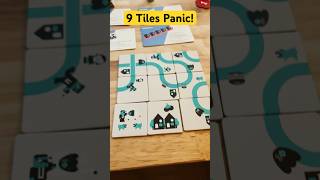
In Nine Tiles Panic (ナインタイル パニック), each player has a set of nine double-sided town tiles.
At the start of a round, three scoring cards are revealed, such as most aliens on a single road, most dogs visible, or longest road. All player then race to assemble their town in whatever pattern seems best, trying to score points for one, two, or three of the scoring cards as they wish. As soon as the first player decides that they're done, they flip the sand timer and everyone else has 90 seconds to complete their town, then players determine who scores for which cards, with ties being broken in favor of whoever finished first. Players score points based on the number of players in the game, and players track their score on a chart over multiple rounds.


- Strange and quirky theme
- Retro feel
- Puzzly and cool
- Quick decision making
- Optimizing tile use
- Burger loving aliens
Mechanics (from transcript analysis)
- Pattern Building — Players arrange tiles to fulfill objectives such as having roads of a certain length or adjacent tiles.
- Set Collection — Players build a city that fulfills themed objectives by collecting sets of tiles or features.
- Tile Placement — Players arrange nine double-sided tiles in a three by three grid.
Video topics + discussion points
Quotes (from this video)
- I always loved discovering board games with a strange and quirky theme
References (from this video)
- Short playtime (~20 minutes)
- Engaging, theme-driven decision making
- Simple core mechanic with tactical depth
- Clear scoring via theme cards
- Flexible tile orientation and grid rules
- Initial setup and theme card understanding can be challenging
- First few games may feel difficult due to rules learning
- Timer pressure may be stressful for casual players
- Aliens, agents, and other town elements reorganized to meet scoring themes
- Town-building with themed cards set in a whimsical, alien-invasion scenario
- light, thematic puzzle with a quirky, sci-fi flavor
Mechanics (from transcript analysis)
- Action Timer — A time pressure mechanic where a timer constrains how many points can be scored per round and signals end of round.
- Capture/placement rules for aliens and agents — Certain tiles and units must be positioned to satisfy capture criteria (e.g., agent on same road as alien, facing alien).
- Compound Scoring — Each theme card awards points to players based on ranking and round completion; incomplete themes score nothing.
- double-sided tiles with rotation — Tiles can be placed on either side and rotated; sides cannot be mixed.
- end-of-round and tie-break rules — Rounds score; ties broken by lowest turn order marker; final winner determined by most points.
- Road connectivity constraint — Roads must connect to adjacent tiles or exit the town; dead ends are invalid.
- Scoring by themes and round completion — Each theme card awards points to players based on ranking and round completion; incomplete themes score nothing.
- Sun timer / hourglass timer — A time pressure mechanic where a timer constrains how many points can be scored per round and signals end of round.
- Themed card objectives — Each round has three theme cards that define scoring criteria.
- Tile Placement — Players place town tiles to form a complete grid following specific adjacency and road connectivity rules.
- tile placement on a 3x3 grid — Players place town tiles to form a complete grid following specific adjacency and road connectivity rules.
- Turn order drafting via tile pick — The player who takes the lowest-numbered tile gains first pick order; turns progress accordingly.
- Turn Order: Draft — The player who takes the lowest-numbered tile gains first pick order; turns progress accordingly.
Video topics + discussion points
Quotes (from this video)
- you're racing against the clock and your opponents to arrange the nine tiles in the town to best meet as many of the three themes of the round as possible to score points
- the town tiles are double-sided neither side can be used
- the symbols are agents alien dog hamburger citizen house and UFO
- roads must be connected to roads on an adjacent tile or lead out of town
- the winner needs 20 points
- it's still a tie they play with the lowest turn order token in the last round will win
References (from this video)

- Chaotic fun
- Fast, quick to play
- Engaging tile-laying and pattern-building mechanics
- Artwork described as cute
- Time pressure can be stressful for some players
- Compared to the older variant, fewer variations in artwork (per transcript) and play feel
- alien invasion and pursuit to capture aliens
- Earth with burger-loving aliens having arrived and eating all of our burgers
- rules and world-building concepts discussed while laying tiles to connect worlds
- 9 Tiles
Mechanics (from transcript analysis)
- connecting worlds / joining rules — reading the rules of joining worlds together
- double-sided tiles with rotation — tiles are double-sided and can be oriented in any way
- Limited Points — points awarded and the round ends when someone reaches a threshold (points depend on the number of players)
- Pattern Building — mechanics such as pattern building are mentioned as core activity
- points and end-game timing — points awarded and the round ends when someone reaches a threshold (points depend on the number of players)
- Simultaneous Actions — tiles are laid simultaneously by players
- Simultaneous Play — tiles are laid simultaneously by players
- tile laying — players lay tiles to complete their patterns and objectives
Video topics + discussion points
Quotes (from this video)
- the tiles are double-sided and can be put in any orientation
- they earn nine times as quickly as possible
- the game is quick
- the artwork is definitely cuter
- chaotic fun
- stressful families
- same publishers has a similar feel sweet but different artwork less variations