/pic3328269.jpg)
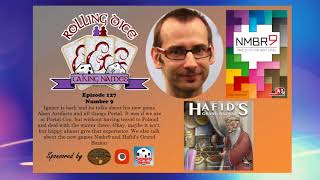
Numbers aren't worth anything in NMBR 9 unless they're off the ground floor and looking down from above.
The game includes twenty cards numbered 0-9 twice and eighty tiles numbered 0-9; each number tile is composed of squares in some arrangement. After shuffling the deck of cards, draw and reveal the first card. Each player takes a number tile matching the card and places it on the table. With each new card drawn after that, each player takes the appropriate number tile, then adds it to the tiles that they already have in play, with each player building their own arrangement of tiles.
The new tile must touch at least one other tile on the same level along one side of a square. A tile can also be placed on top of two or more other tiles as long as no part of the new tile overhangs the tiles below it; new tiles placed on this same level must touch at least one other tile, while also covering parts of at least two tiles and not overhanging.
Once all the cards have been drawn and the tiles placed, players take turns calculating their score. A tile on the bottom level — the 0th level, if you will — scores 0 points; a tile on the 1st level above this is worth as many points as the number on the tile; a tile on the 2nd level is worth twice the number on the tile; etc. Whoever scores the most points wins!

NMBR 9 Review - JonGetsGames
- Simple rules, easy to teach
- Quick setup and teardown
- Good for casual gamers and puzzle lovers
- Portable and can be combined for more players
- Can be frustrating due to odd tile shapes and strict placement rules
- numbers as building blocks
Mechanics (from transcript analysis)
- Pattern Building — Players must place tiles to form a solid foundation, ensuring no air gaps underneath, which involves careful pattern recognition and planning.
- simultaneous action — Everyone works with the exact same number each turn as a card is flipped over, allowing for parallel play.
- Tile Placement — Players take numbered tiles and place them to build layers, scoring points based on height and tile value.
Video topics + discussion points
Quotes (from this video)
- I was so excited to get some shrink wrap off of some games yes and then have to go through the part of opening up Rule books and trying to read rules and then teach rules to all these new games which that's becoming a chore for me it really is.
- The way you deal damage is just like it was with crossfire so everybody basically has a start the deck of cards cleric screen rogues red mages blue and martial arts the fighter is black and the encounters that you have to deal damage based on color.
- You cannot go wrong when there is a game that has an appetizer in it.
- It wasn't anything that I couldn't overcome I understood you know just got play the colors go do the deck building it was very simple from that simple but one thing that threw me off was that event deck.
- I am trying my best to teach it and I can just look across the table everybody's like yeah whatever and I'm like okay huh face grand bazarre.
- It's like oh my gosh Makris gonna teach a game we're not gonna learn it he's gonna screw up the rules and there's this negativity out there and so yeah I am discounted for trying.
- Ignasi is standing right there with an incredible shirt of first Martian where'd you get that so sweet look at those like yeah there was a gift from Erin especially for the show.
- Basically it is a one whole period of pain and frustration and I strongly this no no don't do it don't don't go this path.
- So everybody across the world can watch yes we did it two years ago and last year we did it we didn't do this we definitely shouldn't do this so I totally agree yes yeah cool and I'm kind of curious how difficult is it for a non polish speaking individual to attempt portal con is it going to would it be like terrible no we each year we have couple of our fans from the from the Europe flight tickets in Europe are not that expensive so coming from for a poor token from Italy or from Germany or from the Spain he's not that big a cost and for these players is a one day filled with absolutely craziness about the portal games or people playing portal games games most of our fans speak English fluently because they are gamers so of course they use BoardGameGeek of course they listen to the podcast over so they are fluent in English so there's no problems playing games and as I mentioned like for the for the people's hardcore fans of portal games from German or of France or Italy there is not a big deal to come to us so every single proton we have a couple of people from different countries.
- No you don't say Michael's gonna do anything bad or anything like that but just like what could it be I was pleasantly surprised because he sent us these treats that I had heard people talk about before called well it looks like I said stroopwafels but they're Dutch treats so I assume they're pronounced strip strip waffle or something like that just stop just stop don't embarrass just I'm trying to be correct here okay I don't say it's stroopwafel okay fine anyway.
References (from this video)

Mechanics (from transcript analysis)
Video topics + discussion points
Quotes (from this video)
- go to the link in the description to grab yourself a free ticket
- we're hosting a meet up
References (from this video)

- Very easy to learn and teach.
- Quick playtime.
- Appeals to a broad audience.
- High player count possible with multiple copies.
- Rules regarding overlapping and overhang can be strict.
- Publisher and year not specified.
- tile laying puzzle
Mechanics (from transcript analysis)
- Layering — On higher levels, tiles must overlap previously placed tiles.
- Pattern Building — Tiles must be placed adjacent to existing tiles and follow placement rules.
- Simultaneous action selection — All players place the same tile revealed by a card each turn.
- Tile Placement — Players place polyomino tiles onto their personal board.
Video topics + discussion points
Quotes (from this video)
- There's something so satisfying about fitting the pieces in together and filling in this space
- It feels like Tetris but a board game but it's Unique
- that's half the fun of you know castles of mading lug is I think it'll fit there does it oh it doesn't oh you know that kind of thing
- it is a dry dark black Euro
- easy to learn and hard to master
- It just has the basic Tetris like pie love
- I just love the Wild West theme in general
- there's just so many things to do here
- Patchwork can be a really Cutthroat game of trying to deny the other player the pieces they need while also trying to get the pieces that you need
- it is actually kind of fun to debate where things in your vacation took place
- it's a rare polyomino game that has a theme and the theme actually works
- that game is going to be miabi it is a polyomino game where you are drafting polyomino tiles and creating your own zen garden
References (from this video)
- Junk Drawer
Mechanics (from transcript analysis)
- scoring — The scoring is fairly easy to explain but sometimes it's a little bit tricky cuz you the first layer is zero.
- Simultaneous Play — It's simultaneous play one card is flipped everybody's going at the same time.
Video topics + discussion points
Quotes (from this video)
- A Feast for Odin was a close second of mine actually for this category
- The Magnificent now the reason I chose this one for strategy is because every turn matters so much but not in a punishing way I found like you can still make do and have a lot of various things of strategy of what you can do so it feels good every turn but it feels extra good when you make things work the way that you need them to work or the where the star is align and you have that perfect turn
- what absolutely won this one over for me actually won not huge into the the wild west wild west is definitely not a theme I gravitate towards not at all uh but I think the animals made this one tolerable
- the thing that absolutely won this game won the best them for in this game for me is is the bullets turning into tombstones yeah I think that is such a whoever came up with that genius because it's so funny too of like you go bang bang and then the bullets fly and then they are Tombstone yeah yeah and then they just flip up it as a tombstone and it feels so thematic
- My game with the best theme is actually in the Hall of the Mountain King
- I feel like a lot of polyomino games are not very fantasy themed a lot of them are very like practical that's true maybe that's what it was and I think this one does really stand out in that cuz it does it feels really different than a lot of the rest
References (from this video)

- great game
- one of the best polyomino games ever made
- boring theme
- The number nine
Mechanics (from transcript analysis)
Video topics + discussion points
Quotes (from this video)
- I will cry if it gets me points.
- The judge's rule is final.
- Bring me the most off-putting box cover.
- Bring me the coolest component.
- Bring me the game with the best player colors.
- Bring me the thing I would least like to step on.
- Bring me the game I'd most like to play right now.
- Bring me the thing with the best sound.
- Bring me the game with the most boring theme.
- Bring me the best game I can fit in my pocket.
- Bring me the card that would make the best tattoo.
References (from this video)

- Good game
Mechanics (from transcript analysis)
- number placement — number placement
Video topics + discussion points
Quotes (from this video)
- Ohoy there, YouTube. I'm back again for some more board game content.
- It is December 9th, 2025, and I'm going to go over 60 games under $30 right now on Amazon that I can recommend to you because I already know they're good to great.
- This game is incredibly difficult, that's why it's down here. It feels borderline impossible.
- People are gonna be yelling at each other and you're gonna be really stumped, but in a good way.
- This is Forbidden Island. This is a fantastic familyweight cooperative game. It's a great gateway cooperative game.
- It comes in this big metal tin which most most of the time a lot of people aren't a fan of
References (from this video)

- Fun and simple game.
- Scales up to play with more people.
- Quick game length.
- Interesting scoring mechanism.
- Shapes can be difficult to work with to make stacks higher without gaps.
Mechanics (from transcript analysis)
- Card Drafting — Flipping a card determines the number to be placed.
- Scoring Multiplier — The value of a number is multiplied by its level (height on the board).
- Stacking — Numbers can be placed in layers on top of each other.
- Tile Placement — Numbers are placed on a board, building upwards in layers.
Video topics + discussion points
Quotes (from this video)
- I feel like even though this is a not it's not an old game it's a like the last five four five years it feels like a classic to me
- this is almost some more fun multiplayer Patchwork
- emptying the cooler emptying the cooler
- this is one of the fastest Legacy games I think we finished
- my favorite Parts is you have bullets and when you shoot the Banis they become tombstones
- the mechanics in this game blew me away
- I love seeing the world wonders on the board the they're just so pretty and they're so vibrant
- auction games are not really my thing this is like a nice little like push into the auction space where it is very important to get your stuff but you don't get left in an unfortunate space of not being able to do anything
References (from this video)

- fast teaching time
- puzzle invites thinking about future numbers
- beautiful components (large tiles, nice insert)
- quick setup and getting to the table
- emotional investment and sense of ownership over decisions
- one-trick pony, mainly stacking tiles
- zero player interaction
- below-average variability (deck-driven)
- box space is somewhat wasted; box could be smaller
- Karuba
Mechanics (from transcript analysis)
- deck reveal and shared selection — a 20-card deck is shuffled; the top card is drawn and everyone takes the tile with that number, repeated until all cards are drawn.
- stacking and level scoring — tiles can be stacked on top of others; a tile's points are its printed value multiplied by its level.
- Tile Placement — tiles are made up of small squares; when placing a tile adjacent to other tiles, at least two of these squares must be orthogonally adjacent.
Video topics + discussion points
Quotes (from this video)
- It's a one-trick pony game where you're just stacking tiles on top of each other and sliding them in amongst the other ones on their given levels.
- Incredibly fast teaching time.
- It's a really good-look game with a slightly large box.
- This is a beautiful game.
- I really recommend this game.
References (from this video)
- Simple rules with satisfying high-variance scoring
- Interesting stacking dynamic and risk-reward decisions
- polyomino shapes that correspond to numbers 0-9
- Realm of Sand
- Patchwork
- Cottage Garden
- Indian Summer
- Spring Meadow
Mechanics (from transcript analysis)
- card-driven number reveal — shuffle and reveal a card with a number; players place a corresponding polyomino piece
- placement with no holes underneath — tiles can be placed flat on the table or stacked, as long as no holes remain beneath
- scoring by stacking height — a tile's points equal its number times the height of the stack it sits on
Video topics + discussion points
Quotes (from this video)
- Isle of cats is a brilliant polyomino style game.
- patchwork made polyominoes explode onto the board gaming scene
- I love cats