


















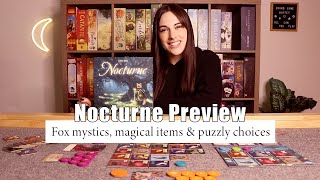




Nocturne Deep Dive
What the Community Thinks About Nocturne
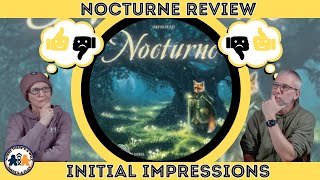
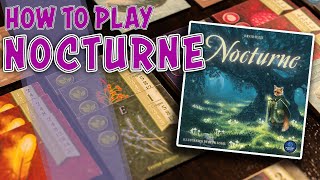
Nocturne has impressed the gaming community as a refreshingly unique entry in the Flatout Games lineup. Reviewers consistently celebrate its spatial bidding mechanic, which sets it apart from the studio's other titles while maintaining the beautiful aesthetic and puzzle-forward design they've become known for. The game strikes a balance between accessibility and strategic depth, though reviewers acknowledge it demands careful planning and multiple plays to fully master. Most agree that Nocturne shines brightest in multiplayer settings, where the bidding tension and player interaction reach their peak.
Core Mechanics That Define Nocturne
Spatial Bidding and Token Placement
The heart of Nocturne is its distinctive spatial bidding system. Players place numbered spell tokens onto tiles in a snake-like pattern, with each subsequent token placed orthogonally adjacent to the previous one and must have a higher value. This creates a deeply tactical dance where you're not just bidding for the tile you want, but strategically placing bids on tiles you might not even care about to control the board's flow. Reviewers found this mechanic ingenious because it forces players to anticipate both what others want and what paths they'll create. The genius lies in its efficiency: by choosing where to place your bid, you simultaneously claim tiles, block opponents, and shape future bidding opportunities.
Set Collection Through Diverse Tile Types
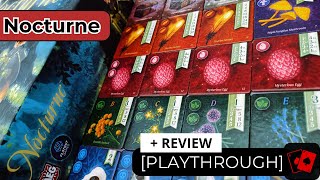
Once tiles are claimed, the real puzzle emerges. Nocturne contains multiple tile types that score in different ways: feather tiles reward accumulation, mushrooms have threshold-based scoring (worthless at two, valuable at three), herbs offer point bonuses for variety, and mysterious eggs score based on majority. Concoction cards layer additional set-collection goals on top, requiring specific icon combinations for bonus points. Reviewers appreciated how these diverse systems interact without feeling bloated, creating multiple valid paths to victory while rewarding players who focus on specific strategies.
The Nocturne Experience
Tense, Interactive Bidding at the Table
The spatial bidding creates a palpable tension at the table. Reviewers repeatedly mentioned the back-and-forth nature of deciding whether to raise the bid, block a rival, or pass entirely. Each decision ripples outward, affecting not just the current tile but the shape of future turns. Players must read their opponents, anticipate chains of moves, and execute corner casts (winning isolated tiles with a single token). This creates a game experience where outsmarting your opponents feels as important as optimizing your own tableau.
Strategic Depth Across Two Distinct Phases
The Twilight and Moonlight rounds feel like two different strategic challenges. In Twilight, you're exploring and racing to complete public goals first. In Moonlight, with full information about available tiles, you're calculating precisely which items you need most and how many bidding tokens will get you there. Reviewers found this transition particularly elegant, as it reshapes decision-making without requiring new rules. The shift from discovery to optimization creates natural pacing and keeps the strategy fresh across both rounds.
What Makes Nocturne Stand Out
Unique Spatial Bidding Among Flatout Games Titles
Reviewers consistently noted that while Calico, Cascadia, and Verdant all emphasize puzzle-solving and pattern recognition, Nocturne pivots to player interaction and bidding. This doesn't make it better or worse, but it is distinctly different. The spatial element elevates bidding beyond traditional auction games by making tile placement as crucial as the values on the tokens themselves. Multiple reviewers expressed genuine excitement about experiencing a mechanically fresh entry in a series they already loved.
Gorgeous Production and Table Presence
Beth Sobel's artwork and component design create a genuinely beautiful game. The translucent card design, the fox mystic characters with their unique names and asymmetric abilities, and the overall nocturnal forest aesthetic all contribute to table presence that makes players want to reach for the game. Reviewers were unanimous that the presentation draws people in, even if the theme itself doesn't carry through the mechanical experience.
Potential Drawbacks
High Cognitive Load and Scoring Complexity
The interaction between concoction cards, tile-based set collection, goal cards, and mushroom thresholds creates substantial mental overhead. Reviewers noted that newer players often feel overwhelmed tracking all scoring opportunities simultaneously. The game demands multiple plays before players internalize optimal strategies, particularly around which icon combinations to pursue. One reviewer explicitly stated the game feels busier than might initially appear, requiring competitive players to track opponents' token pools, available goals, and future board states all at once.
Best at Higher Player Counts, Struggling at One or Two
Multiple reviewers were explicit that Nocturne plays better at three or four players than at one or two. In solo mode, the AI system is simple and the puzzle loses some bite. In two-player games, the dynamic feels more like a head-to-head puzzle than the chaotic, multi-directional bidding that makes multiplayer games exciting. One reviewer found themselves reaching for Calico or Cascadia when they wanted a solo experience, suggesting Nocturne's strengths lie specifically in group play dynamics.
If You Enjoy Nocturne
If Nocturne captures you, explore the rest of the Flatout Games catalog for different flavors of puzzle-driven gaming. Calico offers tile-laying pattern building with a cozy, pastoral feel. Cascadia delivers habitat-building with elegant auction mechanics and remains a standout in the lineup. Verdant focuses on plant cultivation through restricted tableau-building. Fit to Print brings real-time energy and grab-and-go chaos to a newspaper-building theme. Each offers a distinct experience, though none quite match Nocturne's emphasis on spatial interaction and open bidding.
What Reviewers Are Saying
"The binning in the spatial way is so clever because you're always seeing the paths that you're able to build and maybe prevent people from getting some of the tiles that you want by bidding lower potentially on them, cuz the tiles that you bid on people can't take or bid for until the next turn."
— kovray
"I really really like nocturn I think there's a lot to like with that open bidding with the open information I love the back and forth if I do this then they're going to do that then they're going to walk over here and then I can maybe do a corner casting."
— Tabletop Tolson
"It was different from what Flatout games have done before which I thought was new and fun and exciting for me to get to the table, and then also I was thoroughly surprised because the bidding mechanic is something that I'm not like the biggest fan of, particularly when it's like the main thing of a game, so having this interwoven into this game was a nice surprise."
— kovray