

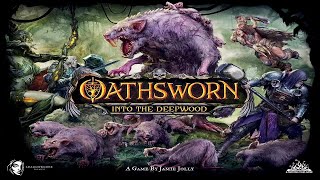
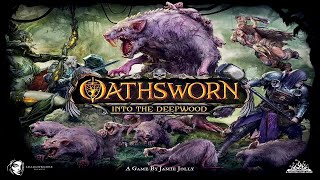
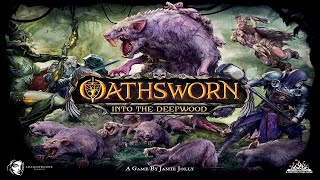
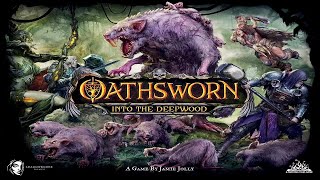
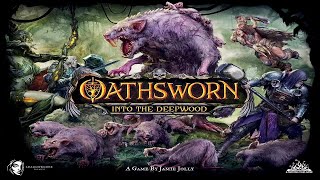
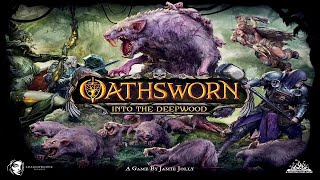
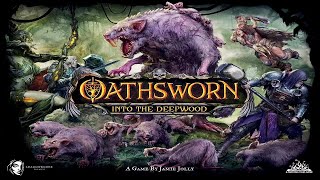
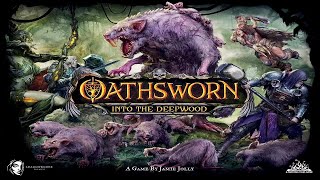
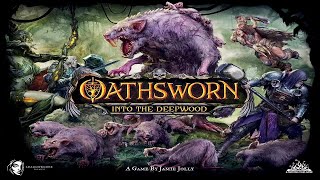
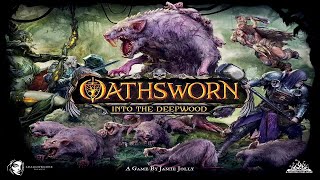
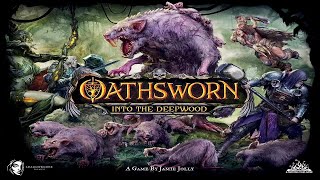
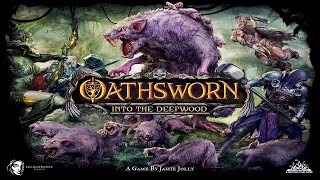
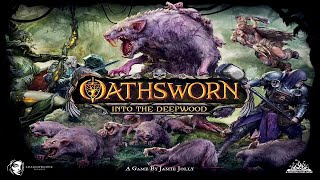
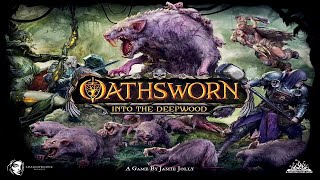
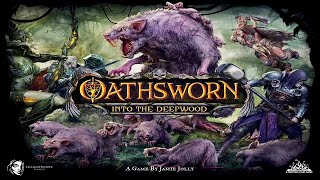
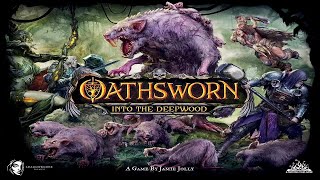
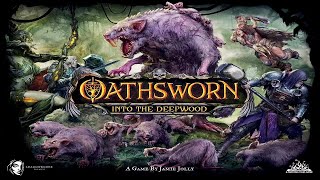
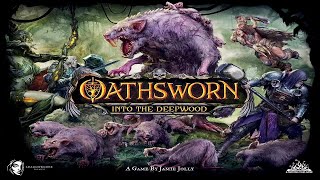
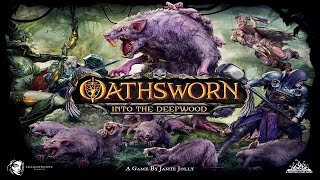
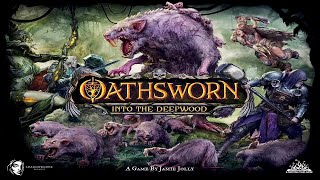
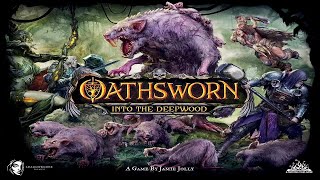
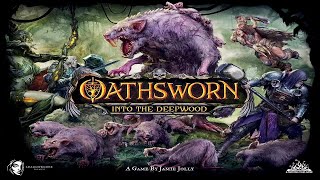
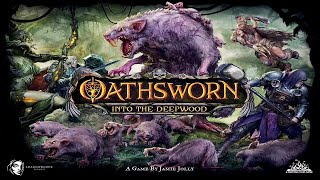
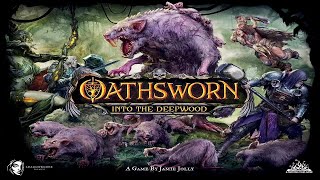
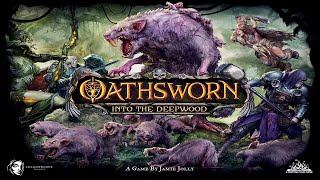












Oathsworn is a Twisting Tales Game for 1-4 players where play is focused on narrative choices and rich miniature combat encounters. The game is set in the Deepwood where a Free company (the Oathsworn) fights for humanity's survival against unnatural horrors and the Deepwood itself.
Each gaming session sees the players participate in a multi path game book where the story unfolds to an inevitable encounter. The encounters are multi phase scripted boss fights on the encounter board where players have to outwit and outplay the AI driven monsters and enemies. As the sessions unfold the group is taken into a deep legacy campaign where they gain levels, loot and new allies to join them in their journey.
Oathsworn boasts a unique push your luck combat system of exploding dice where players are always having to decide between hitting harder and potentially missing the attack. This coupled with a euro style cooldown system called 'Battleflow' makes for a vibrant and engaging play session.
—description from the publisher
- Array
- Array
- grim, story-driven collaboration where a party of heroes pursues a doomed boss
- Array
- Dark fantasy forest setting with mercenary characters in a cursed wood
- Array
- Array
- Array
Mechanics (from transcript analysis)
Video topics + discussion points
Quotes (from this video)
- The battle flow in Oathsworn is brilliant.
- It's easily the most accessible of the three.
- Inverted combat paradigm sounds cool on paper.
- It's barely controlled chaos.
- Kill monster, get pants is the perfect description.
- A violent math equation.
- Not that. Skip Primal if you want a sprawling adventure.
- Portability is zero.
- The storage for Atto is a crime against humanity.
- Oathsworn hits that sweet spot of fun, story, and tactics.
References (from this video)
- Ambitious fantasy cooperative experience
- Potential for strong solo and group play
- Community interest and anticipation
- Long setup and playtime
- High complexity and cost considerations
- story-driven, campaign-style adventure
- Fantasy world with deep woods and epic quests
- cinematic cooperative play with ongoing narrative
Mechanics (from transcript analysis)
- Cooperative campaign play — A narrative-driven, campaign-style cooperative experience.
- Cooperative Game — A narrative-driven, campaign-style cooperative experience.
- large-scale exploration/combat — Tactical exploration and combat with substantial narrative framing.
- Scenario / Mission / Campaign Game — Tactical exploration and combat with substantial narrative framing.
Video topics + discussion points
Quotes (from this video)
- I want to see better board game boards.
- the trend I'd like to see stop is laziness and cutting corners.
- crowdfunding used as a marketing tool.
- I personally want to own more of my stuff and not have to worry about being beholden to something being shut down.
- board games are this like persistent nostalgic thing that have always existed that you can't really you can digitize them and make these digital versions but we haven't seen them explode.
- it's the FOMO hub of our hobby.
References (from this video)
- Exceptional accessibility features integrated into gameplay (simplified characters, quick swap rules) that still preserve strategic depth
- Narrative and gameplay are deeply interwoven, producing a cohesive experience where story events drive combat and exploration meaningfully
- Massive variety in boss encounters and chapter design delivers high replay potential and a sense of continual discovery
- Excellent component quality and organization (inserts, bags, dividers) that support smooth table setup and ongoing play
- Flexible pacing and difficulty options allow groups to tailor intensity to their preferences and to accommodate different play styles
- Occasional typographical and minor rule ambiguities across printings, requiring occasional online clarification
- Balance and downtime can vary depending on chosen complexity level and player count, which may necessitate homebrew adjustments
- Some rule interactions can be subtle or counterintuitive without consulting the rulebooks or official videos, potentially slowing down first plays
- Array
- Fantasy
- Investigation-driven, chapter-based storytelling with a strong emphasis on lore and world-building
- Gloomhaven
Mechanics (from transcript analysis)
- Accessibility/Customization Options — Simplified character options and quick-swap rules that let groups tailor the level of complexity and manage downtime across varying player counts and skill levels.
- boss battler — Persistent boss battles that are integral to the plot, with bosses featuring dynamic threat levels and special chapter-specific rules that influence strategy and risk assessment.
- Boss Battles/Encounter Encounters — Persistent boss battles that are integral to the plot, with bosses featuring dynamic threat levels and special chapter-specific rules that influence strategy and risk assessment.
- campaign/story-driven — Chapter-based campaign that ties battles to a larger overarching narrative, with each chapter presenting unique rules and story beats that affect how you approach fights and exploration.
- Deck building — A card-driven combat system where card play shapes manuever options, cooldown management, and timing decisions during fights. The game emphasizes careful sequencing and the trade-off between immediate impact and future options as cards enter cooldown.
- Narrative-Environment Integration — World-building through tangible components (maps, location tokens, encounter minis) that drive exploration, lore discovery, and narrative immersion without heavy exposition dumps.
- Time track — A time-tracking mechanism that governs exploration, sequencing, and reward timing, creating a sense of urgency and pacing that shapes decisions beyond raw combat.
- time track / pacing — A time-tracking mechanism that governs exploration, sequencing, and reward timing, creating a sense of urgency and pacing that shapes decisions beyond raw combat.
Video topics + discussion points
Quotes (from this video)
- unbelievably thoughtful for being so considerate of basically everything you could ever ask for
- there's no random deck building or dungeon crawling or a PvP mode shoved in—it's always going to be a campaign-driven boss battler
- the story and the world feel so organic, with location tokens guiding exploration and time affecting what you can do
- the narrative meets gameplay is the strongest example I've seen in a board game
References (from this video)
- deep, layered tactical combat with high interaction and tension
- inventive possession mechanic that changes player roles mid-game
- fun, improvised use of LEGO miniatures which enhances visibility and engagement
- live-stream energy and crowd interaction add to the entertainment value
- extremely high learning curve and complexity can be overwhelming for new players
- moving and tracking many LEGO/minifig figures can be cumbersome and error-prone
- stream buffering and tech hiccups can detract from gameplay experience
- possession, hero-vs-boss battles, and shifting loyalties among party members
- Fantasy medieval with grimdark flavor; besieged villagers, possessive foes, and epic boss encounters
- episodic, scenario-driven campaign with evolving threats
- Fire Team Zero
- Vanguard
Mechanics (from transcript analysis)
- Battle Flow / action economy — Cards circulate back into players’ hands via battle flow mechanics, allowing strategic reuse of effects and chaining actions.
- board representation and standees — The game uses standees or miniatures (often LEGO-like figures in this stream) to depict characters and shadows, affecting visibility and spatial reasoning.
- boss battler — The Blade (boss) can take various forms; form advantage influences range, effects, and target priority during play.
- boss forms and form-picking — The Blade (boss) can take various forms; form advantage influences range, effects, and target priority during play.
- Combat: Deck/Hand — Progression is driven by an encounter/stage deck; when depleted or conditions met, the encounter ends with success or failure rules.
- Combat: Dice — Combat uses color-coded dice with potential for critical hits; power/animus/re-roll tokens influence outcomes and damage multipliers.
- Cooperative Game — Multiple players coordinate to defeat a boss (the Blade) while managing shadow minions and possession twists.
- cooperative play — Multiple players coordinate to defeat a boss (the Blade) while managing shadow minions and possession twists.
- dice-based combat with power tokens — Combat uses color-coded dice with potential for critical hits; power/animus/re-roll tokens influence outcomes and damage multipliers.
- encounter deck / stage cards — Progression is driven by an encounter/stage deck; when depleted or conditions met, the encounter ends with success or failure rules.
- possession mechanic — A character can become possessed by Shadow Man; possessed characters gain health but act as enemies until resolved.
- shadow minions / creeping shadows — Creeping shadows move rapidly toward targets and bypass typical armor, creating pressure and area control challenges.
Video topics + discussion points
Quotes (from this video)
- this is thick you really can't get any better
- holy crap what a way to start Baron
- there's Darth Vader and LEGO minifigs in this game
- this scenario is amazing
References (from this video)
- Immersive campaign with engaging exploration and story phase
- Grim, lived-in world that feels atmospheric and credible
- Narrator app is solid and enhances immersion without feeling gimmicky
- Boss fights are described as fun, fast, and brutal
- Unveiling the next boss is a standout moment
- Significant time commitment required to experience the full campaign
- High cost and substantial storage/space demands for all components
- Must usually run four characters, even when using simplified sidekicks
- dark fantasy, heroic protectors vs. otherworldly corruption, investigative narrative
- grim fantasy world with a forest that eats flesh, a pervasive darkness, and an ongoing blight/corrosion threat
- story-driven with branching choices, storybook investigations, and boss-centric narrative progression
- Gloomhaven
- Tainted Grail
Mechanics (from transcript analysis)
- Action Queue — a structured cycle of actions and movement with a rotating action/move order and a battle flow token managing sequencing
- battle flow — a structured cycle of actions and movement with a rotating action/move order and a battle flow token managing sequencing
- boss battler — each boss uses a unique stage deck and rules, plus a collectible miniature and special attack patterns
- boss fights — each boss uses a unique stage deck and rules, plus a collectible miniature and special attack patterns
- Campaign — campaign-based growth of hero skills and equipment across scenarios
- Character progression — campaign-based growth of hero skills and equipment across scenarios
- Conflict resolution — combat resolved with dice or cards of varying types, including blanks, crits, and empowerment upgrades
- exploration — storybook-driven exploration with location tokens, map-based movement, and time/resource tracking
- group composition — players select four characters from a pool and bring their cards, models, and equipment to bear
Video topics + discussion points
Quotes (from this video)
- "I was quite ready and willing to slag this game off as an overblown Kickstarter with pretty figs and not much else"
- "But hot damn did it surprise me"
- "the exploration and story phase is genuinely engaging"
- "this is immersive campaign and boss fights that aren't overwhelmingly complex"
- "the best thing about this game is unveiling the next boss"
- "narrator app is really solid"
- "oathsworn narrates all the fat and just leaves the meat"
- "four characters even if you use the simplified Sidekicks for three of them"
- "oathsworn: the decadent chocolate cake of board games"
- "narrative: this game has a lot of story elements and choices"
- "when you move to an area flip the token and resolve the numbered story entry in the storybook"
- "resolved locations and other actions will add time to the chapter track"
- "throughout the exploration you will gain power-up tokens, information and Equipment"
- "the story will eventually progress to a fight, each boss fight has its own special rules cards as well as a box to unlock with a miniature in it"
- "use the encounter book to set up the board, terrain, monsters and heroes"
- "each player has a pool of yellow animus, movement costs one per hex moved and cards play the amount shown in their top left"
- "the white number on the top right shows where you place the card on your player board"
- "the next time you play a card to that space, the previous ones cycle counterclockwise"
- "this cycle of play and move is called battle flow and the battle flow token can move a pile one space"
- "cards in the bottom spot are reclaimed to hand at the end of your turn"
- "the core conflict resolution in the game uses dice or cards of different types with progressively higher numbers"
- "you can roll any number of white dice plus colored dice based on equipment"
- "here the Cur has one yellow and picks two additional white"
- "the Empower token can upgrade Dice or cards three steps, like so"
References (from this video)
- Huge amount of content and replay value
- Rich narrative with branching arcs and evolving characters
- flexibility for solo play or group play with companions
- Quality components and thoughtful storage/organization
- High complexity and lengthy setup
- Demanding organization to manage envelopes, boxes, and components
- Potential for spoilers if not careful with progression
- Heroic fantasy teamwork, exploration, and evolving character stories
- Fantasy campaign world surrounding the city of Bastone and its chapters in the deepwood, with exploration and narrative-driven locations
- Two halves per chapter: a story-driven, branching narrative akin to Choose Your Own Adventure, followed by encounter/battle segments
Mechanics (from transcript analysis)
- Animus resource and card cooldown — Actions cost Animus; ability cards go on cooldown slots; refresh returns cards to hand and regenerates Animus
- boss battler — Encounters progress through stages (one, two, three) with a boss and minions; stage progression and special rules change behavior
- Campaign structure and branching narrative — Story chapters drive character development and item gains; encounter chapters provide tactical battles with a boss and minions
- Character progression and itemization — Four-person company with starting and acquired equipment; permanent tokens grant ongoing effects across chapters
- Checks using dice or cards — Plausible checks can be resolved with white/yellow/red/black dice or cards; deck composition and card draws influence odds and outcomes
- Stage-based boss encounters — Encounters progress through stages (one, two, three) with a boss and minions; stage progression and special rules change behavior
- Use of standees and miniatures — Standee version uses standees; miniatures exist for allies and main character; deployment on a hex-based map with facing
Video topics + discussion points
Quotes (from this video)
- this is a huge box of stuff
- there is so much content in here
- two halves
- the story part is like Choose Your Own Adventure
- you can skip the story part and go straight into the encounter
- so much content
References (from this video)
- Thematic consistency and ambitious scope for a campaign-driven fantasy adventure.
- A clever integration of story and combat that feels intrinsic to the overall experience.
- High-quality voice acting (Cosmo) and strong narrative writing that elevates mood and pacing.
- Rich variety across chapters, with different tones (town, wilderness, drama, combat) that keep the campaign dynamic.
- Flexible play options for solo or group, with multiple archetypes and companion modes.
- Thoughtful game design that rewards strategic planning and token/resource management without feeling purely luck-based.
- Extremely large and expensive production with lots of plastic minis and bulky components.
- Rulebook complexity and occasional murkiness around targeting, line of sight, and activation order.
- Clunky or heavy mechanics in combat and movement rules that can slow play and increase setup time.
- Environmental and packaging concerns due to oversized boxes and shipping footprint.
- Representation concerns within the narrative and cast; perceived lack of diversity among characters.
- Add-ons and expansion options (e.g., The Armory) can exacerbate cost and logistical burden.
- Dark fantasy investigation, grim storytelling, moral ambiguity, and perilous expedition into a lethal environment.
- A grim fantasy world centered on Deepwood environs around medieval cities; xenophobic frontier with dangerous wilderness.
- Two-part structure (story and combat) with a fully voiced narrative and branching/morally nuanced chapters.
- Tainted Grail: The Fall of Arthur
- Sherlock Holmes Consulting Detective
- Seventh Continent
Mechanics (from transcript analysis)
- App narration with optional reading — An app provides voiced narration (with an option to read aloud yourself) to convey the story.
- Card counting and deck interaction — Players count, draw, and potentially manipulate a deck of attack/defense cards; refresh slots limit reuse.
- Card-dice combat hybrid — Combat uses a combination of action points, cards, and dice with refresh mechanics and situational modifiers.
- Character versatility and standalone modes — Multiple archetypes with full or streamlined companion modes; solo play is supported with flexible party composition.
- Location/monster envelopes and time track — Story locations and monsters are sealed in envelopes; visiting locations advances a time track and unlocks narrative beats.
- Monster body-part targeting — Enemies have body parts (Head, Shoulders, Knees, Toes) each with hit points; breaking parts changes available attacks and triggers effects.
- Target-number tests and optional dice — Tests can be resolved with cards or dice to meet a target number; outcomes depend on deck composition and luck.
- Token economy and loot — Combat and story rewards use tokens; losing items or spending tokens impacts future options and power.
- two-part structure — Each chapter comprises a story part and a combat part, each with its own rules and rewards.
Video topics + discussion points
Quotes (from this video)
- it's the world's first kind direct Dungeon Crawler
- pregnant silence
- this jumbo jet of a board game
- Cosmo gives it his best
- Oathsworn knows that it's a game of two equal parts
- when will board games grow up
References (from this video)
- Seal of Excellence from Dice Tower
- Lots of content in box
- Fantastic artwork
- Great miniatures
- Long playtime per scenario (3 hours)
- 21 scenarios provide extensive gameplay
- Good game mechanics
- Very expensive - 125 pounds for standee version
- Miniature version adds another 100 dollars
- All-in pledge costs 307 dollars
- Extreme cost for hobby
- 21 scenarios times 3 hours is huge time investment
- Miniatures block line of sight
- Artwork on standees already good enough
- Fantasy adventure campaign
- Fantasy Deepwood forest
- Scenario-based campaign adventure
Mechanics (from transcript analysis)
- campaign system — 21 scenarios in connected campaign
- Combat and exploration — Navigate and fight through scenarios
Video topics + discussion points
Quotes (from this video)
- Kickstarter is here to stay whether you like it or not
- I give my honest opinions regardless of whether someone a hero or not
- Just because the creator of pandemics on it doesn't make it an instant hit
- This is the best fantasy based story driven campaign game I've ever played
- The value you get is obnoxious... it's obscene
- Put the how to play Early in the campaign all right not miles at the end
- Board games just aren't worth this kind of money anymore
- I'm not spending 330 on this thing
- Money is tighter the world economy has gone to pot
- Quick turns and simple actions is such a marketing tool line that I can't place any reliance on
References (from this video)
- Unique character design (the Curve) with a visually appealing sculpt.
- Engaging armory/upgrade concept that adds depth to the character.
- Vibrant painting potential and customization opportunities.
- Interactive community engagement during a live painting stream.
- Some complexity in assembly and painting (especially armor/pieces that must be painted separately).
- Shields/attachments can be prone to loosening if not prepped (primed/assembled) properly.
- Color choices and layering decisions can be tricky on certain parts (metal vs leather, purple vs brown tones).
- Heroic fantasy/narrative-driven cooperative exploration
- Fantasy adventure in a deepwood setting with curses and templated quests
- Story-driven campaign with lore and character progression
- Kingdom Death: Monster
- Seventh Continent
Mechanics (from transcript analysis)
- Armory system / weapon empowerment — As tokens are gained, weapons can be expanded or upgraded to become more powerful.
- Character progression through equipment and armor — Gear (belts, daggers, shoulder pads, etc.) influence stats and aesthetics, with a focus on modular equipment.
- Modular painting workflow (in-game narrative context) — While not a core gameplay mechanic, the host demonstrates a painting progression that mirrors in-game character development.
- Push-to-fit miniatures — Miniatures are designed to snap together without glue; priming and careful fit improve stability.
Video topics + discussion points
Quotes (from this video)
- the Cur is done
- the Cur is going to replace the Huntress
- we are painting the Cur from osworn
- this cloak is not great, I think I need to put some kind of drybrush like a white dry brush
References (from this video)
- Heroic fantasy, heavy miniature painting
- Fantasy realm with epic battles
- Campaign-driven, narrative-driven
- Game of Thrones: The Board Game
- Assassin's Creed: The Board Game
Mechanics (from transcript analysis)
Video topics + discussion points
Quotes (from this video)
- a horse from Assassin Creed board game
- this Lannister looking fellow with gold all over the problem
- the biggest miniature from oats sworn the Big Bear
- my minis look too dark
- this witch miniature is so clean I really really enjoyed it
- after 28 days of painting miniatures this was the end result
References (from this video)
- Immersive and cinematic storytelling
- Strong battle system with thematic variety
- Requires significant time and commitment
- Epic battles, personal quests, and a world that reacts to decisions
- High fantasy with deep dungeon exploration and branching story
- narration-forward with branching outcomes
- Mansions of Madness
- Arkham Horror: The Card Game
Mechanics (from transcript analysis)
- narration-driven scenarios — Decisions influence each act and the story’s direction
Video topics + discussion points
Quotes (from this video)
- "This is Spooktacular. It is spectacular and spooky."
- "The theme is very well integrated into the story that you're playing through."
- "You can feel the humanity of the ghosts and the dream transitions."
- "It's like Ford versus Ferrari for fashion."
- "The alien gets on board and starts growing. It’s iconic."
- "This is Mad Max on a board. Thunder Road Vendetta is fantastic."
References (from this video)
- immersive story
- strong narrative integration with combat
- crunchy rule set
- narrative-driven epic adventure
- fantasy dungeon-crawling campaign
- branching story with player choices
Mechanics (from transcript analysis)
- card-based action system with cooldown — cards grant actions and later cooldown mechanics return cards
- narrative-driven campaign — story evolves based on player decisions
Video topics + discussion points
Quotes (from this video)
- Planet Unknown worms its way into my brain like that
- the first 1000 people to use the link in the description below will get a one month free trial of skillshare
- I love deduction games
- this video is sponsored by skillshare
- it's not a parody it's real weird
- hands down my favorite game of 2022 is Planet Unknown
- I cannot wait to play more at this if you like flipping rights and games with combos