



One Deck Dungeon: Forest of Shadows Deep Dive
What the Community Thinks About One Deck Dungeon: Forest of Shadows
This overview reflects one reviewer, the Sir Thecos channel, seen across three videos. Sir Thecos treats One Deck Dungeon: Forest of Shadows as the sequel to the original One Deck Dungeon. The 2017 release is a standalone expansion that adds new heroes, dungeons, foes, and perils, and the reviewer says they like it a little more than the original. They describe it as a great solo game that regularly sits near the top of their solo list.
The reviewer's tone is enthusiastic but practical. They explain the components patiently, praise the rulebook as well explained and laid out, and point out how compact the box is. Their awards video places the expansion in the highest tier of their personal recognition, the golden Ace of Games award. There they describe a solo game that is simple to learn in terms of rules but quite tough to win.
Core Mechanics That Define One Deck Dungeon: Forest of Shadows
Dice pools for every challenge
The central mechanism is a dice pool tied to each hero card. A hero lists attack, agility, magic, and health, and each stat maps to a die color: yellow for attack, pink for agility, and blue for magic. Black dice are wilds that cover most needs. When a challenge appears, the player rolls the relevant dice and tries to meet the target. Defeating monsters pays out in skills, potions, or experience points. The reviewer treats the experience track as the engine of growth, since spending that progress on skills changes how many dice the hero rolls for each stat.
Campaign sheets and skill progression between delves
The second core mechanism is the campaign. Each character needs a campaign sheet, and the reviewer marks off each dungeon completed, floor cleared, level gained, and boss defeated. Filled dots on the sheet unlock new skills, so the hero starts the next delve stronger. The reviewer recommends using the sheet every time, because a character who has been through several games benefits from the skills already earned, which makes the game a little easier and more exciting. Base game and expansion sheets list different skills and can be swapped, but each character can carry only one sheet at a time.
The One Deck Dungeon: Forest of Shadows Experience
Growing from weak to dangerous
The reviewer describes a steady arc. Early on, the harder bosses may be out of reach, but leveling up turns those fights into manageable challenges. The most rewarding moment in their playthroughs is when a hero can roll ten or fifteen dice for a single encounter, which the reviewer calls a genuinely satisfying feeling. Replaying dungeons with a stronger character is what drives the series forward, and the reviewer plans to keep returning to the game for more runs.
Hero personalities and playstyles
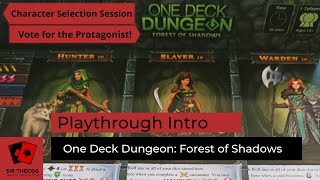
The expansion's roster shapes much of the enjoyment. The reviewer walks through the Hunter, who is balanced between attack and agility, sturdy with health, and can raise any die by two. The Alchemist spends potion tokens and mana to roll specific dice. The Druid is weak at attack but strong at magic, and a transformation ability can swap the values of two non-black dice. The Warden is a heavy attacker that stores black dice for later. The reviewer also covers Kaliana, a fairy-type hero they describe as very tough to play. All of the heroes are female, a touch the reviewer notes was already present in the original. The reviewer finds that each hero plays very differently, which gives the replay value its shape.
What Makes One Deck Dungeon: Forest of Shadows Stand Out
Poison as a new mechanism
The most distinctive new rule the reviewer highlights is poison. Unlike the first game, Forest of Shadows lets heroes become poisoned, and the reviewer tracks it with physical poison tokens. When mixing in the original's characters and playing the hybrid dungeons, the reviewer insists that poison must always be in play, because the hybrid decks contain cards that interact with it. They considered replacing poison with damage and rejected the idea as far too hard, arguing that it would drain the fun from the experience. The product description also lists Event Perils as a new mechanism, but the reviewer's videos focus on poison rather than examining Event Perils in depth.
A roster built for mixing
The reviewer treats the two games as compatible. The base game's dungeons and the expansion's dungeons can be used with any hero and any deck composition, and the reviewer says they are balanced across the hybrid combinations. Each hero is also compatible with each hybrid deck. The reviewer's preferred experience is the combined one, because the different heroes and different enemies make play feel fresh. The value they describe is variety: the more heroes, dungeons, and foes in rotation, the more each delve feels new.
Potential Drawbacks
Difficulty and uneven heroes
The reviewer is open about how hard the game can be. Kaliana is singled out as the hardest hero to play, since her health is very limited and a single point of damage on her ends the game immediately. The reviewer also notes that she offers little attack or agility to work with. The Druid is weak at attack, and the two-player side of each hero card is weaker than the standard side. Poison is punishing, and the reviewer warns that replacing it with damage would make the game nearly impossible.
Setup and component logistics
The reviewer raises practical issues with combining two boxes. Both games come with many tokens, and the two token sets will not fit in one box, although one set is enough for one player. Their suggested workaround is to keep the smaller base-game tokens in the box and store the expansion's larger tokens separately. At the time of the video they had not yet tested whether everything fits. Campaign sheets add another item to track, since each character needs its own sheet and a sheet cannot be reused across characters.
If You Enjoy One Deck Dungeon: Forest of Shadows
The reviewer's clearest recommendation is to own both games if possible. Forest of Shadows is a standalone expansion, so a player can start with it alone, but Sir Thecos argues that the combined experience is the strongest. Dungeon cards from the original can be separated by the symbol beside each name and recombined with the expansion's cards to build hybrid decks. The reviewer notes that each encounter appears at least twice across the decks with different rewards, which keeps repeat sessions fresh. Heroes, dungeons, and campaign sheets can be mixed freely, while poison stays in play for every hybrid run.
This expansion suits solo players who enjoy steady progression, dice-driven tension, and building one character across many short runs. The reviewer's advice for new players is to lean on the campaign sheet, use the mixed decks for variety, and keep poison in play. Players who want a forgiving first experience should expect the difficulty the reviewer describes.
What Reviewers Are Saying
"really really cool at some point you're just able to check 10 15 dice um for an encounter and that is just really satisfying that is a really great feeling"
— Sir Thecos
"if you have both versions which i actually suggest because the different heroines and the different enemies and everything makes um playing that really exciting"
— Sir Thecos
"there's like a little mini campaign you can use you can play there to actually further your skills and that is really cool because you just become stronger and have more options"
— Sir Thecos