/pic7070194.jpg)













































Onitama Deep Dive
What the Community Thinks About Onitama
Across the channels that cover it, Onitama gets treated as a small masterpiece of design rather than just another two-player filler. Actualol calls it a "modern classic" and says its "beauty is in its simplicity," while No Rolls Barred frames it as the game that, along with Hive, makes players stop caring about chess altogether. Get into games lists it among the games most likely to pull a newcomer away from the standard gateway lineup, describing it as a game they truly love. The hosts of Allies or Enemies admit they went in skeptical, expecting a dry chess clone, and came away surprised by how much strategy the small box holds.
Where channels differ is in how they frame the game rather than whether they like it. Adam in Wales treats Onitama analytically, as a case study in blending traditional abstract play with a modern drafting mechanism, calling the result "a really satisfying unique product." Reviewers aimed at casual or couples audiences, like Actualol and The Flip Side, focus less on design theory and more on how fast it plays and how quickly new players want a rematch. The common thread is that nobody covering the base game treats it as merely serviceable; the disagreement is only about which angle of the game deserves the spotlight.
Core Mechanics That Define Onitama
Cards Dictate Every Movement
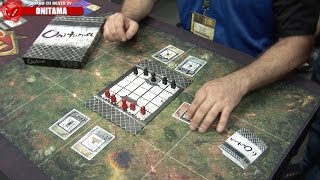
Watch It Played's walkthrough lays out the foundation: each player controls a master pawn on their shrine and four student pawns, and movement is entirely governed by the two movement cards sitting in front of that player. A card shows a small grid of highlighted squares relative to a pawn's position, and a player must move one of their pieces exactly as a chosen card allows. Landing on an opponent's pawn removes it from the board. As Watch It Played explains, victory comes by the way of the stone, capturing the opponent's master, or the way of the stream, walking your own master into the opponent's shrine.
The Rotating Fifth Card
What turns that simple movement system into a genuine game is the card exchange. No Rolls Barred describes it directly: "What makes Onitama such a clever little bastard is that when you play a card to make that move, that card is spent and replaced by the free card in the middle. The card you just played goes to the middle, and after your opponent's next turn they will get that card, and so on. You go the same five cards swapping between you on an endless cycle." Adam in Wales frames the same system in design terms, calling it "an elegant drafting system" layered on top of a classic capture-and-movement game, so that every move also hands the opponent a future option.
The Onitama Experience
A Fast, Easy Teach
Reviewers consistently point to how little friction there is between opening the box and playing a full game. Actualol calls the twenty minute length "perfect" and says it is "ridiculously easy to teach." The Flip Side echoes that from a different angle, saying Onitama "does not take a lot of teaching time" and that new players who are taught the game tend to ask to play again immediately, so it gets multiple plays every time it hits the table.
Quiet Tension and Deep Thinking
Underneath the easy teach sits a surprisingly tense head game. No Rolls Barred describes players "trying desperately to think two moves ahead of your opponent, attacking without leaving yourself lethally exposed" to pieces they did not expect. Allies or Enemies had a similar experience, noting how much the card choices matter because the perfect card for one player might also hand the opponent a strong option, which they found "really interesting," and how differently each game played out depending on which five cards were in the mix that session.
What Makes Onitama Stand Out
A Turn Structure That Rewards Reading Your Opponent
The card-passing system is what reviewers return to most often when explaining why Onitama holds up against chess. Because a played card becomes available to the opponent, choosing a move means weighing the immediate benefit against what it hands away, a tension No Rolls Barred singles out as the game's cleverest trick and Adam in Wales credits with merging "classic gameplay from chess and checkers" with something closer to a modern euro drafting game.
Replayability From a Shifting Card Pool
Because only five of the game's movement cards are in play in any given session, reviewers describe every match as feeling distinct. Allies or Enemies said each game "felt very different just depending on which cards have been in the mix," from games where everyone drifts to one side of the board to games built around a single powerful diagonal jump. The Flip Side made the same point about replayability, noting that once a set of five cards is put away, players draw five different ones for an entirely different game.
Potential Drawbacks
A Very Abstract, Theme-Light Package
Get into games frames Onitama within the broader abstract strategy category, describing that category as offering "a bit of strategy, but very little theme" before naming Onitama as the example. That thin veneer over the martial arts theme is baked into the genre the game sits in, and reviewers coming from thematic or narrative-driven hobbies may need to adjust their expectations accordingly. Allies or Enemies described being initially on the fence about the game specifically because "it is a very chess is game," expecting it to play as dry as it looks before being won over.
A Box That Does Not Travel Well
Production values draw consistent praise, but the packaging itself gets one recurring complaint. Actualol, who otherwise called the components stunning down to the neoprene mat, said the box runs a little bigger than they would prefer and wished the publisher would produce a travel version of the game.
If You Enjoy Onitama
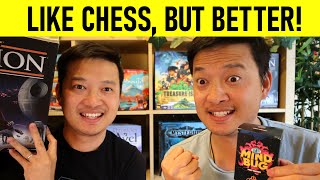
Every channel that discusses Onitama in depth reaches for the same comparison point. Get into games positions it directly against Chess, arguing that where chess is a solved game once you know its openings, "with Onitama, everything's different" because the card pool changes every session. No Rolls Barred makes the same comparison more bluntly, saying that between Onitama and Hive, the two "bury chess and the shallowest of graves," with Onitama serving as "the more exciting version of chess combat and capture" and Hive doing the same for movement and placement. Actualol frames it similarly, saying Onitama "has all the bits of chess" they enjoy while trading chess's steep learning curve for "a more level playing field."
What Reviewers Are Saying
"What makes Onitama such a clever little bastard is that when you play a card to make that move that card is spent and replaced by the free card in the middle. Now the card you just played goes to the middle and after your opponent's next turn they will get that card, and so on. You go the same five cards swapping between you on an endless cycle."
— No Rolls Barred
"Onitama is a modern classic. Its beauty is in its simplicity. If I was to rework my top 10 couples games, this would be in the top five, no question."
— Actualol
"With Onitama, everything's different. There's plenty of cards, so every game can feel different as well as you're passing these cards around."
— Get into games