



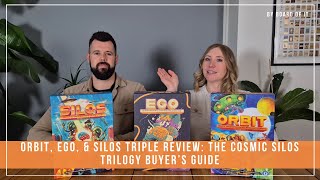

















ORBIT box art

ORBIT

Game ID: GID0235649
Collection Status
Description

Come one, come all to the Silo System, the beating heart of our galaxy, for the race of the decade! We've recruited the best tourists in all the cosmos: travel-hardened explorers who will compete in the ultimate contest. These pilots must race to visit all the planets in the Silo System, surfing upon orbital paths, teleporting between hyper jump portals, and beaming through hyperspace. Enjoy your dream vacation on one of our luxurious planets or lavish space stations as you witness the ultimate interstellar marathon. All the eyes of the galaxy will be watching this decennial event celebrating the unification of our systems under Silo Supremacy.

ORBIT (Orbital Race Between Interstellar Tourists) is a 24th century tactical space race with simple turns, yet challenging possibilities. Players compete to visit all planets of the system, then return to their starting planet first.

On your turn, you play a card, activate its actions in any order, then draw back up to your hand size. Cards allow you to do a combination of things: move your ship, collect energy for bonus movement, advance planets along their orbit, or even reverse the orbital direction of a planet.

When your space ship is docked on a planet, the moving planet will carry you along its orbital path, helping you to traverse the map even faster. Planning your route wisely as you ride orbital currents and bounce between planets is the key to success — but your cutthroat competition will no doubt seek to spoil your plans and sabotage your tourism progress. It helps to be flexible and adapt on the fly, literally.

You shouldn't ignore the opportunity to upgrade your ship along the way. Visiting certain space stations and planets allows you to increase your hand size and energy storage capacity, so you must balance short-term efficiency against long-term advantages. The game board features additional tactical resources such as fuel depots, hyper jump portals, and hyper acceleration cannons.

Players can enjoy a randomized set-up across two unique game boards. The game also includes a few variants: a solo mode, four-player partnership mode, and a stationary planet.

ORBIT is the third and concluding game in the Cosmic Silos Trilogy by Reiner Knizia, and with the Nebular Expansion, you can add three modules to the game: navigation tokens, hyper accelerator engines, and artificial nebulas.

—description from the publisher

Year Published
2025
Transcript Analysis
Browse transcript mentions, sentiments, pros/cons, mechanics, topics, quotes, and references.
Total mentions: 16
This page: 16
Sentiment: pos 16 · mix 0 · neu 0 · neg 0
Mentions per page
Top
Showing 1–16 of 16
Video 6lrG_Rxy_2w Board Game Buzz game_review at 12:22 sentiment: positive
video_pk 62388 · mention_pk 154920
Board Game Buzz - ORBIT video thumbnail
Click to watch at 12:22 · YouTube ↗
Overall sentiment (raw)
positive
Pros
  • Accessible as a racing game with broad appeal
  • Grows in depth with expansions and modular customization
  • Plays well across player counts, including two-player with a dummy block
Cons
  • Production nitpicks on planet color readability (brown vs black issue)
  • Rhythms can slow a tad during activations, especially with many cards
Thematic elements
  • race through shifting planetary positions with modular systems
  • Galaxy racing with constantly moving planets
  • kinetic, fast-paced, carnival-like racing atmosphere
Comparison games
  • El Dorado
Mechanics (from transcript analysis)
  • Energy cubes and resource management — Certain cards grant energy to increase movement or unlock abilities.
  • hand management — Players start with a hand of cards and manage plays to move and activate abilities.
  • Modular board — Different modules and expansions (Nebula, four-player partnership variant) change pacing and setup.
  • Modular board and variant scaling — Different modules and expansions (Nebula, four-player partnership variant) change pacing and setup.
  • Planet movement and directional arrows — Playing a card moves planets according to the card and follows the planet's direction arrows.
  • Variable player powers and card activation — Some cards activate multiple planets or provide unique effects, letting players tailor turns.
Video topics + discussion points
No key topics recorded for this video.
Quotes (from this video)
  • The very first thing that I heard about this game was the theme where you are um aliens are coming to Earth abducting cows because cows are the most intelligent life form on the planet.
  • Turns go by so fast because that's literally all you're doing is you're simply playing a card, doing a couple movements, boom, next person, play another card.
  • I would absolutely introduce this to people as primarily a push your luck game.
References (from this video)
No references stored for this video.
Video 7JmkI5mbmG8 Unknown Channel playthrough at 0:24 sentiment: positive
video_pk 62031 · mention_pk 154637
Unknown Channel - ORBIT video thumbnail
Click to watch at 0:24 · YouTube ↗
Overall sentiment (raw)
positive
Pros
  • Encourages strategic hand management and planning ahead
  • Concrete, interactive teaching of rules
  • Dynamic engine with track and scoring offers nuanced decisions
Cons
  • Can be mentally demanding and complex due to multiple rule constraints
  • Initial setup and understanding of contingencies may be challenging
Thematic elements
  • Planet control and strategic hand management
  • A four-planet system with interactive track and markers
  • instructional demonstration
Comparison games
  • Coffee Rush
  • Origin Story
Mechanics (from transcript analysis)
  • area majority — After each round, players tally who has more cards for each planet type and score accordingly; non-leading cards can be given to the opponent as points.
  • Area majority scoring — After each round, players tally who has more cards for each planet type and score accordingly; non-leading cards can be given to the opponent as points.
  • Contiguity and play limits — If four or more identical planet cards appear contiguously, only 1-3 may be played; if three or fewer remain, all must be played.
  • End condition — The game ends when a player cannot play any cards.
  • hand management — The winner sorts the won cards by planet color face up for visibility and strategic planning.
  • Hand management and sorting — The winner sorts the won cards by planet color face up for visibility and strategic planning.
  • Largest planet wins trick — The player who played the largest planet card wins the round; in ties, the plus sign indicates the larger value.
  • Multi-use cards — Players play 1-3 cards of the same planet and move the matching planet marker on the board.
  • Planet card play — Players play 1-3 cards of the same planet and move the matching planet marker on the board.
  • track movement — The planet marker moves a number of spaces equal to the cards played in that action.
Video topics + discussion points
No key topics recorded for this video.
Quotes (from this video)
  • The winner sorts the cards by planet in front of them face up.
  • You cannot play different planets together.
  • That's cool.
  • You want to win by a narrow margin.
  • The larger number means the larger planet.
  • If the numbers are the same, the one with the plus sign is larger.
  • The winner takes all the cards played this round and sorts the cards by planet in front of them face up.
  • Observe the movement of the four planets carefully.
  • Remember your reputation as a master astronomer is on the line.
References (from this video)
No references stored for this video.
Video ZwUDfOteHlU Unknown Channel playthrough at 32:05 sentiment: positive
video_pk 62040 · mention_pk 154643
Unknown Channel - ORBIT video thumbnail
Click to watch at 32:05 · YouTube ↗
Overall sentiment (raw)
positive
Pros
  • Engaging thematic flavor with cinema setting
  • Clear turn structure and upgrade economy
  • Two-floor scoring creates interesting optimization decisions
  • Bright, humorous character cards add personality
Cons
  • Rule clarity can be challenging for newcomers
  • Some upgrade triggers and floor placement can be fiddly
  • You need multiple players to reach optimal scoring, may feel long in solo play
Thematic elements
  • building the best movie theater by combining characters and upgrades to meet scoring conditions
  • Cinema/theater management and film-themed card drafting on two floors
  • competitive puzzle with interactive card upgrades and audience metrics
Comparison games
  • Far Away
  • Big Sir
Mechanics (from transcript analysis)
  • card drafting — On your turn you pick a card and tuck it under a floor/side to build your theater and trigger actions.
  • card drafting / tableau building — On your turn you pick a card and tuck it under a floor/side to build your theater and trigger actions.
  • End-game scoring via tickets and theater upgrades — Points from upgrades, number of distinct characters, and tickets earned by upgrading.
  • Special abilities via 'friends' or companions — Upgraded cards sometimes come with a friend who modifies scoring.
  • Tuck mechanic — Tuck cards on visitor side or screen side and on first or second floor of theater.
  • Two-floor scoring grid — Score based on combinations across two theater floors with specific requirements for each card type and upgrade effects.
  • Upgrades and upgrade triggers — Cards can upgrade characters and grant a friend or add bonuses; upgrades can be triggered by arrows on cards.
  • Variable player interaction via shared market — All players upgrade and swap cards affecting others’ options.
Video topics + discussion points
No key topics recorded for this video.
Quotes (from this video)
  • Oh, that friend comes with Catwoman. He's not worth it.
  • This is totally what Pink Jupiter thought when they sent this game along.
  • There we go. Okay. Ads are right now.
  • No actual fighting involved. It is the theater is fighting for the top spot.
References (from this video)
No references stored for this video.
Video V5bqtANjeRY Dice Tower game_review at 0:19 sentiment: positive
video_pk 42910 · mention_pk 130448
Dice Tower - ORBIT video thumbnail
Click to watch at 0:19 · YouTube ↗
Overall sentiment (raw)
positive
Pros
  • Beautiful production (foil cover, wooden planet markers, and quality components).
  • Elegant fusion of mechanics from several influences into a coherent two-player experience.
  • Simple core concept with deep, meaningful decisions due to the hand-order constraint and suit interplay.
  • Tight, strategic scoring that rewards planning and information inference.
  • Short play sessions with high replay appeal, especially as a two-player title.
Cons
  • Potentially light for players seeking heavier interactions or longer playtimes.
  • Some may find the scoring nuance less intuitive until familiar with the system.
  • As a two-player game, may see less variance in player count and thus less dynamic pacing for some groups.
Thematic elements
  • Competitive control of planetary markers through suit-based plays and careful sequencing.
  • A space-themered, planet-themed card encounter between two players with four suits of planet markers.
  • Abstract/clever scoring with minimal thematic storytelling; emphasis on optimization and deduction.
Comparison games
  • Scout
  • Tolley
  • Harkcus
  • Jeekal vs Hyde
Mechanics (from transcript analysis)
  • End conditions — The game ends when a player runs out of cards or the following player has only cards in the led suit.
  • End-of-suit scoring and majority — At the end of the game, players tally suits by majority; the minority player scores points equal to the number of cards they won in suits where they are not in the majority.
  • Non-reorderable dealt hands — Players receive 14 cards per hand and must keep the order as dealt; they cannot rearrange their cards.
  • Planet markers movement — After each play, the corresponding planet marker is moved forward by the number of cards played; spaces can be skipped if occupied.
  • Restricted suit play (contiguous requirement) — When playing 1–3 cards of a suit, if the cards chosen are consecutive in that suit, all must be played in that round.
  • Round resolution by suit strength — The round winner is determined by which suit marker is stronger after the move; the winner collects the played cards into their scoring piles.
  • Short playtime with potential for repeat rounds — The game is designed to be quick; players may replay or play best-of-three to extend the experience.
Video topics + discussion points
No key topics recorded for this video.
Quotes (from this video)
  • This is a very simple concept on how you play this game.
  • A beautiful production.
  • It's a short game.
  • I'm giving this an 8 out of 10.
  • A really clever scoring element that works deliciously in the game.
References (from this video)
No references stored for this video.
Video WnUbZwDgdS0 Getting Games game_review at 0:31 sentiment: positive
video_pk 42647 · mention_pk 129549
Getting Games - ORBIT video thumbnail
Click to watch at 0:31 · YouTube ↗
Overall sentiment (raw)
positive
Pros
  • Simple rules with a deep tactical decision space
  • Dynamic interaction through orbiting and card play
  • Engaging late-game drama and comeback opportunities
  • Modular feel with optional expansion/variants
Cons
  • Chaos can be frustrating if you're blocked late-game
  • Large board can be visually daunting
  • Luck of the draw can stall turns
Thematic elements
  • Orbiting and racing to visit all planets and return home, with player interaction and planet-based movement
  • Space race around a hexagonal board of orbiting planets
  • abstract, tactical, chaos-infused race dynamics
Comparison games
none
Mechanics (from transcript analysis)
  • Card-driven actions — Each turn you play a card from your hand to trigger one or more effects, including movement and orbiting actions.
  • Diverging tracks and direction changes — Planet tracks diverge and cards can reverse orbital direction.
  • energy resource management — Energy cubes power longer moves and can be spent for additional actions.
  • Hand size and board bonuses — Certain board spaces increase hand size or energy capacity.
  • Orbit-based movement — Moving along planet-specific tracks; orbiting a planet with a card lets you ride for extra moves.
  • Planet visitation markers — Landing on a planet marks it as visited and places a token on your board.
  • Resource management — Energy cubes power longer moves and can be spent for additional actions.
  • Track advancement — Planet tracks diverge and cards can reverse orbital direction.
  • Warp spots — Warp spots allow teleporting between locations to accelerate routes.
Video topics + discussion points
No key topics recorded for this video.
Quotes (from this video)
  • The late game gets really difficult.
  • This is a racing game with a very complicated board.
  • There are a lot of flexible options out here.
  • super chaotic.
  • It's going to be a bit goofy
References (from this video)
No references stored for this video.
Video XhcB2fYX0Mk The Dice Tower top_10_list at 8:16 sentiment: positive
video_pk 39881 · mention_pk 120526
The Dice Tower - ORBIT video thumbnail
Click to watch at 8:16 · YouTube ↗
Overall sentiment (raw)
positive
Pros
  • High interaction and constant decision points
  • Elegant racing design with minimal downtime
  • Fits bite-sized play with deep strategy
Cons
  • Rules complexity for casual players might be off-putting
Thematic elements
  • space exploration and route optimization
  • Space race across planets with moving targets.
  • competitive, strategic
Comparison games
  • Talisman-inspired racing titles
  • Star Realms-type movement hybrids
Mechanics (from transcript analysis)
  • Card-driven movement — Play a card to move on a route across planets; movement is the core actions.
  • interactive race — Player actions also influence opponents by altering board state.
  • moving objectives — Planets themselves move on every turn, altering routes and targets.
Video topics + discussion points
No key topics recorded for this video.
Quotes (from this video)
  • Flip Tunes is a game that I thought looked really cool.
  • For a 20-minute game, there's a lot packed into it, which I really appreciate.
  • There's so much clever card play in here.
  • Iliad is such a good two-player only game.
  • Toy Battle is so, so good.
References (from this video)
No references stored for this video.
Video 8hamKMqgvYw The Dice Tower top_10_list at 0:41 sentiment: positive
video_pk 36036 · mention_pk 107897
The Dice Tower - ORBIT video thumbnail
Click to watch at 0:41 · YouTube ↗
Overall sentiment (raw)
positive
Pros
  • compact package with appealing artwork
  • positive, fast-paced space racing feel
  • solid visual design by Vincent Drey
Cons
none
Thematic elements
  • Space exploration and orbital competition
  • Space, racing around a solar system with moving planets
  • Abstract strategy with dynamic orbital movement
Comparison games
  • Race for the Galaxy Orbit
Mechanics (from transcript analysis)
  • Card-driven movement — Played cards move both your spaceship and the planets in orbit
  • landing on planets — Landing on planets progresses you toward goals and triggers further movement
  • modular add-ons — Various modules can be added to alter play
  • Modular board — Various modules can be added to alter play
  • orbital manipulation — You can move an orbit (and affect opponent ships) to reach planets
Video topics + discussion points
No key topics recorded for this video.
Quotes (from this video)
  • I really like this.
  • It's just a fantastic game.
  • The artwork from Vincent Drey does not hurt the matters at all. It's a nice small package.
  • This is a cooperative, hilarious, fun adventure that's unlike most games that are out there.
  • It's almost a role playing game.
  • This is not a silly little game. It looks kind of silly on the front of it, but I found it to be very fun.
  • There's a wheel of cards in the middle. Trying to refill those cards at a critical point is a pretty big deal.
  • Recall definitely feels like a cousin of Revive.
  • it's a back and forth nailbiter.
References (from this video)
No references stored for this video.
Video UrG867fpu8g Board Game Animal game_review at 6:27 sentiment: positive
video_pk 28917 · mention_pk 84897
Board Game Animal - ORBIT video thumbnail
Click to watch at 6:27 · YouTube ↗
Overall sentiment (raw)
positive
Pros
  • Most approachable of the trilogy with quick, satisfying turns
  • Elegant core decisions with high payoff for good planning
  • Expansion modules feel optional and low overhead
Cons
  • May still be too light for players seeking heavier Euro experiences
Thematic elements
  • clean, approachable design with inward depth and strategic tension
  • Space exploration with moving planets and return-to-home goals
  • elegant, simple to teach yet with meaningful decisions
Comparison games
none
Mechanics (from transcript analysis)
  • card_play_and_movement — Play a card to move your ship and possibly planets; simple but with many choices.
  • expansion_modules_inclusion — Expansion modules are optional but easy to integrate.
  • planet_movement_and_timing — Move planets strategically to benefit yourself while hindering opponents.
  • quick_turns_with_depth — Very teachable with a depth that emerges as you play.
Video topics + discussion points
No key topics recorded for this video.
Quotes (from this video)
  • Silos is quite a bit of a romp
  • the incredible theme and vibes that have been infused in this version
  • Orbit's got that clean conitio charm of outward simplicity with a lot of inward depth, super quick turns that are elegantly simple.
  • Ego is something else.
  • Is this my new favorite Kitia game?
References (from this video)
No references stored for this video.
Video 7vdjYC-3WKY Unknown Channel top_15_list at 6:53 sentiment: positive
video_pk 28930 · mention_pk 84992
Unknown Channel - ORBIT video thumbnail
Click to watch at 6:53 · YouTube ↗
Overall sentiment (raw)
positive
Pros
  • great family game with high energy
  • light yet engaging mechanics
Cons
  • not a serious strategy experience for hardcore gamers
Thematic elements
  • fast-paced racing with take-that antics
  • space racing around planets
  • family-friendly, chaotic fun
Comparison games
none
Mechanics (from transcript analysis)
  • racing/route optimization — race to hit colored planets and return to base
  • take-that and player interaction — interaction that can disrupt others' plans
Video topics + discussion points
No key topics recorded for this video.
Quotes (from this video)
  • It's one of those lovely puzzle games and I always find myself coming back to it.
  • The board is so small, you feel an intense pressure come on top of you and it's on straight away.
  • I'm the biggest Teenage Mutant Ninja Turtles fanboy of all time.
  • Turtle Power.
  • Easily the best co-op game of the year for me.
  • The amount of replayability from the start is insane.
References (from this video)
No references stored for this video.
Video xtAbGekJTbw The Dice Tower top_10_list at 5:06 sentiment: positive
video_pk 6902 · mention_pk 20454
The Dice Tower - ORBIT video thumbnail
Click to watch at 5:06 · YouTube ↗
Overall sentiment (raw)
positive
Pros
  • clever use of cards to determine orbital dynamics
  • engaging opportunities to interact and influence others
  • compact yet crunchy engine-building feel
Cons
  • may require careful teaching for players new to card-driven movement
  • occasional analysis paralysis in planning long-term routes
Thematic elements
  • orbital mechanics and planetoid travel
  • space around a solar system with moving planets
  • clever, card-driven choreography of planetary movement
Comparison games
  • Cosmic Encounter (team dynamics)
  • Race for the Galaxy (hand-management card play)
Mechanics (from transcript analysis)
  • Card-driven movement — the cards you hold determine which planets orbit and how you travel, impacting choices and interactions.
  • hand management — you manage a hand of cards to influence orbit choices and movement opportunities.
  • interaction-rich engine choices — you can affect other players’ plans as you seek efficient routes and better positions.
Video topics + discussion points
No key topics recorded for this video.
Quotes (from this video)
  • the map has all these different ways, and where they're located is very deduction-based
  • this is a nice marriage of the two—cooperative play and deduction
  • I love the pieces on this
  • it's a good heavy euro where you have action bidding; you don't just place out a worker
  • the interaction of the player spaces and the gears that you put out that allow you to basically pick from adjacent action spaces
  • everything in this game is so logical and cohesive
References (from this video)
No references stored for this video.
Video Mjj59O43USE BGG Live live_stream_discussion at 7:06 sentiment: positive
video_pk 6100 · mention_pk 18088
BGG Live - ORBIT video thumbnail
Click to watch at 7:06 · YouTube ↗
Overall sentiment (raw)
positive
Pros
  • insanely chaotic and fun
  • great party game energy
Cons
  • not for everyone; can be chaotic to the point of randomness
Thematic elements
  • chaotic space race with unpredictable chaos
  • space race chaos and chaos-driven chaos
  • light, fast-paced, chaotic
Comparison games
  • RAW
  • Llama Party
Mechanics (from transcript analysis)
  • player-interaction chaos — highly interactive, chaotic simultaneous actions that create chaos at the table
Video topics + discussion points
No key topics recorded for this video.
Quotes (from this video)
  • This game is extra which is a very hard to find game.
  • Chaos. I love it.
  • Die Hard is a Christmas movie.
  • The equals thing... you complete three in a row and you get a free check off.
References (from this video)
No references stored for this video.
Video vqa5i1-Yqe4 Unknown Channel top_10_list at 6:50 sentiment: positive
video_pk 5473 · mention_pk 16308
Unknown Channel - ORBIT video thumbnail
Click to watch at 6:50 · YouTube ↗
Overall sentiment (raw)
positive
Pros
  • Clear, accessible core with tense decisions
  • Replayable due to variations and planet movement
Cons
  • Some players may find it abstract compared to heavier euros
Thematic elements
  • Hyperspace exploration with moving planets
  • Space race to visit planets
  • lighthearted space adventure
Comparison games
  • Bejeweled-style engine games
  • Other abstract racers
Mechanics (from transcript analysis)
  • abstract strategy race — planning routes to visit planets as they move
  • varying tile/planet interactions — each planet offers different opportunities and challenges
Video topics + discussion points
No key topics recorded for this video.
Quotes (from this video)
  • card dancing. It's a thing that I didn't understand and then I saw it happen and now it makes sense to me.
  • An odd little game where a bird lays gems and gold.
  • pirates and their inability to share properly.
  • All hail the mind bug.
  • I am such a fan of Tableau engine building games.
  • How can you make a great gateway game and make it better? Add golems.
  • Ah gosh, I want this. This is I I want this game because you start off with a yellow die and it's just who scores you score the face.
References (from this video)
No references stored for this video.
Video BYSD6GhdM0Q Matthew Answers the Internet general_discussion at 13:51 sentiment: positive
video_pk 3666 · mention_pk 10822
Matthew Answers the Internet - ORBIT video thumbnail
Click to watch at 13:51 · YouTube ↗
Overall sentiment (raw)
positive
Pros
  • brain-busting puzzle
  • innovative movement mechanics
Cons
  • heavy to learn for new players
Thematic elements
  • orbital movement, resource gathering
  • space / orbital mechanics
  • brain-bending, puzzle-like
Comparison games
none
Mechanics (from transcript analysis)
  • area control / movement mechanics — manipulate orbiting pieces and move resources around the board
  • engine-building — build sequences that influence future actions
  • movement / area influence — move and rotate components to change accessible actions
Video topics + discussion points
No key topics recorded for this video.
Quotes (from this video)
  • I'm all for getting rid of board game boxes when needed.
  • The more this has happened, the more I think I should do it to all my games.
  • I feel like an assassin. The first one's hard, but then it gets easier.
  • Keyside is it's the heaviest installment in this series. I think it's a masterpiece.
  • Ticket to Ride is one of my all-time favorites.
References (from this video)
No references stored for this video.
Video 2fX2NqJ_W9Q The Dice Tower multi_topic_live_stream at 4:24:15 sentiment: positive
video_pk 3227 · mention_pk 9464
The Dice Tower - ORBIT video thumbnail
Click to watch at 4:24:15 · YouTube ↗
Overall sentiment (raw)
positive
Pros
  • Elegant, compact design with high interaction
  • Strong two-player head-to-head feel
  • Allows multiple decks and strategies for variety
Cons
  • Can be punishing for new players
  • Requires careful tracking of many moving parts
Thematic elements
  • Abstract space race with planetary movement
  • Space exploration and planetary interaction
  • Strategic, competition-driven
Comparison games
none
Mechanics (from transcript analysis)
  • area control / route shaping — Players influence routes and positions to optimize scoring on various tracks.
  • card-based movement — Cards drive movement and placement of planets; interactions shift scoring potential.
  • dynamic interaction — Planet movement by all players creates shifting goals and opportunities.
Video topics + discussion points
No key topics recorded for this video.
Quotes (from this video)
  • This is a roll and right or flipping right game.
  • Energy bars let you duplicate actions.
  • It's Christmas. This is Christmas.
  • Chop chop till you drop.
  • Undersea theme. Isn't it just calming?
  • Orbit is a new Riner Knizia game.
  • Azul Duel is a really engaging version of Azul.
  • Tag Team is almost like an auto battler, but you program the order.
References (from this video)
No references stored for this video.
Video kTU-_4ieokQ Steve's Board Games Channel top_23_list at 8:51 sentiment: positive
video_pk 2710 · mention_pk 7962
Steve's Board Games Channel - ORBIT video thumbnail
Click to watch at 8:51 · YouTube ↗
Overall sentiment (raw)
positive
Pros
  • very fast, smooth play
  • clever card-driven movement
Cons
  • player interaction can be tough to manage if misplayed
Thematic elements
  • exploration with route planning
  • space racing and planetary travel
  • dynamic, competitive, fast-paced
Comparison games
none
Mechanics (from transcript analysis)
  • racing/route progression — players race to visit planets and return, moving via cards with special abilities.
Video topics + discussion points
No key topics recorded for this video.
Quotes (from this video)
  • Starting off with the two-player game, Agent Avenue.
  • It's a boatload of fun and it's another game which I've just brought out and it just never misses.
  • This is another two-player abstract game that I can't stop playing and that's Zenith.
  • Rival Cities takes Tug of War to another level.
  • The production on Shackleton Base is through the roof.
  • Ponzi scheme is one of the most stressful games you'll ever play and it's brilliant.
References (from this video)
No references stored for this video.
Video xSdEfO9evIs Going Analog general_discussion at 47:32 sentiment: positive
video_pk 2086 · mention_pk 6083
Going Analog - ORBIT video thumbnail
Click to watch at 47:32 · YouTube ↗
Overall sentiment (raw)
positive
Pros
  • Clever, tight pacing in a space-themed package
  • Strong three-game trilogy with distinct flavors
Cons
  • Can be intimidating at first glance
Thematic elements
  • Plotting efficient routes through a grid of planets
  • Space travel with planetary stops
Comparison games
  • Silos
  • Silos (Quanchoria)
  • Orbit (part of trilogy)
Mechanics (from transcript analysis)
  • Auction-style resource/card acquisition — Tradeoffs around when to acquire resources and cards for future moves
  • Routing / timing — Move planets and your ship to stop at key locations; timing and card play affect movement
Video topics + discussion points
No key topics recorded for this video.
Quotes (from this video)
  • "It's so simple, but it's really clever."
  • "This is a two-player head-to-head card combat game."
  • "We are the aliens."
  • "Bot or Not has me laughing a lot more."
  • "Gen Con party game of the show, Bot or Not, unanimous."
  • "Flip Tunes is my Gen Con game of the year."
References (from this video)
No references stored for this video.
Transcript Navigation
Top
Showing 1–16 of 16
View on BoardGameGeek