






Orichalcum Deep Dive
What the Community Thinks About Orichalcum
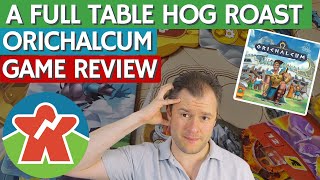
Reviewers who have played Orichalcum, the 2022 game co-designed by Bruno Cathala and Johannes Goupy, describe a short, pointed strategy game that rewards careful planning more than its modest play time suggests. The Dice Tower included it on its top 10 lists, and one host described it as "a bigger strategy game that's like disguised as a light game with just some drafting." The Broken Meeple reached a more reserved verdict. Luke Hector called Orichalcum a game they genuinely enjoy, but one that does not quite earn the very high ratings it has attracted, and gave it a 7 out of 10 mainly because of table space, downtime, and limited replay value. Getting Games covered the game before playing it, relying on the published description of a tense, fast-paced strategy game similar to a short 4X, and said that description alone was enough to make them want to try it.
Core Mechanics That Define Orichalcum
The Shared Action Row and the Terrain Draft
Each turn, players take one action card from a shared row. Cards further up the row cost more to claim, and each card does several things at once: it sets the size of the terrain tile that enters play, it grants an action, and if a volcano appears on the tile, it may bring monsters onto the board. The claimed tile goes onto a personal island board, which is where most of the strategy lives. The Broken Meeple summarized the rhythm as choosing a card, placing its tile, and then resolving the action, which might mean recruiting hoplites, producing orichalcum, fighting monsters, or constructing buildings.
Reviewers stressed that terrain placement is the heart of the game. Three or more matching terrain tiles connected together claim the favor of a Titan, and a tile covered by another tile no longer counts toward buildings, temples, or Titan favor. Players therefore weigh whether to cover a valuable patch of terrain or to build somewhere else, and which building to construct, since buildings are tied to terrain type.
Monsters, Titans, and the Three Ways to Score
Reviewers describe three main routes to victory: building majestic temples, collecting medallion tokens, and winning the favor of Titans. Monsters sit on the island and get in the way, since they block building and the gaining of resources. The Dice Tower described the solution as smacking them around by rolling dice, and the Broken Meeple noted that defeating a monster can earn a bonus even though monsters are mainly a hindrance. Titan favor changes hands during play. The Dice Tower explained that some points are permanent while others are hot potatoes: a player who controls a deity holds a point only until a rival gains that deity's favor. Taking a Titan from an opponent therefore swings the score in both directions at once.
The Orichalcum Experience
Short, Tense Turns and a Race to Five
Reviewers describe the moment-to-moment play as quick and absorbing. The Broken Meeple said that turns are still fulfilling even though they are short, since each choice pits terrain placement against building options and the cost of a card's position in the row. The race itself creates strong tension. The reviewer described the feeling of sitting on four victory points while a rival might be going first, and called that tension "really cool." Because the game ends the moment someone reaches five, the first player marker matters a great deal. It goes to the player with the most hoplites, and the player to the right receives a bonus hoplite, so late-game armies are partly a way of contesting that marker.
Setup, Upkeep, and Table Space
The experience also has a logistical side that reviewers remember. Every round requires refreshing buildings, sliding the action row along, and populating it with new terrain tiles and any volcanoes drawn from the bag. The Broken Meeple said the upkeep can take longer than the turns themselves, and recommended dividing it among the players. The footprint is large as well. Each player needs room for an island board and space above it for victory point tokens, while the building board and action row also need space on the table. The reviewer had passed on bringing the game to club tables because it would not fit. The rules, however, earned praise as clear and pictorial, with a player summary sheet that doubles as a memory jogger once the game is familiar.
What Makes Orichalcum Stand Out
A Clean, Decisive Win Condition
The Dice Tower praised the game's clarity of purpose. Reaching five victory points ends the game immediately, with no final scoring, no completed round, and no counting afterward. Because deity control is fluid, a player who loses a Titan's favor drops a point while a rival gains one, and the Dice Tower found that sudden jump from three to four points exciting. The Broken Meeple also highlighted how little teaching the game requires, saying the rules are easy to learn from the rulebook alone and that the player summary makes a video tutorial unnecessary.
Mythic Theme and Tactile Components
The theme of Greek deities, Titans, and monsters gives the mechanics a narrative reason to exist. The Dice Tower described the theming as neat, pairing it with combat and pushing your luck to get the right outcome. The components earned favorable comments. The action cards are large, Dixit-sized cards that hold their terrain tiles and creatures, so each turn's options sit on a single card, and the terrain tiles carry brightly colored artwork that the Broken Meeple considered nicer than the board art. The reviewer called the production good rather than stellar, and singled out the wooden hoplite pieces and the bags sized to hold the buildings and monster bases.
Potential Drawbacks
Downtime and the Question of Player Count
The Broken Meeple argued that the third and fourth players add little interaction. Card selection is standard Euro-style choice, and the only other interaction is Titan favor moving between players, which led the reviewer to call the game mostly multiplayer solitaire at higher counts. Downtime grows at four players because the first player marker can take several turns to return to a given seat. The reviewer preferred two players, where the game finishes in about 45 minutes and tension over the card row and the first player marker is sharper. Solo play is not in the box and comes only as a print-and-play mode. The reviewer disliked that and found the artificial opponent's behavior, which relies on die rolls for picking and discarding cards, to be a decent but unexciting substitute.
Limited Variety and Replay Value
Reviewers worried about how often games feel alike. The Broken Meeple noted that the action card supply is small, so players shuffle the same deck again and again, and that the three scoring routes tend to produce a similar mix of temples, medallions, and at least one Titan in every game. The reviewer said they were concerned about the game's long life for exactly that reason. Read together, the reviews suggest that Orichalcum is a strong, compact choice for a few plays, but one whose novelty may fade faster than its tension holds up.
If You Enjoy Orichalcum
Cyclades is the closest comparison in the reviews. A Dice Tower host said Orichalcum feels like a lighter take on the same vibe from the same designer, and that if you want that feeling in a game that is "way simpler, a lot more approachable," Orichalcum is a good choice. Players who like Cyclades but want a faster, easier table game may find this a natural next step.
Overboss is the other comparison. A Dice Tower reviewer pointed to the drafting in Orichalcum, where taking a card gives you both an action and a tile to build out your own tableau. That double-benefit pick, the reviewer said, is what makes Overboss feel similar, so fans of Overboss's draft structure should find the same satisfaction here.
What Reviewers Are Saying
"Trying to get to five victory points, the second you achieve that you win the game, I love that clarity of purpose in a game."
— The Dice Tower
"Honestly, you don't need a rules video for this, don't bother watching one, you can learn this game in a matter of minutes."
— The Broken Meeple
"A short 4x game and that right there definitely caught my attention."
— Getting Games