
















Pagan: Fate of Roanoke Deep Dive
What the Community Thinks About Pagan: Fate of Roanoke
Pagan: Fate of Roanoke has struck an immediate chord with reviewers as a masterclass in asymmetric two-player design. Foster the Meeple's first impression was visceral: reading the rules, they were already convinced of its quality before even playing. After their first play, they described it as an instant love and a forever game, one they intend to keep returning to. Meeple University praised its accessibility, positioning it as an entry point to deduction gaming that does not overwhelm. The consensus across channels is that this is a rare game that delivers tactical depth and beautiful presentation without overstaying its welcome.
Core Mechanics That Define Pagan: Fate of Roanoke
Asymmetric Action and Card Play
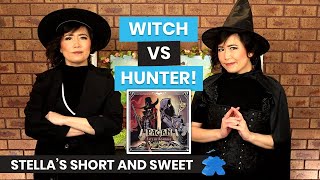
Pagan operates on a foundation of asymmetry so complete that each player inhabits an entirely different game state. The witch and witch hunter have distinct card pools, different powers, and opposing win conditions that shape every decision. Each turn, players assign three action tokens to tasks like drawing cards, gaining influence as currency, or visiting villagers. The witch hunter and witch interpret these same spaces through their opposing lenses, creating tension from the outset. Card play demands influence, a currency earned through action placement, forcing players into constant tactical choices about whether to spend resources on immediate advantage or invest in future potential.
Social Deduction Through Hidden Information and Token Placement
At its heart, Pagan is about reading the opponent's intentions through their resource allocation. The witch knows the true identity of their secret villager and must distribute action tokens across the nine-villager tableau while appearing innocent. The witch hunter lacks this knowledge but gains clues with each action the witch takes, building a probability map of where the threat lives. The witch places secret tokens on their true villager to eventually perform the ritual, while the witch hunter draws villager cards and spends tokens to narrow the field and eliminate suspects. What makes this deduction elegant is that tokens also activate villager powers, meaning both players weigh whether to spread their attention widely or concentrate it. The witch wants to commit to their ritual but risks broadcasting themselves, while the hunter wants confirmation yet loses if they kill too many innocent villagers.
The Pagan: Fate of Roanoke Experience
A Tense Battle of Behavioral Tells
Reviewers emphasize that Pagan delivers a deeply psychological experience despite mechanical simplicity. Each play is a single room, two players, nine suspects. The witch cannot immediately rush to their villager without risking exposure, and the witch hunter cannot know for certain without risking innocent lives. This creates a genuine cat-and-mouse rhythm where small choices ripple with significance. One reviewer admitted to having little idea what they were doing in their first game but immediately wanting another play to refamiliarize themselves with the system. The game's beauty lies in how it makes players paranoid and observant at once.
Variability From Card Depth and Strategic Plurality
While the core loop is tight, the witch and witch hunter each unlock a suite of unique actions. The witch can brew potions, deploy familiars to make village actions more powerful, and cast enchantments to hinder the hunter. The witch hunter can deploy investigation cards on villagers for additional intel or recruit allies to bolster their hunting power, though these come at an influence cost during upkeep. Reviewers noted that the abundance of cards and strategic options means no two games follow the same path, even at two players where the board state is constrained. The game does not require expansions to deliver this variety, a point Foster the Meeple emphasized when contrasting games that feel built on sand against games like Pagan that feel architecturally complete from the start.
What Makes Pagan: Fate of Roanoke Stand Out
Elegant Asymmetry Without Teaching Burden
Pagan avoids a common trap of asymmetric games: teaching overhead. Both roles operate on the same three-token action economy and the same influence-based card play system, but the specific cards and powers differ. This architecture lets players grasp the scaffolding in minutes and then explore how asymmetry reshapes strategy across plays. Meeple University described it as medium complexity, positioning it as accessible to experienced gamers without alienating newcomers who understand two-player games. The rules themselves are not the burden; the burden is reading your opponent, which reviewers identified as the true design achievement.
Presentation That Deepens Theme
Both Meeple University and Foster the Meeple highlighted the game's visual and tactile appeal. The artwork and components draw players in, and that physical presence matters for a game about hidden identity, where players are constantly manipulating tokens and studying an opponent's board. The look of the game supports its psychological warfare, creating a feedback loop where theme and mechanics reinforce each other.
Potential Drawbacks
Role Preference and a Steep First Game
One Foster the Meeple reviewer admitted a strong preference for the witch role over the witch hunter. While they did not fully detail the imbalance, the comment suggests the hunter can feel more reactive, depending on correct deduction to succeed while the witch sets the pacing. Early-game confusion on a first play also signals that the asymmetry, elegant as it is, asks each player to learn two different games at once, which can slow the teach in mixed-experience groups.
Two-Player Only Limitation
Pagan is built exclusively for two players. This is not a drawback for purists, but it constrains flexibility for groups larger than two. Reviewers who love the game at two players may hesitate to pull it out when a third person is present, unlike games that scale gracefully across player counts. For couples and dedicated dueling pairs, this specificity is a feature; for others, it limits the contexts in which the game reaches the table.
If You Enjoy Pagan: Fate of Roanoke
Reviewers positioned Pagan within a constellation of two-player games that prize deduction and asymmetry. Star Wars: Rebellion was invoked as a larger-scale parallel, with one reviewer noting it plays almost like a huge-scale version of Pagan built around the same hidden-information hunt. The Undaunted series resonated as tightly asymmetric two-player card games that reward repeated play. The Lord of the Rings: The Confrontation, a classic of hidden movement and simultaneous reveals, explores similar deduction at a small scale. For those drawn to Pagan's character-driven card play, Dice Throne offers one-versus-one conflict through asymmetric combatants, trading covert deduction for overt combat. The common thread is games where roles feel fundamentally different and deduction unfolds slowly.
What Reviewers Are Saying
"One player is playing as the witch and the other player is playing as the witch hunter. The witch's goal is to trick the witch hunter. There's a bit of a deduction here: the witch is secretly one of the villagers in the village, and the witch hunter is trying to figure out who they are."
— Foster the Meeple
"It was an instant love. It was one of those games where you read the rule book and you're like, I already love this, I already love it."
— Foster the Meeple
"If you enjoy two player asymmetric games with a bit of love and deduction, Pagan may hit that spot for you."
— Meeple University