









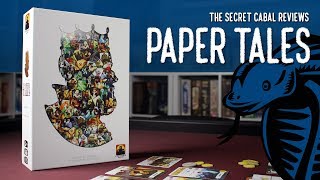
Paper Tales Deep Dive
What the Community Thinks About Paper Tales
Reviewers tend to describe Paper Tales as an elegant, compact card game that delivers more decisions than its half-hour runtime suggests. Designed by Masato Uesugi and published by Catch Up Games, the two-to-five player drafting game earns praise for its tight rules and clear presentation. The Secret Cabal Gaming Podcast called it a filler game with real depth, a combination the reviewer considered unusual. Some reviewers changed their minds after a few sessions. Board Games UnLocked placed Paper Tales on a list of games its host had first judged to be broken, a view that softened once the host recognized that an aggressive building upgrade strategy was a legitimate line of play.
The main points of disagreement concern length and the simultaneous structure. Some reviewers wanted the four rounds to run longer, while others found that fully simultaneous play takes away some of the satisfaction of having a turn of one's own. Luke Hector was more focused on replay value, arguing that the core deck and its theme decks need more additions over time to stay fresh.
Core Mechanics That Define Paper Tales
Card Drafting
Each round opens with a recruitment phase in which every player is dealt five unit cards and drafts one, passing the rest to a neighbor until the hand is spent. Reviewers agree that this draft is where most of the strategy happens. The Secret Cabal Gaming Podcast described the opening draft as the meat of the game, since players are effectively programming their whole round when they choose which card to keep. JestaThaRogue noted that the direction of the pass depends on the current round, which means the people a player can influence change as the game proceeds. Because everyone drafts at the same time, the draft also creates a constant comparison between what a player keeps and what the table is leaving behind.
Engine Building
Units and buildings come into play with ongoing abilities, but the engine they form has a limited life. Luke Hector explained that each card arrives with supplies that represent its activations, and once those supplies run out, the card moves to the score pile. That tension between using an ability now and keeping it around for later shapes the middle of the game. The Secret Cabal Gaming Podcast described the design as a short-term engine, because characters age and die, and the reviewer valued that the engine can be built up robustly even though it will not last. Luke Hector also connected the feel to Valley of the Kings, another game in which cards are eventually moved into a tomb to score.
The Paper Tales Experience
Cozy Charm With a Tight Puzzle
The table feel is warm and inviting. Luke Hector described the game as a very cute, cozy experience, with artwork that draws players in more than the card text does. Beneath that presentation sits a puzzle. Effects are short, keywords are standardized, and the reviewer found the sequencing satisfying once the rules were understood. Board Games UnLocked made a similar point about the phase icons, which let players see at a glance when each ability resolves, so attention can go to combinations instead of the rulebook.
Mounting Pressure From Snowballing Choices
Reviewers describe a steady sense of tension that builds as the deck runs down. Luke Hector noted that around the final third of the game, players start speeding through the deck because the engine snowballs. Every choice between a villager and a gear card carries the question of whether its supplies can be drained before the game ends. The tension is not aggressive, however. Reviewers consistently describe it as a quiet calculation about timing and resources rather than direct attacks on the other players.
What Makes Paper Tales Stand Out
A Solo Mode Built Around Drafting
Solo play is where reviewers were most impressed with the design. Gaming with Edo & Jessica described the Lich King opponent, which comes from the Beyond the Gates expansion, as one of the best solo drafts the reviewer had encountered. The opponent gains points from the cards the player does not take, so every pick becomes a choice between improving one's own position and feeding the opponent. Because the decisions stay with the player, the solo mode keeps the core draft tension intact rather than replacing it with a simplified opponent turn.
Aging Units That Feel Like History
Aging gives Paper Tales a narrative shape. Gaming with Edo & Jessica explained that cards age over time, which lets the game simulate the passage of history, and that many units will not stay on the table for long. Board Games UnLocked described how certain cards can remove aging tokens, keeping a favored unit alive for many rounds and turning that persistence into points. Reviewers see the aging system as one of the clearest links between the mechanics and the theme, and it is a major reason the game feels distinct from other drafting titles.
Potential Drawbacks
Replay Value and the Role of Theme Decks
Luke Hector was the most cautious about long-term replay value. The game uses a core deck along with two theme decks of about 25 cards each, and the reviewer felt that variety alone might not sustain repeated play. They also noted that any future expansion decks would require a redesigned insert, and they suggested that more theme decks, mixed and matched across sessions, would be the simplest way to keep the game fresh. They also pointed out that the box lists two players while the solo rules are not included in the box, which the reviewer felt could mislead buyers.
A Fully Simultaneous Structure
Some players find simultaneous play less satisfying than a conventional turn order. The Secret Cabal Gaming Podcast said that when every phase after drafting resolves for everyone at once, the game can feel as though the real action is waiting until the end. The same reviewer also wanted two more rounds, since the game leaves players wanting to keep building on their engines. The reviewer framed both points as personal preference, and noted that the structure is what makes the game flow so well for others.
If You Enjoy Paper Tales
Valley of the Kings is the most frequently referenced comparison. Luke Hector drew the connection directly, pointing to the shared experience of building an engine and then deciding when to tear it down for points. Board Games UnLocked placed Paper Tales alongside Seven Wonders, describing it as a lighter card drafting game with far fewer icons. Players who want a drafting experience with more interaction than It's a Wonderful World offers may also find the game appealing. All You Can Board described Paper Tales as a candidate for that gap, since the reviewer was looking for a drafting game with more direct interaction than the one already in the collection.
What Reviewers Are Saying
"There is some depth to this game. There's a lot of hard choices during that drafting phase, and it's just a good game. This is one of my go-to filler games right now. I'm keeping it on the shelf, ready to go whenever we need 30-minute games."
— The Secret Cabal Gaming Podcast
"What they do that's actually really fantastic in this is they have icons or numbers for the different phases of when that triggers. You're able to look at the card and see, oh, this is the income because it's number two, and so this is going to trigger during that phase."
— Board Games UnLocked
"It is an awesome mechanic because what I do is I look at what cards I actually need to move ahead, because that's, you know, the main goal. But then I also have to look at the cards I'm not choosing and say to myself, okay, am I giving up any victory points to the Lich King with these?"
— Gaming with Edo & Jessica