/pic4746947.png)














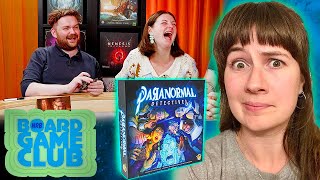

Paranormal Detectives Deep Dive
What the Community Thinks About Paranormal Detectives
Board game reviewers consistently describe Paranormal Detectives as a bridge between party games and deduction mechanics, a perfect modern replacement for Cluedo that brings fresh energy to murder mystery gaming. The game has earned praise for being family-friendly, accessible, and genuinely fun while maintaining enough deductive challenge to keep seasoned gamers engaged. Reviewers highlight how the creative communication restrictions transform what could be a simple guessing game into something memorable and distinctive in the crowded mystery game space.
Core Mechanics That Define Paranormal Detectives
Asymmetrical Communication Through Varied Methods
The heart of Paranormal Detectives lies in its clever constraint: the Ghost must communicate how they died, but only through specific, bizarre methods selected by the Detectives. Unlike traditional deduction games where information flows freely, here each Detective plays an interaction card that forces the Ghost to respond in a particular way. The Ghost might have to mouth a single word silently, arrange rope or wire into abstract shapes, draw with a continuous line while a Detective guides their hand, spell out letters using tokens on a Ouija board-like grid, or even inscribe symbols directly onto a Detective's back. This mechanical variety ensures that clue-giving becomes an exercise in creative problem-solving, where the method chosen can either clarify or mystify depending on the information being conveyed. One reviewer noted the elegance of this design: players must choose not only what question to ask, but how the Ghost will answer, turning decision-making into a puzzle within the puzzle.
Competitive Yet Cooperative Structure
Paranormal Detectives occupies interesting mechanical ground, it's competitive in nature but with a curious twist that creates tension between shared goals and individual ambition. The Ghost wins if anyone solves the case before time runs out, meaning the Ghost genuinely wants the Detectives to succeed. However, the Detectives are racing against each other to be the first to guess correctly, and each player only gets two attempts to solve the mystery. Once a Detective has used both guesses, they're locked out of further guessing but can continue learning information. This structure prevents the game from devolving into pure cooperation while ensuring it never becomes purely cutthroat, the Ghost's success depends on the Detectives collectively finding the answer, even if one Detective claims victory. The scoring mechanism tracks how many keywords each Detective correctly identifies, allowing the game to crown a winner even if nobody fully solves the case.
The Paranormal Detectives Experience
Tactile Silliness Meets Genuine Deduction
What separates Paranormal Detectives from purely cerebral deduction games is its commitment to physical, silly communication methods. Drawing on someone's back, mouthing words they must read from lip movement alone, and constructing questionable rope sculptures are inherently amusing activities. Yet beneath this playfulness lies real deduction work, players must note fragments of information, piece together inconsistent clues, and eventually synthesize disparate hints into a coherent story. The game oscillates between moments of genuine laughter (when the Ghost attempts to convey being eaten by a shark using only bent wire) and moments of focused concentration (when a Detective connects a whispered word with an earlier Ouija board clue). This tonal balance makes the game accessible to casual players who value fun and entertainment while remaining substantive enough for groups seeking deduction challenges.
Variable Information Flow and Hidden Knowledge
Information revelation in Paranormal Detectives follows an intentionally asymmetrical pattern. Most clues given by the Ghost are public, all Detectives see and hear the clue, but the Ghost Touch interaction card is an exception: only the Detective who triggered it receives that specific piece of information. This creates pockets of private knowledge that players must selectively share or strategically withhold. Additionally, the Ghost receives private feedback when a Detective makes an incorrect guess, learning exactly how many of the five answer categories were correct without being told which ones. This incentivizes the Ghost to give targeted bonus clues that address the areas where the current leader stumbled. Over the course of a game, information flows unevenly: early rounds feature tentative groping in the dark, middle rounds accumulate clues that begin forming patterns, and late rounds demand the logical leap that connects fragments into a solution.
What Makes Paranormal Detectives Stand Out
A Fresh Take on Deduction Game Tropes
In a market saturated with Cluedo variants and social deduction games, Paranormal Detectives carves out territory by inverting traditional deduction structures. Rather than providing a fixed set of suspects and weapons to eliminate, the game leaves the solution space completely open, the Ghost's story card contains the unique answer, which could be any profession, location, motive, method, or weapon. There's no master list to work through. Furthermore, instead of players asking yes-or-no questions that the Ghost answers under strict rules, the Detectives dictate the communication method, forcing creativity on the Ghost and interpretive skill from the Detectives. One reviewer placed it second in a ranked list of Cluedo alternatives precisely because it preserves what makes Cluedo fun, that satisfying moment of collective realization, while stripping away the parts that haven't aged well, like roll-and-move movement and limited suspect pools.
Inclusive Design for Mixed Groups
Paranormal Detectives succeeds because it works for players with radically different interests and skill levels. Casual party gamers engage with the physicality and humor of the Ghost's communication attempts. Puzzle enthusiasts find satisfaction in decoding abstract information and spotting logical contradictions. Storytellers appreciate how the hidden scenario card creates narrative coherence, each clue makes sense within a larger story, so players can intuit answers rather than purely deduce them. The two-guess limit prevents runaway leaders and keeps lower-performing players engaged and hopeful. A Detective who hasn't solved the case can still enjoy the intellectual exercise of the deduction rounds. The cooperative element (the Ghost genuinely wants Detectives to win) prevents hostile gaming dynamics that plague some social deduction games.
Potential Drawbacks
Communication Method Unpredictability
Because the Ghost must work within the constraints of cards chosen by Detectives, some questions become nearly impossible to answer clearly through certain methods. Trying to convey complex information like "the victim was a conductor who was killed in a concert hall by a cellist wielding a cello bow" through rope sculpture is legitimately difficult, potentially frustrating for the Ghost and confusing for Detectives. While this unpredictability creates memorable moments, it can also lead to clues that, in hindsight, seem completely disconnected from their intended meaning. Some groups may find this leads to solutions feeling more luck-based than deduction-based, especially if the Ghost struggles to adapt their communication style to the chosen method.
Group Dependency and Quiet Game Dynamics
Unlike Mysterium, which encourages collaborative group discussion and shared interpretation, Paranormal Detectives functions as a more solitary deduction experience wrapped in a party game package. Each Detective maintains private notes on their investigation sheet, and since everyone hears the clues simultaneously, there's actually incentive to keep thoughts private to maintain a competitive edge. This can result in stretches of silence as players internally process information, which some groups may find awkward or slow-paced compared to the discussion-heavy chaos of traditional party games. The game walks a narrow line: it needs enough group engagement to sustain energy, but too much overt discussion undermines the competitive element and reduces the deduction puzzle's challenge.
If You Enjoy Paranormal Detectives
Fans of Paranormal Detectives should seek out Mysterium for a deeper, more collaborative ghost-communication experience with more abstract art cards. Sherlock Holmes Consulting Detective offers meatier deduction puzzles where you actively research answers rather than receive hints. Cluedo remains the thematic companion if you want traditional suspect elimination. For similar party-game energy with deduction elements, Cryptid strips away the Ghost roleplay but delivers pure logical puzzle satisfaction, while Awkward Guests layers deduction into a card-trading mechanic with hidden information. Those who love the silliness should try Chameleon or Fake Artist Goes to New York for non-violent party games built on creative communication.
What Reviewers Are Saying
This is a brilliant family-friendly murder mystery game. It's the perfect modern replacement for Cluedo.
— John Perkis, Actualol
I loved the artwork on the box, and it has a Mysterium vibe all over it. The ghost powers and the different ways you communicate make this really cool. I suggest you look into it if you're a Mysterium fan.
— Board Game Coffee
It's loud fun and funny with room for all at the Cluedo family table. Unlike the tense, quiet, thinky games, this one lets you have a good time while you're solving a murder.
— No Rolls Barred