




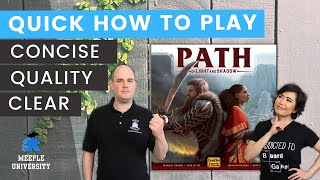



Path of Light and Shadow Deep Dive
What the Community Thinks About Path of Light and Shadow
Reviewers describe Path of Light and Shadow as an area control and deck-building game with a lot packed onto one table. Meeple University introduces it as a game where players lead rising nations, recruit followers into their decks, build structures on personal player boards, and fight for provinces over twelve rounds. Board Gaymes James calls it an area control game mixed with a deck builder and says it scales well from two to four players. The game is set in a realm where the Tyrant Queen has seized the throne and the exiled houses of Foxway, Gorga, Mherzeen, and Spyre fight to take it back.
The shared tone is respect for the depth, paired with a feeling that the game gets less attention than it deserves. Board Game Spotlight says it was hot for a short stretch after release and then faded, while still wishing it had more time at the table. TheGameBoyGeek approaches it as an empire builder that rewards players who manage their deck well, and the enthusiasm comes with an honest acknowledgement that the systems take effort to learn.
Core Mechanics That Define Path of Light and Shadow
Province Conquest Through Dice and Defense
Area control is the spine of the game, and reviewers spend the most time on how conquest works. Meeple University explains that a player spends sword icons from cards in hand and rolls dice equal to the swords on their strongest card, adds the remaining swords to the total, and claims a vacant province if the result meets its defense. TheGameBoyGeek walks through the same sequence and points out that an attacker can only conquer where their leader is standing, which makes leader movement a real strategic choice. When a province is already held, the defender places face-down defense cards, both sides reveal at once, and the attack is never a simple roll. Meeple University also notes that a conquered province weakens by one step for each ruin rolled, so a hard-won hold can slowly erode.
Deck Building With Promotions and Culling
Every player starts with a small deck, and the upgrade path is the engine. Meeple University describes spending hammers to build structures, swords to conquer or to cull low-value cards from the deck, and either icon to promote a card into a stronger counterpart. TheGameBoyGeek shows a promotion in action: a Trusted Follower becomes a Trusted Loyalist drawn from a face-up faction deck, and the promoted card can gain strength or labor based on how far the player has pushed cruelty or mercy. Recruiting from the realm where a province sits adds new cards to the discard pile, and those cards cycle into the deck as it reshuffles. Meeple University sums up the payoff: upgrading followers grants raw points while also making later actions more powerful.
The Path of Light and Shadow Experience
Interactive Area Control Battles
Conquest is never a solo affair. Meeple University calls conquering the map a dynamic area control battle, because the opponent can answer an attack with defensive cards and add the province's innate defense to their own roll. TheGameBoyGeek explains that when the defender's total holds, the attacker must give up cards from their played set to cover the ruins rolled, so a failed attack costs real deck quality. The result is a table where players watch each other's provinces and realms closely, since a province that looks secure can fall on a single good roll.
A Satisfying Engine of Chained Upgrades
The second pleasure is building a deck that works. TheGameBoyGeek puts the goal directly: players manage their deck and leverage the strategies within their cards to have the most influence at the end. Meeple University notes that actions form pathways to victory, with each promotion or structure making the next play stronger. Board Game Spotlight adds that each card offers several options but only one can be used, and everyone shares the same card set, which keeps choices sharp without hidden advantages. Board Gaymes James gives the cleanest summary of the feel: it scales very well at two and at four players and plays smoothly at both counts.
What Makes Path of Light and Shadow Stand Out
A Morality Track That Changes Every Deck
The mercy and cruelty track is the feature reviewers keep returning to. Meeple University explains that pushing a player's morality to either end of the track earns bonus points, and that the extremeness of that morality combines with card powers differently for each faction. Sigil-born cards favor the merciful, Numerai cards have their own effects whichever path a player takes, and the rest of the factions reward the path in their own ways. TheGameBoyGeek adds that players must tailor their decks, their morality, and their actions together to drive a truly optimal strategy. That single tension turns every promotion and every conquest into a decision about who the player is becoming.
Asymmetric Starts and an Expansion That Keeps Its Shape
Starting position changes the game as well. TheGameBoyGeek notes that each player's starting deck depends on where they begin in the realm, and that the ally deck uses only as many cards as the player count plus one, so each game feels different. Board Game Spotlight reaches a similar conclusion, describing a game with so much going on that each play feels unique. Meeple University's preview of the Solstice expansion adds a new faction, Veratus, with a mechanism called doubt that tempts players across the morality track for a range of benefits. Meeple University says the expansion keeps the core mechanism largely intact and adds variety around it.
Potential Drawbacks
Conquest Carries Real Costs
Board Gaymes James is candid that conquest destroys buildings, so players often need to rebuild them, which can undo progress made elsewhere on the board. Meeple University notes that ruins steadily reduce a province's defense, and since defense sets its scoring value, each ruin also costs points at the end of a scoring round. A failed attack in TheGameBoyGeek's walkthrough forces the attacker to remove cards from their deck, so aggression is risky even when it looks promising. Players who dislike losing ground after investing in a fight will find this frustrating.
Complexity and a Long Table
Meeple University rates the game as medium complexity, and its overview covers conquest, promotion, morality, ally requirements, and multiple scoring stages before the final tally. TheGameBoyGeek's explanation confirms how many layers a first play has to absorb, from realm bonuses to end-of-year scoring. Board Game Spotlight describes a 60 to 120 minute game with so much going on that it can be a lot to hold at once. Board Gaymes James offers a counterpoint, saying the game plays relatively quickly even at four players, but the number of systems stays the consistent concern across reviews.
If You Enjoy Path of Light and Shadow
Players who enjoy the card-driven territory fight might look at Ethnos, an area control card drafting game that Board Game Spotlight names as a favorite. Fans of the upgrade loop will likely appreciate Orleans, which Board Game Spotlight ranks among its top games and describes as a deck builder that uses chips in a bag rather than cards. For a deck builder with a strong theme, Board Game Spotlight points to Legendary, which it calls one of the best deck builders ever made. Each of these shares a piece of what makes Path of Light and Shadow engaging, from the territorial fight to the satisfaction of a deck that keeps improving.
What Reviewers Are Saying
"it scales very well and plays very smooth"
— Board Gaymes James
"you're trying to build and manage your deck and leverage the different strategies within those cards to have the most influence in the end"
— TheGameBoyGeek
"to me it's one of those underrated games that people just don't talk about enough"
— Board Game Spotlight