/pic7744587.jpg)


















Patterns Deep Dive
What the Community Thinks About Patterns
Patterns has arrived as one of the standout two-player abstract games of 2023, earning quick recognition among serious gamers. Channels like Chairman of the Board and All You Can Board place it on top-ten lists and praise its elegant design and surprising depth. Reviewers frequently tie it to its spiritual predecessor, Mandala, noting that while Patterns charts its own course on a shared board, it preserves the cerebral, opportunity-cost tension that made the original so beloved.
Core Mechanics That Define Patterns
The Closed Economy of Color Control
Patterns operates within a tightly constrained system where every token is accounted for and every placement matters. Players manipulate tokens on a board, attempting to create connected groups of matching colors while locking in the point values of those colors. The elegant constraint, inherited from the Mandala scoring system, is this: the first color you commit to is worth little per token, but the last color you claim is worth far more. This forces a fundamental tension between grabbing secure early points and gambling on lucrative late ones. The board grows claustrophobic quickly, so by the time the high-value colors arrive, most of it has already been claimed, making every token decision a calculated risk rather than a casual placement.
Pattern Building Through Token Expansion
On your turn, you either start a new region with a color you have not yet claimed, or expand an existing one. Expansion happens in clean, simple ways: flip an adjacent face-down token, or place a new token next to your existing markers. This simplicity masks tremendous depth. Because you hold only one token at a time, you are constantly restricted by what is available. You might envision the perfect expansion, but lacking the right color, you must first waste a turn flipping tokens or pivot your strategy. The board state is perpetually dynamic, and optimal plays shift moment to moment as both players commit to colors and territories.
The Patterns Experience
Tense, Cerebral Abstract Strategy
Reviewers consistently describe Patterns as a brain-burner that generates palpable tension despite having no dice, no randomness, and no cards. The tension stems from opportunity scarcity: the board looks spacious at the start but fills rapidly, so players are perpetually seizing windows before they close. You might line up a perfect arrangement only to watch an opponent start snatching those tokens away, forcing you to reclaim them while they grab opportunities elsewhere. This creates a dance of shifting priorities that keeps both players fully engaged from the first move to the last.
Deceptive Simplicity With Abundant Decisions
Patterns achieves remarkable mechanical elegance: two simple actions, no fiddly exceptions, no rules overhead. Yet the volume of meaningful decisions rivals games several times its complexity. New players grasp the loop within a few turns, but mastery takes repeated plays. The game flows in roughly twenty minutes while maintaining tension throughout, creating a pristine environment where every choice feels weighted. It respects the player's time without skimping on strategic depth.
What Makes Patterns Stand Out
The Mandala Scoring System as the Heart
Patterns inherits the Mandala scoring framework and applies it to an entirely different mechanical substrate. Where Mandala uses card play to manipulate a shared layout, Patterns uses token placement on a shared map. The result feels distinct and self-contained while preserving the signature tension of its predecessor. The scoring system is its soul: it constantly asks whether a color is worth developing now for secure low points, or saving for a richer late payoff that may never materialize. This dilemma never gets stale, and it naturally balances early-mover advantage against come-from-behind plays, the mark of elegant architecture.
Replayability Through Strategic Evolution
Patterns rewards repeated plays with the same opponent in ways few games achieve. A meta develops naturally as both players refine their reads and make fewer mistakes, so each game can feel sharper than the last. Reviewers describe playing it many times with the same partner and finding every session better than the previous one. The depth relative to its weight suggests committed players could stay genuinely competitive across dozens of plays, the hallmark of a true classic design.
Potential Drawbacks
Analysis Paralysis and Extended Turns
Because the game opens so many meaningful planning horizons, players prone to analysis paralysis can bog down turns. The two-player format intensifies this, since there is no downtime to absorb a long think. The board is always dynamic, always offering new possibilities, which means optimal play sometimes demands extended deliberation. Competitive players who love deep tactics will relish this, but casual players seeking a quick, light experience may find the constant tension tiring.
Aesthetic Minimalism May Not Grab Everyone
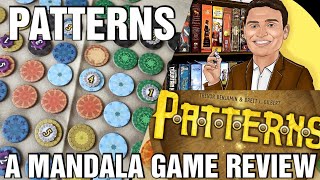
The production is clean and functional: a board, tokens, and control markers, in the understated aesthetic of Mandala. Reviewers find the production perfectly fine and fitting for the game's elegant sensibility, but it is visually restrained compared to flashier modern designs. Patterns will not wow anyone with table presence the way an Azul might. This is not a genuine fault, since the minimal presentation serves the game's purity, but it is worth noting for players who value visual spectacle.
If You Enjoy Patterns
If Patterns resonates with you, several kindred spirits deserve exploration. Mandala, the spiritual predecessor, offers a different mechanical expression of the same tension-filled scoring, emphasizing tactical card play over territorial control. Tiny Towns provides a polyomino-placement puzzle with similar pressure to commit before space runs out. And Biblios delivers comparable decision weight in a lighter package, using card drafting and set collection to create meaningful moments in under thirty minutes. All three share Patterns' philosophy: spare rules, abundant decisions, and finite opportunities that vanish if you hesitate.
What Reviewers Are Saying
"This game is genius. It's an abstract strategy game where you're manipulating this board of tokens, trying to create groups of the same type, and just like the original Mandala, the first set you collect is worth fewer points than the last set you collect. But by the time you get to that last set, most of the board's dried up, so you're going to get few opportunities to score it. So much cerebral tension in this game."
— Chairman of the Board
"This game does a fantastic job of blending strategic and tactical gameplay. You can plan several turns in advance, as long as your opponents don't mess with your plans, but because you only ever have one token to play with at any time, sometimes you are restricted on what you can do."
— Chairman of the Board
"Patterns strikes that balance. It has some of that tactical decision-making, but I have to look at the board and think more strategically, look at where there are clusters of colors, look at the colors in my opponent's supply, and try to discern where they're going to move. I really, really enjoy that decision space."
— All You Can Board