











Paupers' Ladder Deep Dive
What the Community Thinks About Paupers' Ladder
Reviewers describe Paupers' Ladder as a small, warm adventure game that rewards exploration more than combat. The Dungeon Dive ranks it first on its 2024 list of the top ten adventure games of all time, placing it above Fallen Land Second Edition, A Touch of Evil, and Sleeping Gods. Daniel calls it a passion project from a single designer, Paul Stapleton, who handles both the art and the writing, and says that discovering the game was one of their favorite things in recent years. The Dungeon Dive also sees it as a distinctive, almost prototypical adventure game for its channel.
Gaming with Edo & Jessica approaches the game from a storytelling angle. Jessica names it among their favorite solo storytelling experiences because each region deck produces a new event and because the expansions play as separate adventures rather than being shuffled into one enormous deck. In another video Jessica stresses that the game sits on the lighter side of exploration titles and that setup and rules are quick to learn. A third review praises the same qualities from a different angle, describing a welcoming world full of humor in its shops and notes, and emphasizing the amount of care that went into the design.
Core Mechanics That Define Paupers' Ladder
Area Movement
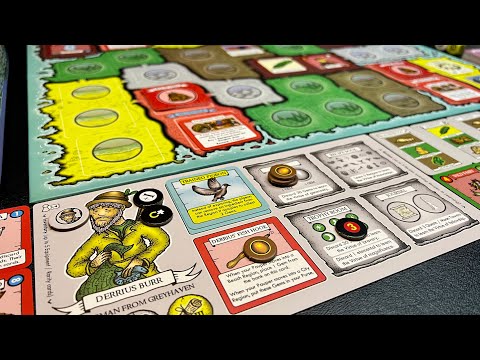
The map of Brighthelm is divided into forest, swamp, mine, mountain, and beach regions, along with cities, and these areas are linked by bridge symbols. The Dungeon Dive compares each area to a space in Talisman: when a popper enters an empty area, the player draws from that region's encounter deck. Daniel notes that the mine deck is especially large, and that the board stays compact enough to take up little table space. Because the expansions add a traveling boat in the Cobbled Isles set, movement can also carry players across water regions and into cities that are otherwise hard to reach.
Resource Management
Gems serve as the game's currency, and reviewers stress that nearly every reward forces a decision. The Dungeon Dive explains that when a hazard is defeated, the player may keep it as a trophy toward a virtue, trade it for gems, or trade it for an ingredient needed for a recipe. Gems can also train a bird for four gems, buy equipment in cities, or fund the virtue of generosity. Daniel's walkthrough shows a pigeon removing unneeded ingredients from a region to collect gems, which turns ordinary exploration into a steady economy. The Dungeon Dive summarizes the result by saying that these small choices make a game that is otherwise driven by luck feel more meaningful.
The Paupers' Ladder Experience
Whimsical Charm
Whimsy is the feeling reviewers mention most often. The Dungeon Dive describes the game as charming, joyful, and full of little surprises, from a pest that is a hazard to be slain to a shipwreck, a gambling den, or a quest to become an exterminator. The Dungeon Dive also compares the game's tone to early British progressive rock and folk, suggesting that Paupers' Ladder feels like the board game equivalent of King Crimson and Fairport Convention. One review adds that the humor in the notes and shops makes the game a source of laughter during play, even when the monsters are dangerous.
Cozy, Breezy Pacing
Several reviewers describe the game's pace as relaxed. Gaming with Edo & Jessica calls the art colorful and the atmosphere cheery and cozy, something they say they rarely find in the adventure genre. The Dungeon Dive describes a "breezy, nicely paced" adventure that can be learned in minutes by anyone familiar with Talisman or Prophecy. Because a complete adventure takes roughly 30 to 45 minutes, reviewers see it as a game that can fit into an evening without demanding a long commitment.
What Makes Paupers' Ladder Stand Out
Two Turns Each Round: Popper and Bird
The Dungeon Dive highlights a structural choice that many reviewers find especially effective. Each turn, a player moves the popper and the bird separately, so the player effectively takes two turns. Daniel argues that this speeds up exploration and keeps pure travel turns from feeling incremental, a problem they see in games such as Talisman and Runebound. The bird can be trained with gems to gain new abilities, which gives the companion a meaningful role rather than making it a simple token.
Expansions That Stand as Separate Adventures
Reviewers repeatedly praise how the expansions are designed. Gaming with Edo & Jessica notes that the expansions are not simply mixed together, which keeps each adventure distinct. One review explains that Moon Towers replaces most decks rather than doubling them, so players experience a separate story with dragons replaced by elementals and moon towers rising from the board. The Dungeon Dive considers the Cobbled Isles expansion the best purchase after the base game, because its city encounters, points of interest, and traveling boat add variety. That same review is less enthusiastic about the boat, however, noting that tracking its movement and its available wares adds upkeep that can be easy to forget.
Potential Drawbacks
Limited Non-Combat Encounters and Solo Scenarios
The most consistent criticism concerns variety beyond combat. The Dungeon Dive says it wishes there were more non-combat encounters, such as an underground river or dwarven tunnels, and it would welcome more solo adventures beyond the existing scenarios. Gaming with Edo & Jessica adds that the quests lack a great deal of flavor text, so players sometimes have to supply the narrative themselves. Reviewers still find the core experience satisfying, but they see the solo options and encounter variety as areas where the game could grow.
Price, Import Availability, and Expansion Difficulty
The Dungeon Dive notes that Paupers' Ladder is not distributed in the United States, so American buyers must order directly from the publisher's website. Because of currency conversion and shipping, the game is expensive, and a single expansion costs close to fifty dollars shipped to the United States. The second edition also does not include expansion material, and the box is only slightly deeper than the first edition. One review describes Moon Towers as a more difficult adventure, and Gaming with Edo & Jessica reports losing badly in that mode, so newcomers may want to master the base game first.
If You Enjoy Paupers' Ladder
- Talisman: The Dungeon Dive places Paupers' Ladder in the same overland space as Talisman, describing it as sitting snugly between Talisman and Prophecy, with a similar board of connected areas.
- Prophecy: The Dungeon Dive compares the game's overland crawl and random encounters to Prophecy, making it a natural next step for players who enjoy that style of adventure.
- Runebound: The Dungeon Dive describes Paupers' Ladder as an evolution of Talisman meeting Runebound, with a card-driven exploration loop and a sandbox approach to goals.
- Lands of Galor: The Dungeon Dive identifies this as the only other game that delivers the same whimsy and joy, though it has a slightly darker edge.
- Realm of Playing: Gaming with Edo & Jessica mentions this title as working in the same general idea, though it typically runs for five or six hours rather than under an hour.
What Reviewers Are Saying
"Paupers' Ladder is my favorite adventure game of all time. I love this world, I love playing in this world, I love the charm, I love the whimsical nature. This game just has a sense of joy to it, and it's simple, but there is a lot of cool little things going on."
— The Dungeon Dive
"Paupers' Ladder plays in about, I'm playing in about 35 to 45 minutes from start to end. Setup is pretty simple, the rules are straightforward."
— Gaming with Edo & Jessica
"I really can't recommend this game enough. When I was setting it up I thought, oh, this seems so simple and there's not a lot to it, but as I was playing it more and more started to kind of reveal itself."
— The Dungeon Dive
DISCLOSURE: This overview was compiled by MindForge's AI from 10 community video discussions. Watch the featured videos above for the full human perspective.