







Pirate's Cove Deep Dive
What the Community Thinks About Pirate's Cove
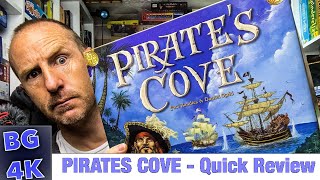
Pirate's Cove, the 2002 Days of Wonder game, is remembered differently depending on whether a reviewer judges it as a family game or as a strategy game. Most commentators agree that its appeal rests on the theme, the ship boards, and its table presence, while the decision-making is considered thin. BoardGameBollocks is the most negative voice, giving the game two out of five and arguing that its length is out of proportion to its simplicity. Tom Vasel of The Dice Tower is far warmer, placing it ninth on a list of favorite pirate-themed games and praising its production for a game of its era. Vasel's later top 100 retrospective on The Dice Tower is more nostalgic still, describing the game as one the reviewer still thinks is good and would love to see fully reworked. Nights Around a Table is dismissive in its Merchants & Marauders review, calling Pirate's Cove boring and dull and a simplified sibling of that design rather than a worthwhile standalone game. The shared view is that families with young children tend to enjoy it, while players looking for strategy tend to find it repetitive.
Core Mechanics That Define Pirate's Cove
Simultaneous Actions
Every turn in Pirate's Cove opens with a hidden choice. Each player secretly selects the island their ship will visit on a wheel, and then all selections are revealed at once. Tom Vasel of The Dice Tower calls this simultaneous selection and points out that the player is choosing where to take their ship while everyone else does the same. BoardGameBollocks describes the same reveal and then explains its consequence: since nobody can see the others' choices in advance, the decision often comes down to hoping no one else picks the same space. Reviewers tend to see this as the game's core tension, and as the reason it feels more like a guessing exercise than a planning exercise.
Ship Upgrades on Rings
Each player's ship mat tracks sails, hull, crew, and cannons with ring markers that start on the second space. Visiting islands lets players move those rings upward, so a ship that has been upgraded can take more damage and hit harder. BoardGameBollocks explains the stakes plainly: if combat knocks a category off the mat, that player loses the battle and is sent to Pirate's Cove. Reviewers like how visible this progress is on the table, although the upgrades are not deep enough to shape the game on their own.
The Pirate's Cove Experience
Lighthearted Family Piracy
Pirate's Cove feels silly and bright. Reviewers describe a swashbuckling atmosphere that is closer to a children's adventure than to a grim sea story. Tom Vasel of The Dice Tower values the swashbuckling theme even when it is mostly playful silliness, and calls the game a very family-style pirate experience. BoardGameBollocks reports that the reviewers' own children enjoy it, and the game works best when the group is happy to go along with its theatrical trappings rather than looking for a tight contest.
Waiting on Other People's Battles
The more frustrating feeling in the reviews comes from downtime during combat. BoardGameBollocks says that players who are not part of a battle have nothing to do but watch, and that the combat is not especially fun to watch. With several battles resolving in a single round, that waiting drags the game down. Combined with a luck-heavy dice system, this produces a sense that a player's fate is partly out of their hands during long stretches of the game.
What Makes Pirate's Cove Stand Out
Named Pirate Captains With Distinct Targeting
BoardGameBollocks singles out the inclusion of famous pirates as one of the game's best features. Edward Teach, Blackbeard, fires first at the player ship with the most cannons, Captain Hook fires at the ship with the biggest hole, and Anne Bonny and Mary Read target the fastest ship. Reviewers appreciate that these special abilities anchor the theme in recognizable history and folklore, and that they add a little more variety to combat than dice alone would provide.
Treasure Cards That Always Reward
The same review praises the treasure phase for almost never leaving a player empty-handed. Treasure cards offer victory points, balloons, or tavern cards no matter which island a ship visits, so the game keeps offering something to celebrate. Tom Vasel's description of the island system supports this reading, since each island is a reason to visit and each visit produces an outcome that feels worthwhile.
Potential Drawbacks
Length Against Thin Decisions
The most common complaint is that Pirate's Cove runs longer than its decisions justify. BoardGameBollocks says a game of twelve rounds takes about an hour, and that the group starts to tire around the eighth or ninth treasure card. Removing cards is not a simple fix, because it would change which treasures appear and could make the draw unfair. Critics conclude that the game has shallow mechanics for its length, with little strategic skill beyond guessing where opponents will travel.
A Dense Rulebook
Reviewers also say the rulebook makes a simple game harder to start. BoardGameBollocks describes it as too dense for a game of this nature, with core rules in the first half and additional essential rules in the second half that are not clearly flagged. The included cheat sheet helps, but reviewers feel the learning curve is out of proportion to the game's actual depth.
If You Enjoy Pirate's Cove
Players who enjoy Pirate's Cove's ship boards and island map will find a more developed version of the same idea in Merchants & Marauders. Nights Around a Table calls Pirate's Cove a vertical slice of that design, keeping the ship mat and archipelago while dropping the freedom, rumors, and missions that make the larger game feel piratey. Players who like the pirate theme but want a bigger, more exploratory adventure may also enjoy Dead Reckoning, which Nights Around a Table describes as having a similar ship-and-island core with buried treasure, ferrying, and attacks, though it runs longer.
What Reviewers Are Saying
"When combat occurs, the people that aren't involved aren't actually going to be doing anything. They're just going to be observing. And the combat's not even that fun to watch."
— BoardGameBollocks
"There's legendary pirates like Blackbeard and stuff going around that you might have to fight, too. It's very lucky in many ways, and it's a very family-style game, but it is very piraty."
— Tom Vasel, The Dice Tower
"Almost everything you do boils down to just a random dice roll, and unlike in Merchants & Marauders where you can mitigate those dice rolls, you're kind of beholden to them in Pirate's Cove. There's no rumours, there's no missions, so there's none of that extra flavour that makes the game super piratey."
— Captain Ryan, Nights Around a Table