







































Pixies Deep Dive
What the Community Thinks About Pixies
Reviewers across the board gaming community have embraced Pixies as a charming, accessible drafting game that delivers more strategic depth than its simple ruleset suggests. The game resonates with both casual players seeking an engaging filler and experienced gamers who appreciate the interplay between card drafting, tableau building, and multiple scoring paths. What stands out most consistently is the game's elegance as a design: it teaches quickly, plays fast, and fits into spaces where heavier games cannot. The game has become a portable favorite at conventions and game nights, praised for being simultaneously light and satisfying.
Core Mechanics That Define Pixies
Card Drafting and Placement
The foundation of Pixies rests on accessible drafting and constrained placement. Each round, players reveal a number of cards equal to the player count and take turns selecting one. The selected card must then be placed into a 3x3 grid tableau, with each position corresponding to the card's number (1 through 9). This simple constraint creates meaningful tension: players must balance what they want with where they can actually place it. The drafting order rotates such that the last player to pick in one round becomes the first in the next, providing a small structural balance. Reviewers appreciate how quickly this mechanism becomes intuitive, allowing players to teach it in moments and jump into satisfying decisions immediately.
Validation and Compound Scoring
Pixies introduces a twist that elevates the puzzle: validation. When players draft a second card matching a number already in their grid, they choose which card remains face-up and which goes face-down beneath it. The face-up card scores its numerical value at round's end, while the hidden one waits for a third matching card to appear later. This validation system creates a strategic layer: do players pursue guaranteed scoring from low numbers or gamble on higher-value cards arriving in future rounds? Beyond card values, players score bonus points from icons (spirals and X symbols) visible on face-up cards. Color-matching bonuses reward building contiguous zones of the same color, with multipliers increasing in later rounds. Reviewers highlight how this multi-faceted scoring keeps decisions engaging without overwhelming complexity.
The Pixies Experience
Relaxed and Meditative Gameplay
Despite its strategic options, Pixies evokes a distinctly calm, almost meditative experience. One reviewer called it relaxing and pleasant, noting that the game's pace and decision space invite unhurried contemplation rather than frenetic optimization. The game plays in roughly 30 minutes, and even a single round feels complete and satisfying. Players mention enjoying a break from heavier games through Pixies, describing it as a palette cleanser that reminds them why lighter designs can be so refreshing. The game's speed makes it ideal for convention play, where 10-minute rounds fit neatly between larger commitments, and for travel, where the tiny box and quick setup remove logistical friction.
Gorgeous and Polarizing Art
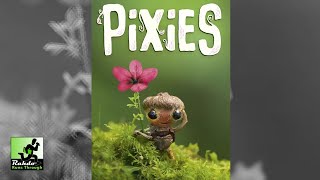
The art forms perhaps the most discussed aspect of Pixies across every review. The cards feature intricate, whimsical illustrations of small creatures by artist Sylvain Trait, created through an unusual process: the artist collects tiny natural objects from the woods and arranges them into characters, then photographs them outdoors. The result is endearingly strange. Reviewers describe the creatures as adorable, weird, Groot-like, reminiscent of a Chihuahua crossed with a bug. Some find the art delightfully charming and evocative; others find it unsettling or off-putting. However, virtually all reviewers agree that the art becomes a conversation piece at the table. One reviewer noted feeling compelled to study the illustrations carefully, finding them worth the time spent looking. Another praised the designer's distinctive visual signature, evident across multiple games. The art is inseparable from Pixies' appeal: it makes the game memorable and gives it personality that transcends mechanical elegance alone.
What Makes Pixies Stand Out
Colorblind-Friendly Design
While many modern games acknowledge colorblind accessibility, Pixies implements the Colour Blind Accessible (CBA) system across all card suits. One reviewer specifically called out how the game uses this symbol language, noting that it represents a best-in-class approach to inclusive design. This is not tokenism but rather thoughtful engineering that lets colorblind players experience the full game without workarounds. Reviewers appreciated seeing this level of care, viewing it as setting an example for the industry.
Genuine Portability and Replayability
Pixies ships in a box barely larger than its card deck. Reviewers highlight that this is refreshingly honest design: no wasted air, no shelf-space padding, just the game. This tiny footprint makes Pixies genuinely portable, fitting into a coat pocket or travel bag without burden. Beyond logistics, the randomness of the deck and the variety of player decisions create high replayability for a game of its weight. Reviewers report playing Pixies repeatedly at conventions, teaching it to new opponents, and finding fresh decisions even in their tenth play. One reviewer mentioned playing as few as one round when time was limited and still feeling satisfied, suggesting the game's design scales gracefully with available time.
Potential Drawbacks
Limited Depth and Luck Dependent
Some reviewers noted that while Pixies offers more strategy than it appears to, it remains fundamentally light. One reviewer observed that strategic players may not face tough enough decisions to feel truly challenged; the game succeeds on charm and accessibility rather than depth. Another mentioned that luck of the draw determines available cards each round, which can frustrate players seeking pure optimization. If drafted cards do not align with a player's developing strategy, they must adapt on the fly. This is manageable and often leads to creative adjustments, but players seeking to execute a master plan may find it constraining.
Polarizing Aesthetics and Potential Complexity for New Gamers
The distinctive artwork divides players. While many adore the quirky creatures, some find them actively off-putting or creepy in ways that detract from enjoyment. Additionally, while Pixies teaches quickly to experienced gamers, it may pose a barrier for absolute beginners transitioning from mass-market games. The concepts of drafting, grid placement, and multi-faceted scoring represent more than a single mechanic, and reviewers who discussed teaching it to non-hobbyists noted targeting existing gamers rather than using it as a gateway title.
If You Enjoy Pixies
Reviewers who loved Pixies often mentioned enjoying Sea Salt and Paper, Six N Mind, Flowers Far Away, and Castle Combo. These games share Pixies' lightness, quick teaching, and satisfying decision density. Players drawn to the art and whimsy might explore other titles by designer Johannes Gopi (who also created Flowers Far Away). Those who appreciate the grid-building puzzle aspect may enjoy Arcs or Windmill Valley, though these venture into heavier territory. For pure portability and filler-game charm combined with light strategy, players often reach for Sea Salt and Paper or keep Pixies permanently in their bag alongside other small-box titles.
What Reviewers Are Saying
"The artwork is adorable and the game is surprisingly more strategic than it looks, with good accessibility through colorblind-friendly design that really sets a standard for the hobby."
— Ryan and Bethany Board Game Reviews
"Pixies is a relaxing game that is pleasant to play, and the images are worth taking time to look at because they are very interesting looking."
— DaniCha
"This is a game that you can take with you everywhere because it packs a big impact in such a tiny box, making it a great gift game and even a stocking stuffer."
— Our Family Plays Games