/pic4199323.png)











































Planet Deep Dive
What the Community Thinks About Planet
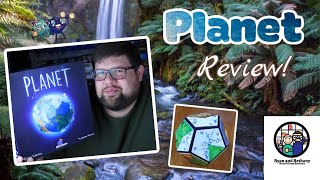
Reviewers who cover Planet mostly land in the same place: it's a family-weight tile-placement game whose novelty is a magnetic, three-dimensional sphere that stands in for a planet core. Ryan and Bethany Board Game Reviews called the magnetic system "really innovative," noting they hadn't seen tiles snap into place quite like this before. Board Game Hangover kept its take short but positive, framing the appeal around a simple hook: magnets are cool, and this game is built entirely around them. Watch It Played and JestaThaRogue both walked through the rules in detail, describing how players build continents, deserts, and glaciers to attract animal cards over a fixed number of turns, without adding much personal opinion beyond the mechanics themselves.
Not every take is uniformly glowing. Our Family Plays Games described a rocky start: they first learned the game incorrectly at a convention and did not enjoy that session, only turning around once they relearned the rules properly and found it treasured in their collection afterward. Actualol landed on a more mixed note, praising the production and the layered objectives but singling out the game as one of the more solitary titles in a roundup of games they had been playing lately, since there is little reason to interact with what other players are doing on their own spheres.
Core Mechanics That Define Planet
Building habitats with magnetic tiles
Each player starts with an empty planet core and, turn by turn, chooses a tile bearing mountain, ice, forest, or desert terrain to snap onto their sphere. Watch It Played's walkthrough frames this as building vast deserts, frosty glaciers, and growing forests across a set of turns, with players free to place a new tile against any region already on their own planet. Ryan and Bethany highlighted the physical side of that placement specifically, since the tiles hold to the sphere with magnets rather than sliding into a track or slot.
Matching habitats to score animal cards
Placing tiles is only half of each turn; the other half is chasing the animal cards that reward specific habitat combinations. Board Game Dad summarized the loop directly: the game is about connecting up regions so that, by the end of a round, the animal whose living conditions are satisfied goes to the planet that built the right habitat. Actualol added that scoring runs on two objective layers at once, a secret objective each player keeps to themselves plus public objectives that everyone is racing to complete, which keeps every tile placement from being a purely private decision.
The Planet Experience
A tactile, visual puzzle
Multiple reviewers come back to how the game feels in the hands as much as how it plays. Ryan and Bethany described real surprise at how well the magnets held a tile in place regardless of how the sphere was turned, calling the result satisfying to handle. Board Game Hangover's take on the same system was blunter: the magnets are simply cool, and that alone helps sell the game to a family table. Our Family Plays Games echoed that appeal, describing the sphere board as a unique way to hold a personal puzzle unlike anything else in their collection.
Ramping tension across the rounds
Reviewers also describe a game that starts simple and tightens as it goes. Ryan and Bethany noted the early turns are just about taking tiles and looking ahead, before the game adds a second and then a third animal card per round, which multiplies how much a player has to track at once. Actualol described the late game similarly, saying that by the closing turns a player's own sphere fills up to the point that certain objectives become very hard to complete, which is where the forward planning of earlier turns pays off or falls short.
What Makes Planet Stand Out
The sphere itself
The three-dimensional magnetic planet core is the detail every reviewer mentions first. Ryan and Bethany singled it out as something they hadn't seen another tile-placement game do, and Actualol opened its coverage of the game by pointing straight at the "3D plastic planets with magnets" before explaining a single rule. That table presence is doing real work for the game's identity, since reviewers reach for it before they describe scoring or turn structure.
Approachable rules with real decisions
Despite the unusual board, reviewers frame the rules themselves as easy to pick up. Actualol pointed out that the rulebook runs only two pages and that almost anyone could play it, while Board Game Hangover described the core action as simple enough that young kids can do it: pick one tile, add it to the planet. Board Game Dad went further, framing Planet as excellent for spatial reasoning specifically because players are constantly turning their sphere to check how different faces border each other, which gives a simple placement rule some real thinking behind it.
Potential Drawbacks
A solitary experience for some tables
Actualol's main reservation was about interaction. There is no real way to interact with other players beyond looking at their spheres, since everyone is mostly working on their own planet and their own objectives, which left the reviewer wanting a bit more back-and-forth from a family gateway game. That criticism sat alongside praise for the same objective structure elsewhere, suggesting the parallel-play design is a matter of table preference rather than a flaw in execution.
A rough first impression if taught incorrectly
Our Family Plays Games' experience is a cautionary example of how much a correct teach matters here. They were taught the game wrong at a convention and came away not liking it, only changing their minds once they relearned the rules themselves and found the full game clicked. Ryan and Bethany raised a related concern about the mental load of stacking three dimensions at once, describing the adjustment as something that twisted their thinking in a way they did not enjoy, even while acknowledging everything the game was trying to do.
If You Enjoy Planet
Board Game Dad grouped Planet with other science-themed picks in the same educational rundown, including Planet X, a logical deduction game built around locating a hidden planet among the stars. Our Family Plays Games placed Planet in the same countdown of underrated favorites as Maglev Metro, praised in that same list for its transparent, painted tiles.
What Reviewers Are Saying
"I like that it just stuck there, and it was perfect, and regardless of when you were moving around it just stayed in place. And so I just thought it was really innovative. I haven't seen anything like that yet, so it was really fun for me to see that."
— Ryan and Bethany Board Game Reviews
"This game is all about animals and where they live. It's not a very informative game, but it is a very exciting game. It'll get children excited about animals, and it's also excellent for spatial reasoning."
— Board Game Dad
"Almost anyone could play this. It has this wonderful 3D appeal, and it has things to think about. My only downside with the game really is that it's a little bit solitary, that you are spending your time looking at your globe and the cards that are there that you're competing over."
— Actualol