




























Point Galaxy Deep Dive
What the Community Thinks About Point Galaxy
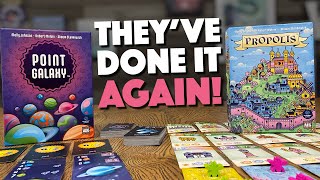
Point Galaxy is the third card game in Flatout Games' "Point" line, following Point Salad and Point City, and channels who cover all three tend to place it in the middle of that lineup. Let's Table It calls Point Galaxy "an excellent addition to this line of games," saying it "fits nicely in between Point Salad and Point City" with more depth than Point Salad but less "stingy" weight than Point City. Tabletoptiktok reaches a similar conclusion from a different angle, describing Point Galaxy as "straightforward to teach" while offering "a little bit more interesting decisionmaking" than Point Salad, and naming it a personal favorite among the three.
Other channels rank the trilogy differently. Tabletop Tolson says Point City still holds their attention the most because of its grid system and building tokens, and calls Point Galaxy "the most complex" of the three, with "more difficult concepts to understand" than either predecessor, even while praising it as "lovely." On a year-end top-ten list from The Dice Tower, one host ranks Point Galaxy as a personal second favorite of the series behind Point Salad, while a second host on the same list highlights "some cool scoring mechanics" and how the solar-system theme comes through on the table. Across channels there is agreement that Point Galaxy is the weightiest and most intricate entry in the series; the disagreement is only over whether that added complexity makes it the best of the three or a reason to keep reaching for Point Salad first.
Core Mechanics That Define Point Galaxy
Open drafting from a shared market
On a turn, a player takes any two cards from a shared market of planet and space cards. Let's Table It summarizes the structure directly: "each turn you'll draft two cards from the market." Tabletop Tolson walks through the options in more detail, noting a player can take "this card and this card," two cards from the same pile, or a card revealed underneath another, as long as both chosen cards can go straight into that player's own solar systems. Because a new card immediately refills each empty market slot, Tabletoptiktok describes the choices as constantly shifting, noting that "the market's always refreshing" and that a player has "tons of options to pick from," even when the exact card wanted is not currently visible.
Building solar systems through sequencing and compound scoring
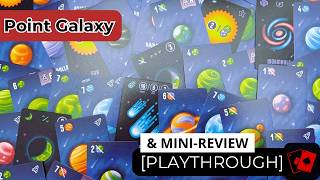
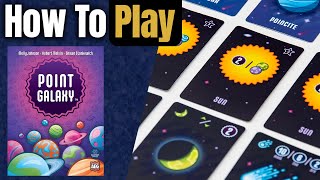
Cards taken from the market form personal solar systems, where planet cards must be placed in ascending or descending numeric order once a direction is set. Tabletop Tolson compares the structure to another familiar game, saying the layout "should remind you of Lost Cities" because "once you choose a direction you can always put cards above" or below the existing run rather than being forced to start at the top. Moon cards attach to a system and only score if they sit next to the color they require, asteroid cards stack one per sun and pay out to whichever player has collected the most by game's end, and wormhole cards reset the numeric sequence so a missed number can still be slotted in later. Rocket tokens, earned for every five matching symbols a player collects, add a further scoring layer once the game ends.
The Point Galaxy Experience
A tense scramble that stays close until the final tally
Several channels describe the game as one where the leader is hard to spot before scoring. Let's Table It says they always enjoy a game where you really don't know who's winning until the scores are tallied at the end, adding that a player who looks ahead can still be caught once "those special scoring conditions come into play" and "the tables can turn pretty quickly." That uncertainty comes from the number of scoring paths running in parallel, since suns, planets, moons, asteroids, rockets, and research icons are all tallied only once play stops.
Fast to teach, with more to chew on than it first looks
Multiple channels describe Point Galaxy as quick to pick up despite its layers. Tabletoptiktok calls it "super quick and easy to teach, easy to pull off the shelf," while still offering "great interesting choices." Tabletop Tolson frames the same trait from the opposite direction, calling Point Galaxy the hardest of the three Point games to teach because of "the sequencing system," the rocket mechanic, and the combined roles of moons, asteroids, and wormholes stacked on top of each other.
What Makes Point Galaxy Stand Out
Distinct iconography across a crowded card set
With suns, planets, moons, asteroids, wormholes, and rocket and research symbols all sharing table space, Let's Table It credits the design for keeping the card types readable, saying "the iconography and graphic design is clear" and that confusion between card types was avoided only because "each had a distinctive icon and style."
Systems that feel familiar without feeling copied
Tabletop Tolson ties several of Point Galaxy's systems back to well-known games rather than treating them as untested, saying the ascending or descending sequence building "should remind you of Lost Cities," and that scoring the most asteroids for a first, second, or third-place bonus "kind of reminds me of Sushi Go." Framed that way, the design reads as a confident remix of proven ideas layered on top of the existing Point Salad and Point City systems, rather than a wholesale reinvention.
Potential Drawbacks
Color-dependent scoring can be hard to read at a glance
Let's Table It raises a concrete concern about accessibility, saying they are not sure Point Galaxy is the most colorblind friendly game, since much of the scoring runs through color, and that even with a distinct pattern on each planet, some patterns risk "getting confused if you're quickly glancing at the cards."
The steepest learning curve of the three Point games
Tabletop Tolson calls Point Galaxy "the most complex" of the trilogy, pointing to the sequencing system, the rocket mechanic, and the combined roles of moons, asteroids, and wormholes as concepts that take longer to teach than either Point Salad or Point City. The same channel says Point City still holds their attention more, in part because Point Galaxy asks new players to track more moving pieces before its scoring pays off.
If You Enjoy Point Galaxy
Channels that cover the series consistently point players toward the rest of Flatout Games' line. Point Salad comes up as the lighter, more introductory option, recommended by Tabletoptiktok for "the most intro game." Point City is named by both Let's Table It and Tabletop Tolson as the other sibling in the trilogy, with Tabletop Tolson calling it a personal favorite of the three for its grid system and building tokens. Tabletop Tolson also draws two comparisons outside the Point series: Lost Cities for its ascending or descending sequence building, and Sushi Go for its ranked bonus scoring on the asteroid cards.
What Reviewers Are Saying
"Point Galaxy really lives up to its name. There are so many ways to score points and many different strategies to try out. The iconography and graphic design is clear. There could be a lot of confusion between planets, Suns, and moons if the care hadn't been taken to make sure that each had a distinctive icon and style."
— Let's Table It
"If you want the most intro game, I would recommend Point Salad. And if you want something with a little bit more decision-making, I would recommend Point Galaxy."
— Tabletoptiktok
"Point Galaxy is the most complex. It has the more difficult concepts to understand, with the sequencing system, with understanding what the rockets are, and with having the moons that are part of it, the asteroids that are part of it, the wormholes that allow you to reset your number system."
— Kimberly, Tabletop Tolson