Point Galaxy
Games in This Video
1 game is featured in this video — it unlocks as you watch.
Transcript
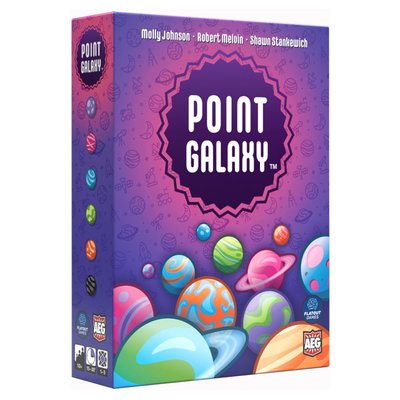
Hello. So, today I want to talk to you about the game Point Galaxy. And you may be familiar with Point Salad or Point City. This is the third game in the series. Not sure if it's a trilogy or if there will be more coming, but this is the newest version. And I think I can safely say it's my favorite version. Point Salad is still the most straightforward and the easiest to teach to people. But this one, I feel like is straightforward to teach, but has a little bit more interesting decisionmaking. So, it's a little bit more elevated than Point Salad. Um, I still will pull Point Salad out, especially with younger players, but I am really loving Point Galaxy. This plays one to five players, and it plays very well solo. It feels just like the regular game. It is a beat your own score, but like with most FlatOut game productions, there are a whole bunch of achievements and like specific goals to try and hit in the back with the solo mode. So, everybody will get a player aid and it is a five player game and came with five player aids as it should.
Everybody will also get a starting card. These are just randomized and you can decide which side you want to play on. And this will be your first starting galaxy. You're going to be building several galaxies and they're all going to score you points at the end of the game. And the bigger you can get your galaxy in general, the more points you will get. So, you'll have a certain number of cards based on player count because the game will end when there are exactly seven cards left. So, everybody gets an equal number of turns. So, you start out with three equal piles. If you want to count it out, go for it. And then below that, you will flip two cards. So, the cards that are flipped are the planets. And they're kind of the primary way that you're going to score points.
So, the biggest thing you would like to be able to do is get numbers sequentially in your solar system 1 through 7 or 7 through 1 because that's going to get you the most points. And all of that is going to be on your player aid. It's going to tell you how those score and on the back is going to tell you what each of the card types are. So, everything is laid out really well. And then there's also these research icons and the more unique ones you can get of that, the more points you will get as well. And then there's things like moons and they're going to score based on colors of planets that they are near. And then there are asteroids. And the more asteroids you can get, whoever has the most at the end of the game will get 10 points, then eight points, then five. So on your turn, you have your starting galaxy. And you can start as many of them as you want. You're going to pick two cards. So I could pick this, which would then start me another galaxy, which is great. I can pick planets. I can pick a com anywhere. Any two cards that are visible I can pick. So maybe I really like this asteroid option to get that started. And it's going to tuck up above my galaxy. And then I like the idea of starting with a two because this tells me I get extra points for green and um pink if I could think of colors.
Green and pink symbols. So each sun you can see will have a scoring condition on it. So that's going to give you something to pay attention to. So, I'm going to take that and put it here. Now, my goal will be to build up from there to get a three and a four to get those sequential numbers. And a card flips out. And my card did have a rocket token. And there's going to be different rockets out here again based on player count. And if I have enough rocket tokens, which is if I can get five of them, then I can pick one of these bonuses that will give me some endgame scoring as well. So then the next person goes, maybe they want this card and this card to put in their galaxy. New cards come out and the third player goes. They took those and new cards come out and it's back to me. So wormholes are great because they essentially let you skip numbers in a sequence and start new numbers. So they can be really helpful if you missed a number. But let's see. I have a two here. So a three and a four would both be helpful. So I just do that. Add on to my galaxy. Cards keep coming out. This you can see on here is one of those research symbols. So the more of those I can get on a future turn. Maybe I'm going to start a new galaxy. And like I said, we keep going until there are only seven cards left.
And then you're going to score up per all of the ways that you can score, which is right on your player aid. Most points wins. So I like this because again, the market's always refreshing. You have tons of options to pick from. Sometimes the card you want, you may not really see, but there's generally enough ways to score and do things that you can be tactical and you can switch it up and you can make it work. So, I think this game is super fun. It fits into the point line that, you know, if you've played any of the other point games, you're very familiar with the three stacks with things coming out with cards being double-sided and you playing one or the other side. I think this one gives great interesting choices, but is also super quick and easy to teach, easy to pull off the shelf, but gives you a little bit more than just Point Salad did. And Point City, I liked it, but where you had to always remember to flip the to the token and all of that, I like Point Galaxy better myself. So, if you are going to get one, if you want the most intro game, I would recommend Point Salad. And if you want something with a little bit more decision- making, I would recommend Point Galaxy. I'm not saying Point City is a bad game. I own all three. I'm a completionist. If that is you, get all three as well. But if you are trying to pick and choose, those are my thoughts. So, let me know what you think. Give me a like and a follow, and I'll keep bringing you more board game content. Thanks. Bye.