/pic5264401.jpg)
Polis is a two-player civ-lite game set in the beginning of the conflict between the two major poleis of the 5th century B.C: Athens and the Delian League against Sparta and the Peloponnesian League. The winner will be the Empire with more population and prestige at the end of the game.
Both players must secure their supplies and the routes to five markets to trade with them. Every turn you get goods from a territory where you have population supporting your Empire, but you should feed them.
You can fight to control the territories and siege other polis or you might use your diplomacy to convince a polis to join your league. But polis are proud of their independence so you will have to create some projects to gain prestige needed for your military manoeuvres.
This new edition of Polis has updated revised rules and new art that will enhance your game experience.
—description from the publisher


Mechanics (from transcript analysis)
Video topics + discussion points
Quotes (from this video)
- From a designer standpoint it didn't disappoint
- I'm not talking about the gameplay I mean who cares about that
- See when I first heard that the publisher was going to change the game's title for the American version I was discouraged
- A unique name gives a game instant mindshare
- At least the new name mysterium continues the brilliant trend of unnecessarily cramming the letter Y into a possibly made up word
- That's how you grab people's attention in today's marketplace
- The market has inevitably become flooded by a sea of game supporting superfluous letters in their titles
- My design theory that anything worth doing it's worth overdoing
- If you want your game to stand out in the marketplace forget innovative mechanisms original gameplay or quality components what you need is an indecipherable name that consumers won't be able to correctly type into a search engine
- Need proof just check out the upcoming wisely named suburbia expansion 5-star
- Try typing that into a search engine that'll wake you up
- It's a brilliant strategy that I'll be employing in the title of my next game
References (from this video)

- innovative auction mechanic with hidden information
- large, visually impactful cards and table presence
- English edition not yet published at time of recording; access depends on publisher
- complex enough that downtime and learning curve may affect some groups
- civilization development via color-coded mechanics
- civilization-building with tableau
Mechanics (from transcript analysis)
- Color-Coded Resource Management — cards of different colors drive actions and bonuses; colors correlate with types of development
- face-down card auction — players auction off face-down cards (with visible back color only) to be built immediately
- Hand management and drafting — draw cards on turns, then bid/choose among face-down options to develop your civilization
Video topics + discussion points
Quotes (from this video)
- I love it
- the fact that the game has you making a long-term strategy and really thinking lots of turns ahead but forcing you to reconsider your plans at every step of the way
- I was not expecting to like this game at all what happened is that I not only liked it but I loved this game
- this is dominating all of my desires to play games over this last month
- it's a very light style game
- this is absolutely a puzzle style experience
- the randomness of input adds freshness
- the beating heart of this game is the bag
References (from this video)

- tension in a light-to-medium euro with influence mechanics
- influence tokens, city/politics style
Mechanics (from transcript analysis)
- influence token placement — players place influence tokens on spots; after all are placed, zones are evaluated by influence density
Video topics + discussion points
Quotes (from this video)
- it's a sleuthing and cooperative game where everybody tries to figure out what actually happened and you can use the internet and Wikipedia
- Isle of Skye it's one of my favorite games ever well my favorite game so far definitely a top-10 game at this point
- the full released copy of Teotihuacan
- I'm writing these large documents with just all of these different thoughts that I have for ways that these games can be tweaked
References (from this video)
- theme-rich and strategically dense
- layered combat and resource planning
- complexity can be a barrier for casual players
- rules and flavor may require careful setup
- resource and population management via wheat
- Athens vs Sparta in an ancient war context
- competitive yet strategic conflict with drafting elements
Mechanics (from transcript analysis)
- action-based turns with two actions per turn — Players alternate taking two actions, then pass and score.
- Resource Management — Managing a scarce resource to feed populations and expand influence.
- Resource management (wheat) — Managing a scarce resource to feed populations and expand influence.
- territory/polis control and development — Conquer and develop polis to gain prestige and population bonuses.
Video topics + discussion points
Quotes (from this video)
- This is a very interesting game I really appreciated the way that the card pairing works I think it's really cool
- Production in this game is super cool there's some surprises in the box
- it's unlike any board game I've played
- the more you put into this game the more you get out of it
- the battle system is so much fun and very smooth
References (from this video)

- tight resource management
- deep strategic decisions with strong interaction
- dynamic swings and head-to-head tension
- Auckland
- Watergate
Mechanics (from transcript analysis)
Video topics + discussion points
Quotes (from this video)
- the art knit is absolutely phenomenal
- it's a very exciting game
- the edge of the seat factor really elevates this game
- it's a tug and pull in an internal tug and pull
- production, the theme, the art, the rules are easy to teach
References (from this video)

Mechanics (from transcript analysis)
Video topics + discussion points
Quotes (from this video)
- There's a lot of designers and company representatives that are there, like GMT Games is there, uh Uwe from Sound of Drums was there coming in from Europe.
- So, if you're looking at a chance to play up-and-coming games with some of the designers that are designing on them, it's quite an experience.
- You really get some insight into the design process, into how historical board games are created as you're playing them and giving feedback to the designers.
- In this game, you take on the role of companies that are trying to win military contracts uh from the US
References (from this video)

- Appealing to families and friends for frequent play.
- Quick setup and gameplay.
- Interesting mechanics.
- Concerns about long-term variety and replayability.
- Elections
- United States Politics
Mechanics (from transcript analysis)
- Set Collection — Implied by collecting cards that give abilities or scoring.
- Worker Placement — Players place a worker or recall workers.
Video topics + discussion points
Quotes (from this video)
- Elect yourself president from Parker Brothers.
- It's all it takes to buy your presidency.
- Flip It Jackpot endorsed by television personality Flip Wilson.
- Nightrider.
- Chips.
- The Bionic Woman.
- $6 Million Man.
- Thunderbirds.
- Pre Matt Lecock.
- Get smart.
- I love this.
- I love this book.
- This is my favorite one that I've ever pulled off the shelf.
References (from this video)

- Described as a 'really really good game'.
- Considered 'way too heavy' by some.
Mechanics (from transcript analysis)
Video topics + discussion points
Quotes (from this video)
- I have tons of like RPG books that I'm like, why did I buy this?
- we end up in situations where there's diamonds in the rough.
- I found the complete book of necromancers. I forgot that I ever owned that.
- if you try to auction that now, um, you can get a few hundred for it, which is ridiculous.
- I'm actually excited to have like Aldi on cuz I want to talk cuz he's one of those guys that, you know, obviously he runs conventions.
References (from this video)
- Simple to learn and play
- Inexpensive
- Portable
- Has a unique move where opponent's piece is trapped and moved
- Derivative of Pente
- Thin, unsightly pieces with a large 'C' on them
- Cloth board is disliked
- Lacks the depth and tension of games like Chess or Pente
- Doesn't feel unique
- Pente
- Checkers
- Chess
- Othello
Mechanics (from transcript analysis)
- Five in a row — The objective of the game is to get five of your pieces in a row to win.
- Piece trapping/flipping — A special move involves trapping two opponent's pieces between two of your own, flipping one, and forcing the opponent to move it instead of placing a new piece.
Video topics + discussion points
Quotes (from this video)
- Smarter than checkers, more fun than chess. A rip-off of Pente.
- It's okay. It's okay, right? It's very okay
- Chess has trauma. This doesn't really have drama, unfortunately.
References (from this video)

- Freeform racing concept; interesting idea
Mechanics (from transcript analysis)
- Race — Players move a vehicle along a track; the path determines eventual motion.
- racing — Players move a vehicle along a track; the path determines eventual motion.
Video topics + discussion points
Quotes (from this video)
- Cash and Guns is such an excellent game.
- I think it's the last game they made and it just wasn't very good.
- Beasty Bar Down Under... five out of 10.
- Aridia. One of my favorite, probably my favorite adventure dungeon crawl style game. A 10 out of 10.
References (from this video)
- tight puzzle with high stakes that grows with play
- historical setting grounded in real locations and geography
- presents satisfying payoff when resource optimization lines up
- potentially heavy setup and two-player focus may limit variability
- territory control and resource economics within a historical milieu
- Ancient Greece city-states (Athens vs. Sparta)
- historical attribute-driven strategy with a tight resource puzzle
- Barrage
- Vital Lacerda games
Mechanics (from transcript analysis)
- combat_and_territory_conflict — limited direct conflict to determine territorial advantage
- economic_engine_building — players build an economy across rounds to outpace rivals
- resource_management — players optimize scarce resources to perform actions and advance their position
- territory_control — players contest map areas to influence and control resources
Video topics + discussion points
Quotes (from this video)
- it's going to be a look back at what we've been playing in the previous month
- the more you play this the more it opens up because you learn how it works
- we rinsed it, I've had a lot of comments on Instagram and the video that we put out there
- it's addictive little game and it's not always heavy; it's nice to have a quick round at the end of the night
- you can feel free to explore more tiles than in Maracaibo because it's not a race to the end
References (from this video)

- High production feel and solid euro mechanics
- Production may feel dry vs other heavier euros
- resource management and area control euro
- ancient Greece
- mean, tight, and combat-lite
- Twilight Struggle
Mechanics (from transcript analysis)
- Area control / engine reduction — Tight control of provinces with resource costs.
- Resource Management — Trade/invest resources (wheat, wine) for actions.
Video topics + discussion points
Quotes (from this video)
- it's incredibly well balanced and it's drafting game as well
- it's chess like and really tense
- cooperative game... until it isn't
References (from this video)
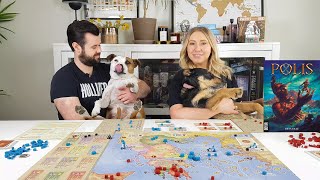
- tight resource management
- strong thematic integration
- high production value and components (divots, silk screens)
- fast setup and intuitive rulebook
- flexible playstyle appealing to euro and war-game players
- combat feels tedious and rarely occurs
- potential for stagnation with repeated plays and non-confrontational play
- not a must-have and not completely novel mechanically
- price may be a consideration for some players
- Resource management, civilizational growth and political strategy
- Ancient Greece, city-states such as Athens and Sparta
- historical/abstract
- Barrage
Mechanics (from transcript analysis)
- Action economy — Two actions per turn, with a no-repeat rule for actions; some actions convert population into units.
- combat deck — A deck of cards governs battles; combat is infrequent and can be cumbersome.
- Event cards and scenario variance — Round-based event cards can shake the state of the board.
- Movement and territory control — Move units, lay siege to a polis, and contest control.
- Population cube resource management — Population cubes on polis cards represent population; spent to upgrade units and influence control.
- Prestige as resource and VP — Prestige is precious, used for actions and tracked as victory points; running out loses the game.
- Resource management (wheat) — Wheat scarcity drives growth; you pay wheat to grow population and to end rounds.
- Trade and tribute — Trade actions via proxies; bribe population to influence politics and capture resources.
- Unit types and conversion — Population can be converted into hoplites, galleys, or merchants.
Video topics + discussion points
Quotes (from this video)
- the rule book is pretty great
- setup is lightning quick
- the components are so high quality
- Polis allows you to play like a euro game with minimal interaction or more like a war game with more aggression
References (from this video)

Mechanics (from transcript analysis)
Video topics + discussion points
Quotes (from this video)
- you're like one of the nicest people ever
- that was a perfect picture round you did awesome
- you got a total of 14 points emerson, which is huge
- look up emerson's games on bgg everybody they're fantastic
- cyber bunny