



















Quirky Circuits Deep Dive
What the Community Thinks About Quirky Circuits
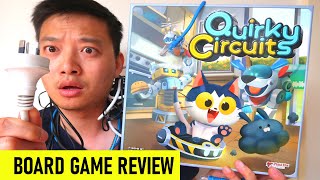
Quirky Circuits, designed by Nikki Valens and published by Plaid Hat Games, is generally described as a light cooperative programming game that packs a lot of deduction into a short session. The core appeal is consistent across reviewers. Board Game Sanctuary calls it a fully cooperative programming game in which every player contributes to a shared robot program without revealing the cards in hand, and it treats the resulting guesswork as the heart of the design. Meeple University, in a live playthrough of the game's second scenario, shows how quickly a session moves and how often a group's plans fall apart once the cards are flipped.
Opinions diverge mainly on who the game suits. Several channels treat it as a family or teaching game first. Board Game Hangover names it as one of its most-played titles of the year because it is easy to teach to children, and it notes that a failed scenario can simply be restarted. Board Game Sanctuary takes a similar view but warns that serious competitive players are unlikely to enjoy a game where so much of the outcome rests on teammates. Most other reviewers agree that the game's charm grows with repeated play, even if they differ on whether that growth is worth the frustration along the way.
Core Mechanics That Define Quirky Circuits
Programming
Reviewers tend to describe programming as the engine of the game. Each round, players select command cards from their hands and place them face down in a single shared row. There is no turn order. A player may add a card whenever they believe it belongs in the sequence, but each new card must go to the right of those already placed, and the order cannot be rearranged afterward. Only when the row holds at least five commands and every player agrees does the group reveal it and carry out the moves one card at a time. Watch It Played walks through the rules in detail, and Board Game Sanctuary notes that the lack of turn order fits the theme, because players drop cards in as soon as they think the sequence is about to work. Because the robot's path is determined by the row as a whole, a player must anticipate several steps of movement and what the other players are likely to add at the same time.
Limited Communication
The restriction on speech is the feature reviewers return to most often. Players may not describe the hidden side of their cards, reveal which cards they have already played, or suggest what others should do. The only shared information is printed on the card backs. Each command shows a movement category, such as a turn or a forward move, but not the exact action, so a player who places a turn card is signaling a turn without revealing whether it goes left, right, or around. Board Game Sanctuary describes this as a deductive exercise in which players try to read the intentions of their teammates from a row of card backs. Board Game Sanctuary's video on silence in games makes a related point: the limited communication pushes players to try to tap into each other's thinking, and the group often ends up synchronized after enough rounds.
The Quirky Circuits Experience
Collaborative
Playing Quirky Circuits feels like sharing one nervous plan with the whole table. The win or loss belongs to the group, and the battery track acts as a steady clock that reminds everyone that each round costs a little of the robot's energy. Reviewers describe the moments when the group's guesses line up as especially satisfying. Board Game Sanctuary says that when players reveal their cards and see the robot land where it should, the table gets a sequence of small celebrations. The same channel says the group often ends up synchronized, even though no one is allowed to say what they are thinking. The opposite experience is equally vivid. Meeple University's hosts laugh through a run where the robot drifts into the wrong corner, and their tone suggests a team that is frustrated but still invested in the attempt. Collaboration in this game is not a comfortable agreement; it is a shared negotiation conducted through cards.
Rewarding Mastery
Many reviewers say that the game only reveals its depth after a group has played for a while. Board Game Sanctuary explains that the later scenarios become much harder, with new mechanics and more challenging goals, and that a group's experience with each robot gradually improves its results. Board Game Hangover admits that its group had never progressed beyond the third scenario, yet still describes the feeling of finally clearing a stage as deeply satisfying. That combination of difficulty and reward is central to the experience. Players who return to a scenario after a failed attempt tend to talk about it as a puzzle they have not yet solved rather than as a loss.
What Makes Quirky Circuits Stand Out
A Scenario Book That Escalates Steadily
The most praised feature is the scenario book. Board Game Sanctuary describes each entry as increasing in difficulty, with new rules introduced gradually and objectives that grow more demanding as players work through the set. The reviewer compares this structure to Super Mario World, where each stage builds on the lessons of the last. Watch It Played notes that the scenario book contains many different puzzles that go beyond removing items from a board, including picking up objects and delivering them to new locations. Meeple University's live playthrough shows the later stages introducing flower pots, chairs, and tunnels, each requiring a different plan. The book gives the designer room to pace difficulty and to keep the game fresh across many sessions.
An Accessible Gateway for Families
Reviewers also praise the game as an approachable entry point for new and younger players. Board Game Hangover describes it as simple and quick enough for children to learn, while still giving adults a meaningful puzzle to solve. Because failure only costs a restart, families can keep trying scenarios without a long reset. The Cardboard Herald, reporting from PAX Unplugged, notes that Plaid Hat is using the game to reach families who are not yet hobby gamers, and that the publisher had brought it to a programming club for young people.
Potential Drawbacks
Limited Control for Competitive Players
The most consistent criticism is that the game does not suit players who want to control their own result. Board Game Sanctuary says that players who dislike putting the outcome of a game in other people's hands will probably find it frustrating, and that serious competitive players are unlikely to enjoy it. The same reviewer frames the game as a fun, social experience that is better at building cooperation than at delivering a sharp contest of skill. Players who value precise planning may find that the hidden cards and limited speech undercut their ability to optimize, and that a single misread card can undo several turns of careful setup.
Coordination Gets Harder as the Table Grows
Reviewers note that the game plays differently at different player counts. Board Game Sanctuary describes the two-player game as especially elegant, but says that with three or four players the table becomes more frenetic, because it is harder to stay in tune with several other minds. The same reviewer observes that a hand can contain a combination of cards that do not work together, such as several turn cards that send the robot in circles. Meeple University adds that the limited speech can make a live stream difficult to follow, since the hosts cannot explain their reasoning while they play.
If You Enjoy Quirky Circuits
Players who enjoy Quirky Circuits's programming system will find a similar satisfaction in Robo Rally, where players also commit a sequence of moves in advance and then watch the robot follow it. Board Game Sanctuary notes that players familiar with Robo Rally or Colt Express tend to feel at home with the game's programming, and Board Game Hangover describes it as a mix of The Mind and Robo Rally. Those who appreciate the limited communication will find a similar challenge in The Mind, where players must read each other's intentions without speaking. For fans of the scenario structure and the family-friendly tone, Mice and Mystics and Familiar Tales are worth exploring. Meeple University groups these Plaid Hat titles together when discussing how the publisher handles its scenario books, and The Cardboard Herald places Mice and Mystics among the publisher's marquee releases.
What Reviewers Are Saying
"That kind of deductive puzzle element is truly what makes this game so good. Each play, it feels like they're fulfilling their role in the action sequence, and when you start revealing the cards and seeing whether the robot actually goes there, there's so many of those great aha moments."
— Board Game Sanctuary
"To be honest, we've never gotten farther than the third scenario out of what, 20 I think, but the satisfaction from finally beating that level is immense."
— Board Game Hangover
"Because we can't talk strategy, we can only let it happen and then talk about it."
— Meeple University