


Quodd Heroes Deep Dive
What the Community Thinks About Quodd Heroes
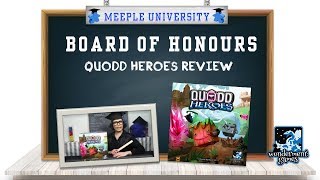
Reviewers describe Quodd Heroes as a fast, modular adventure board game that borrows the feel of a video game. Meeple University introduces it as a board game version of Super Smash Brothers, Mario Kart, and Legend of Zelda, where players race, compete, and cooperate across different scenarios. The praise centers on the movement system, the cartoon artwork, and the way each scenario feels distinct. Opinions diverge on how demanding the movement rules are and how much the chaos suits a particular group. The Dice Tower's Tom Vasel said the first edition was very fun, while expressing uncertainty about whether the second Kickstarter edition ever delivered.
Core Mechanics That Define Quodd Heroes
Tumble first, then act on the face that lands up
Each player controls a cube-shaped hero. On every movement, the hero tumbles into an adjacent space and then performs the skill on the face that ends up on top. Meeple University lists the faces as diagonal or orthogonal slides, another tumble, or a jump, with the sixth face granting a unique character action. Board to Death TV's designer demo explains that the tumble skill is affected by movement points, so a hero can tumble more than once in a turn and change direction partway through. Reviewers treat the landing face as the real decision, because the side a hero finishes on determines what its next step can do.
A second copy of the hero for planning
Every player receives a duplicate of their hero. The copy on the board must keep its orientation, so players can plan multi-step turns with the spare miniature while other players act, then carry the plan out on the board. Meeple University's review says the spare copy makes special rotations easier to picture. The designer's tips video recommends using the tumble skill whenever possible, since it lengthens a turn beyond what a single tumble allows.
Cards, tokens, and a board that changes
At the end of a turn, players draw cards equal to the number shown on their player board. Cards offer temporary movement boosts, lasting item and pet abilities, and board effects such as springs, walls, tunnels, and teleporters. The designer's tips note that a spring placed directly ahead of a hero can carry it several spaces further in one turn, and that a token placed on a wall removes that wall from play. Meeple University notes that five cards are laid out for players to choose from, and that not every card is used in every scenario, which keeps the game balanced. The play area also changes from scenario to scenario, with pits, trenches, rivers, and other obstacles that alter how a route can be planned.
The Quodd Heroes Experience
Chaos layered on top of planning
Board to Death TV describes the feel as more chaotic than the box suggests. Players push one another, build walls and tunnels, and use rotating elements, so a carefully planned route can be disrupted on another player's turn. Meeple University warns that planning can run long and invites analysis paralysis, especially for players who chain several movement cards together. Reviewers describe the rhythm as a blend of puzzle solving and reacting to what the other players have just done.
Modes that share one movement system
Scenarios include point-to-point races, team-versus-team games, collection events, overlord challenges in which one player tries to spoil the others' objectives, and solo or cooperative puzzles. Meeple University says these modes all use the same mechanisms but give a different feel. The cooperative puzzle mode earns particular praise. Each player still moves their own hero, but the group divides responsibilities at the start and works toward a shared goal, a structure the reviewer compares to the feel of Kingdom Rush.
What Makes Quodd Heroes Stand Out
Video-game presentation
Meeple University's reviewer says the cartoon artwork reflects the video-game adventure theme across the board and cards. Board to Death TV likens the way pieces move to a platformer, with heroes sliding, jumping, and tumbling through hazards. The production also draws comment, with the reviewer noting that the box is heavy because it holds a large amount of cardboard, and that the icons make rules easy to recall once a player is familiar with them.
Forgiving failure and replayability
Players are never eliminated. A hero that falls into a pit or is pushed off the board respawns at the nearest checkpoint. Meeple University calls the game a little forgiving and notes that every player receives unlimited lives, which keeps newcomers in the action. Replayability comes from the variety of scenarios, modes, heroes, and cards, and the reviewer suggests playing several times once the rules are familiar.
Potential Drawbacks
Rules that take a few games to absorb
Meeple University found the basic movement straightforward but said that combining it with card effects required some searching through the rulebook, and the publisher's online clarifications help with those cases. The same reviewer had not noticed an obvious catch-up mechanic, and acknowledged that the scenarios can produce king-making moments. The designer recommends playing loosely in the first few games and learning how movement and cards interact by simply tumbling and seeing what happens.
Heavier than some casual groups expect
Meeple University's reviewer believes the movement can be complicated for families and casual players, although the cooperative and overlord modes let parents guide younger players through the game. One of the Dice Tower hosts described the game as a slower, more complex Robo Rally where the goal is to beat up on one another rather than simply race, and admitted the game did not win them over because so much is happening at once. Buyers should also know that reviewers were unsure whether the planned second edition ever arrived, so the first edition is the version most reviewers actually played.
If You Enjoy Quodd Heroes
Players who enjoy Robo Rally will recognize the appeal of racing around a board where movement is the main decision. The Dice Tower's Tom Vasel calls the game "a fun almost Robo Rally type thing," and Board to Death TV's designer demo describes its race scenario as "a bit Robo rally ish." Players who enjoy the Mario Kart, Super Smash Bros., and Legend of Zelda comparisons will find the chaos, shifting scenarios, and varied objectives familiar. Players who prefer puzzle planning and cooperative play should start with the cooperative scenarios.
What Reviewers Are Saying
"there is chaos in this game for sure either created by other players pushing you or creating board elements"
— Board to Death TV
"it does feel like playing video games a bit with the artwork and the movement style"
— Meeple University
"it's like a fun almost Robo Rally type thing"
— The Dice Tower