/pic1950487.jpg)
/pic3264158.jpg)
Qwixx is a quick-playing dice game in which everyone participates, no matter whose turn it is. Each player has a scoresheet with the numbers 2-12 in rows of red and yellow and the numbers 12-2 in rows of green and blue. To score points you want to mark off as many numbers as possible, but you can mark off a number only if it's to the right of all marked-off numbers in the same row.
On a turn, the active player rolls six dice: two white and one of each of the four colors listed above. Each player can choose to mark off the sum of the two white dice on one of their four rows, then the active player can choose to mark off the sum of one colored die and one white die in the row that's the same color as the die. The more marks you can make in a row, the higher your score for that row. Fail to cross off a number when you're the active player, however, and you must mark one of four penalty boxes on your scoresheet. If you mark off the 2 or 12 in a row and have at least five numbers marked in that row, you get to also mark off the padlock symbol in that row, locking everyone else out of this color.
When either a player has four penalty boxes marked or a second color is locked, the game ends immediately. Players then tally their points for each color, sum these values, then subtract five points for each marked penalty box. Whoever has the highest score wins.
This page includes videos and mentions from the whole Qwixx family. Drill into a specific game below.
/pic1950487.jpg)

How to Play Quiltable
- Simple to play
- Suspenseful dice rolls
- Fast-paced
- High replayability
- Small box, good for travel
- Can be sad when you don't get desired rolls
Mechanics (from transcript analysis)
- Dice rolling and crossing off — Players roll dice and cross off numbers on their sheet.
- Left-to-right progression — Players must go from left to right on their sheet.
- Point scoring — Points are gained by crossing off numbers, aiming for the most points by creating long combinations of breaks.
- Simultaneous Play — It's simultaneous play.
Video topics + discussion points
Quotes (from this video)
- This is probably one of the most unique roll and writes I think I've ever played.
- It's got a lot of challenging things in it and it's not a simple roll and write.
- You're taking tiles out of this central area, you're drafting tiles, and then you're placing those tiles into your grid on your paper.
- And then the scoring is based on sets of symbols.
- It uses very minimal components, just a pencil and paper.
- We're doing a giveaway.
- We'll be talking about the two games that we're being we'll be giving away actually today so if you're looking to win a copy of silver and gold or sonara then make sure you comment down below and check out our other videos to get even more.
References (from this video)

- Host does not love Quixx.
- Quixx
Mechanics (from transcript analysis)
- Roll and Write — it's just an okay roll and write.
Video topics + discussion points
Quotes (from this video)
- Hens is a game I didn't like at all.
- Gobblet is a simple game in which you are to stacking pieces and trying to get four in a row, but bigger pieces cover up other pieces.
- Dice as resources to buy cards, kind of like a Dominion-style game. And it was fine. It just didn't have any kind of air of excitement to it.
- And it's a big, grandiose Euro-style game that I thought worked pretty well.
- The biggest problem with Echoes of Time is I think it's almost too short.
- It's a cool mechanism. This is the game that should have it.
- It's a very different feeling of Lost Cities. It's not as good as Lost Cities, but it's still pretty cool game.
- It's very Ameritrashy.
- It's a lot going on in this game.
- I think my favorite of those is Pixel Tactics 2.
- Thanks as always for joining me in my pile of mid games.
References (from this video)
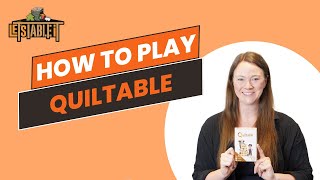
- clear communication of rules in a prototype context
- focus on pattern drafting and tile placement
- thematic link to quilting and competition adds flavor
- prototype components and some rules may change before final production
- scoring rules can be somewhat nuanced in early iterations
- pattern construction under time/competition pressure; crafting the best quilt through card drafting and placement
- tabletop quilting competition with a 4x4 quilt grid, pattern piles, and a outside pattern ring
- instructional/tutorial
Mechanics (from transcript analysis)
- Card Drafting — take a visible pattern card from the central piles
- Compound Scoring — score patterns by how many times they occur in your quilt; a Quilt Block can count for multiple patterns but only once per pattern
- outer_ring_discard_and_taken_on_future_turns — discarded cards can be taken on future turns if the outer ring has space
- pattern_area_refill — refill the empty spots in the pattern area after you take blocks
- pattern_card_drafting — take a visible pattern card from the central piles
- pattern_scoring — score patterns by how many times they occur in your quilt; a Quilt Block can count for multiple patterns but only once per pattern
- premium_block_bonus — score an additional point for each premium Quilt Block indicated by a star
- quilt_expansion_and_scoring_trigger — move 1-4 connected cards from your quilt to the outside ring of the pattern area
- Tile Placement — take 1-3 connected Quilt Block cards from the pattern area and add them to your quilt while preserving their order and position
- tile_block_placement — take 1-3 connected Quilt Block cards from the pattern area and add them to your quilt while preserving their order and position
Video topics + discussion points
Quotes (from this video)
- game quilp designed by Jared Richardson
- remember patterns are scored as many times as they occur in your quilt
- one Quilt Block can count for multiple patterns but can only count once for each pattern
- and published by Circle J
- first Shuffle the quilt cards and
- prototype to us because this is a prototype
References (from this video)

- Easy to learn and quick to play
- Supports a large number of players
- High replay value due to different dice outcomes and scoring opportunities
- Relies on dice luck, which may upset some players
- Limited complexity may not satisfy heavier gamers
- speed, scoring, probabilistic decisions
- Casual party/rapid-fire family gaming
- pragmatic, results-focused
Mechanics (from transcript analysis)
- Dice Drafting — Two white dice and four color dice are rolled; players selectively mark numbers on their score sheets based on dice results.
- dice-drafting / roll-and-write — Two white dice and four color dice are rolled; players selectively mark numbers on their score sheets based on dice results.
- dynamic score-sheet progression — Players cross off numbers in color rows that advance toward a finishing condition; strategic choice vs. luck governs progress.
- multi-player simultaneous play with turn-order influence — Active player marks two items; other players may mark one, all while racing to complete score lines; sequential constraints apply to scoring.
Video topics + discussion points
Quotes (from this video)
- This is a classic for us.
- Our copy is getting worn and it may be time to upgrade.
- This is definitely one of our most played games.
References (from this video)
- Ingenious simple concept
- Family-friendly accessible design
- Strategic depth despite simplicity
- Reminiscent of classic games like Scrabble
- Classic accessible abstract game
- abstract
- color matching
- shape matching
- Scrabble
Mechanics (from transcript analysis)
- Grid Building
- line completion
- pattern matching
- Set Collection
- Tile Placement
Video topics + discussion points
Quotes (from this video)
- This is the tile laying game this is the entry point into the modern board gaming um world for many many people
- Those moments are rare in gaming and it is one of those games where you'll stand up and shout yeah yes you know your your your camels just won the race
- When it works oh my word it's a Sublime experience
- Dominion was an absolute turning point in the hobby
- The Artistry that has gone into this game the beautiful images the beautiful artwork
- You can't really talk about carcassonne without thinking about Ticket to Ride because really these are the two most significant games as Gateway Games into our hobby
- This game is that it's it's so ingenious the fact that you can explain the rules on a single rule sheet
- Dixit is the game that's going to convert people
- If I want to show people what the board game world is capable of Dixit is the game that's going to convert people