











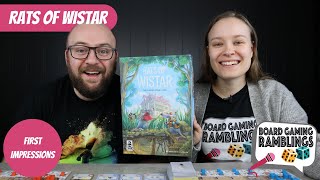



Rats of Wistar Deep Dive
What the Community Thinks About Rats of Wistar
Published commentary on Rats of Wistar is limited, and the reviews that cover it in depth land on different sides. The game casts one to four players as rats who escaped a laboratory and must prove they deserve to lead their colony. They explore a house, gather cheese, build inventions, dig rooms, and welcome host mice. Reviewers find the action system interesting, but they disagree on whether it rewards the effort it asks for.
BoardGameCo placed Rats of Wistar ninth on a list of games that disappointed its host in 2025. Alex Radcliffe tried the game several times and says it never came together for them. Getting Games describes a more positive experience. That reviewer enjoyed the game, was unsure whether they had won, and later gave their copy to a friend who had asked for it and went on to play it several times. The two perspectives are far apart, and the available coverage is too thin to establish a settled consensus.
Core Mechanics That Define Rats of Wistar
Worker Placement With a Sub-Action Economy
Getting Games describes the core system as a worker placement mechanic built around an action wheel. A player places a single worker, but how fully that action resolves depends on smaller sub-workers, the rats, which the player moves around the wheel. The reviewer explains that to perform an action well, a player must spend sub-actions moving rats into position, and that the sub-workers work almost like an economy to be managed. Players can then repeat the action as often as they want, which makes the sub-action economy the central decision in each turn.
Majority-Based Area Control and Quests
BoardGameCo frames the game as worker placement combined with area control, with an important qualification. Alex Radcliffe says it is "not really area control" in the usual sense and that players are instead worried about majorities. At the same time, players pursue quests as they move further into the house. Card play and combinations add another layer, and Getting Games notes that many actions involve flipping a card to see what you get, which introduces randomness into those turns.
The Rats of Wistar Experience
Thematic Immersion
The theme is the most divisive part of the experience. Getting Games describes the premise of super-intelligent rats that escaped from a laboratory and now explore a house, and says the flip-to-resolve actions make thematic sense even if the reviewer was not fully won over by them mechanically. BoardGameCo takes the opposite view. Alex Radcliffe says the theme never pulled them in and that they cannot say exactly why. Reviewers who connect with the rat-escape premise may find the house exploration the strongest part of the game, while those who do not may find little to compensate.
Satisfying Engine
The engine-building payoff is where the reviews diverge most. Alex Radcliffe describes the pleasure of a good Euro game as points connecting one to another, and says that sensation never arrived during their plays of Rats of Wistar. Getting Games, who found the game enjoyable from the first play, does not describe the same feeling in detail. Players who enjoy watching a system come together should expect the reward to depend heavily on how they respond to the game's randomness and sub-action management.
What Makes Rats of Wistar Stand Out
The Sub-Action Economy
Getting Games highlights the way sub-actions shape each turn. Rather than selecting an action and simply executing it, players manage a flow of small moves that determines how strong each action becomes. The reviewer calls this an interesting part of the design, and it is the feature most likely to appeal to players who enjoy tight resource management.
Card Play and Combinations
Getting Games also points to the card play as a strength, noting that there is a good deal of it and that cards combine in ways that reward planning. Only one reviewer makes this point, so it is best read as a considered opinion rather than a broad consensus.
Potential Drawbacks
Randomness in Action Resolution
Getting Games finds the flip-to-resolve actions thematically sensible but says they were not necessarily to the reviewer's taste mechanically. For players who want a predictable result from each decision, this element may take some getting used to.
A Lack of Payoff for Some Players
BoardGameCo offers the most sustained criticism in the available material. Alex Radcliffe describes the game as interesting on paper but not fun in practice, and says the rewarding feeling of connected scoring never emerged. The reviewer also suggests that a full rereading of the rules might change their view, since some elements still do not feel fully understood. The reviewer notes that in an earlier video, many viewers said the game worked well for them, which reinforces that the experience varies from table to table.
If You Enjoy Rats of Wistar
Neither reviewer compares Rats of Wistar directly to another title, so this overview does not name specific recommendations on their behalf. Readers who respond to the sub-action economy or to majority-based area control, both described above, can use those features as a filter when browsing for similar designs. Readers who are drawn mainly by theme should note that the reviews suggest theme alone may not carry the experience for everyone.
What Reviewers Are Saying
"I never got that from Rats of Wistar for whatever reason. It just it wasn't fun. And I do think I'm in the minority here. Like if I I remember talking about it in a different video and a bunch of people were like it really worked for them and I'm happy it did but it really didn't work for me."
— Alex Radcliffe, BoardGameCo
"Thematically I think that makes a lot of sense mechanically I wasn't necessarily in love with that and I played this one just once and honestly I had a good time."
— Getting Games
"For whatever reason, the theme never really pulled me in. I don't know why. I just the whole the whole concept never pulled me in."
— Alex Radcliffe, BoardGameCo