


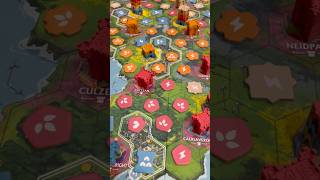


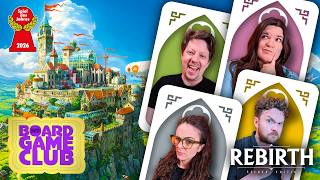







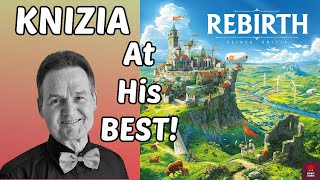

















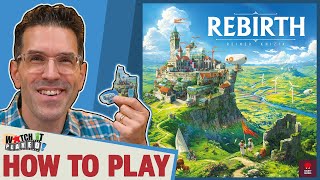
Following a series of calamities that left civilization in shambles, societies around the world are being rebuilt anew in harmony with nature. Scotland lies in ruins and the ancient clans have taken it upon themselves to restore the land. As clan leaders you will compete for strategic control of the land by rebuilding its prestigious castles.
Rebirth is a new tile-laying game from Reiner Knizia. The game revitalizes this classic genre by combining Knizia’s elegant mechanics with Mighty Boards’ evocative world building. The result is a eurogame with smooth gameplay, set in a lush and hopeful future.
Each turn, players draw a tile from their supply and place it strategically on the board. These tiles represent your clan’s contribution to rebuilding the land. Rebirth rewards strategic foresight and clever tactical play, with tougher decisions emerging over the course of the game.
—description from the publisher
Mechanics (from transcript analysis)
- asymmetric factions — Different factions with distinct boards and setups; exploration and track-based bonuses.
- Asymmetric Mechanics — Different factions with distinct boards and setups; exploration and track-based bonuses.
- Deck building — Card slots unlock stronger actions and improve resource flow.
- deck building and engine building — Card slots unlock stronger actions and improve resource flow.
Video topics + discussion points
Quotes (from this video)
- this is really interconnected worker placementish game.
- it's surprisingly smooth for how many moving parts there are.
- it's a game of inches where every space matters.
- there's way too many moving parts to explain here, but it is very very satisfying.
- you can definitely not just follow one thing and focus on one thing.
References (from this video)
- simple to learn
- deep decisions
- hard to master
- space on table due to decisions
- tile placement and scoring multiple paths
- Scotland map
- Ra
Mechanics (from transcript analysis)
- tile placement — placing tiles to build map and control castles
Video topics + discussion points
Quotes (from this video)
- It's your game night, so you get to decide.
- Storing your games vertically isn't perfect.
- If your shelves are overflowing, why not play a game that doesn't take up any space because it's Hearthstone.
- This is your game night.
References (from this video)
- Prototype components (rewood) with plans for varied clans and animal icons
- Two map sides (Scotland and Ireland) for replayability
- Clear progression from drafting to placement with visible scoring opportunities
- Scales from 2 to 4 players, with rules adjustments for two-player games
- Prototype components may change before production
- Some rule details may be missing in the preview; post-edit may add clarifications
- Two-player mode uses an extra color to block spaces, which could confuse early play
- clan-based reconstruction with control of regions, cathedrals, and castles
- Scotland and Ireland on a map; clan-led rebuilding after ruin
- tile-laying engine with area control and card-driven endgame objectives
Mechanics (from transcript analysis)
- area control scoring via clusters — score points based on adjacent clusters of farms and settlement icons; larger clusters yield more points
- card-driven endgame objectives — cathedral cards provide targeted goals used to score at game end
- castle/cathedral control mechanics — placing tiles adjacent to castles or cathedrals can grant you control or force displacement when contested
- end game bonuses — cathedral cards provide targeted goals used to score at game end
- Endgame scoring — final tally includes castles controlled, cathedral cards, and extended scoring from farms and settlements
- tile drafting — draw a tile from a faced-down stock and reveal/place it on the board according to rules
- tile placement — place tiles on the map with adjacency and icon-specific placement rules (farms, settlements, etc.)
- tile placement with restrictions — place tiles on the map with adjacency and icon-specific placement rules (farms, settlements, etc.)
Video topics + discussion points
Quotes (from this video)
- this is rebirth
- you are trying to build up Scotland again after it is in Ruins
- it's a tile game
- you draw one tile from your stock
- the more and more of the same icon... you gain points
- you only have eight Cathedral cards
References (from this video)
- Easy to learn with surprising depth and crunchy decisions
- Accessible core idea with a strong puzzly feel
- Dynamic board development; replayable through placement decisions
- Cluster-based scoring with community missions and cathedral/castle control
- Fantasy dungeon-crawler where players build farms and settlements around cathedrals and castles
- Abstract, puzzle-driven with light narrative framing
- Cascadia
Mechanics (from transcript analysis)
- area/cluster scoring — Larger clusters yield more points; spatial proximity influences bonuses.
- Cathedral/Castle control — Control of cathedrals/castles grants bonuses and scoring leverage.
- Compound Scoring — Larger clusters yield more points; spatial proximity influences bonuses.
- End-game scoring focus — Final points depend on ownership/adjacency of key structures and cluster strength.
- mission cards — Visiting cathedrals grants community missions that contribute end-game scoring.
- Multi-use cards — Visiting cathedrals grants community missions that contribute end-game scoring.
- tile placement — Drafted tiles are placed to form clusters; placement choices drive scoring and board shape.
- Tile-type differentiation — Three tile types (Farms and Settlements) form distinct scoring areas and strategies.
Video topics + discussion points
Quotes (from this video)
- it's easy to learn but then it's got quite a bit going on for how little rules there is
- the bigger the cluster the more points you score
- you can actually finish you can get and it's not like you need to invest six months of your life just to finish this game
- it's a classic knizia kind of style and feel very 1999 feeling it was
- we took that dungeon crawler thing and we're doing it our way
- Lake creates this whole basically modular organic growing network that changes every game
References (from this video)
- Easy to teach to new players
- Strong interactive feel with blocking and competition
- Multiple map variants add depth
- Meaner edges may deter casual players
- Rule explanations can be dense for some players
- competitive tile laying with area majority and castle control
- Shared battlefield/board with multiple maps
- competitive, with tactical tension and interaction
Mechanics (from transcript analysis)
- area majority — Compete for majority on contracts across different map sections.
- area majority / contract fulfillment — Compete for majority on contracts across different map sections.
- dual-map board design — Two different maps (Scotland-like and island) with distinct scoring dynamics.
- tile laying — Place tiles on a shared board to fulfill contracts and score points.
- tile placement — Place tiles on a shared board to fulfill contracts and score points.
Video topics + discussion points
Quotes (from this video)
- This game is so clever. It's so quick to play.
- Rebirth was our game of the year in 2024.
- What a game.
- Ego is a tremendous game by a famous designer called Rhina Cania who we also saw in Rebirth and we may see again in this category.
- Quest for El Dorado is going to introduce you to basically deck building combined with racing.
- Ra, we talked about auction bidding already with Ego, but if you wanted something that takes that idea and distills it down to its bare essentials, you are just bidding.
References (from this video)
- Accessible and distilled design that still yields deep strategic choices
- Two very different maps (Scotland and Island) that markedly change gameplay
- Beautiful production with a strong table presence and readable components
- Wooden castles and ornate tokens replace plastic parts, enhancing aesthetics and eco-friendliness
- High interaction and area-control tension that feels fair and dynamic
- Tile-draw randomness can frustrate some players, though there are always viable options with the tiles you draw
- The Island map's public objectives can accelerate endgame and raise pressure, which may not suit very casual players
- Two-map package may feel slightly heavier for absolute beginners, though rules are stated as concise
- reconstruction and restoration through tile placement; towers/cathedrals as scoring mechanisms
- Scotland and Ireland (island and mainland) in a post-catastrophe, rebuilding scenario
- tile-laying, area-control with evolving objectives
- Kassan
- Cascadia
- Through the Desert
Mechanics (from transcript analysis)
- Area Control — Adjacent tiles and their features interact to control castles and other strategic spaces; control can be gained, contested, and locked in as play continues.
- area_control — Adjacent tiles and their features interact to control castles and other strategic spaces; control can be gained, contested, and locked in as play continues.
- progressive_scoring — Points accrue as tiles of the same type cluster, with escalating points for larger groups and end-game bonuses tied to towers, cathedrals, and completed objectives.
- random_draw_from_bag — Tile draws come from a bag rather than dice; players must adapt to what is drawn and find best-use options across the board.
- tile placement — On your turn you draw a tile from a bag and place it on the board in a matching environment (house/village, energy space, cathedral/tower area) to scaffold scoring opportunities.
- tile_placement — On your turn you draw a tile from a bag and place it on the board in a matching environment (house/village, energy space, cathedral/tower area) to scaffold scoring opportunities.
- variable_objectives — Scotland map provides hidden objectives; Island map uses public objectives that are contested by all players and tiered by first-come/first-served timing.
Video topics + discussion points
Quotes (from this video)
- this is such a beautiful looking game it really pops on the table
- 100% one of the best game ever made
- this is why it's one of those modern classic like Cascadia for example
- we fell in love with this game a while ago
- this is a wonderful wonderful game
References (from this video)
- sustainability-centered theme
- appealing use of recycled/reclaimed materials
- material choices may constrain some design options
- Sustainability, transformation, nostalgia
- Rebuilding with old themes/materials given new life
- nostalgic yet modern in sensibility
Mechanics (from transcript analysis)
- campaign/scenario structure — Story-driven progression with structured scenarios.
- Resource management — Utilizes recycled wood/materials in construction or gameplay components.
- Resource/wood reuse — Utilizes recycled wood/materials in construction or gameplay components.
Video topics + discussion points
Quotes (from this video)
- Adventure is the word
- what's old is new again
- it's a cinematic game
- the experience around the table
- you plug in the players
- satisfaction is the word
References (from this video)
- Dual-side design provides replay variety
- Multiple scoring vectors and evolving strategies
- Strategic depth remains accessible with simple core rules
- territorial influence and resource placement with scoring
- two-sided board with Scotland and Ireland variants
- engine-building with area control feel
- Tyrants of the Underside? (not mentioned)
- Longest road style settlements analogs
Mechanics (from transcript analysis)
- cathedrals and missions — Cathedrals give secret/board-wide bonuses and unlock varied strategies.
- influence and castle scoring — Influence on settlements; castles score based on surrounding tiles.
- tile placement and contiguous grouping — Place tiles to form contiguous groups and score for placement.
- two-sided board asymmetry — Scotland and Ireland sides offer different goals and scoring dynamics.
Video topics + discussion points
Quotes (from this video)
- Ink. Now, this game is a lot nicer than Azul, I would say.
- The second side is a little bit more thinky, a little bit more bite to it.
- This game is absolutely fantastic.
- If you're looking for a two-player game that has a little bit of everything, Gatsby's it.
- This is the first game of this type that I know of ... takes that concept and just adds a lot of things around it.
- This is a lifestyle game where like I didn't have any baseball cards when I played this.
References (from this video)
- streamlined yet flavorful area-control experience
- two-sided board adds variability and depth
- crunchy for casual players
- rules complexity can grow with expansions
- territory, influence, and mission-driven scoring
- Scotland vs Ireland influence with cathedrals and towers
- team-agnostic, abstract-ish
Mechanics (from transcript analysis)
- Area Control — score based on surrounding settlements and castles
- area control / influence — score based on surrounding settlements and castles
- multi-faceted scoring (cathedrals, towers, missions) — end-game points come from a mix of goals and bonuses
- multifaceted scoring (cathedrals, towers, missions) — varied end-game scoring through cathedral locations and mission cards
- tile drafting / placement — draw a tile and place it; scoring occurs for adjacent structures and groups
- tile-drafting and placement — draw and place tiles to influence scoring regions
Video topics + discussion points
Quotes (from this video)
- This game you're going to be basically dressing up uh the kids in different costumes.
- You're going to be mixing and matching or matching and placing them on different things.
- Waddle is kind of a meaner area control game.
- There's a little bit of everything here. There's pressure your luck. There's some planning and mitigating.
- Datoms is a crunchy puzzle to figure out.
- Ink is a lot nicer than Azul, I would say, uh because you can't really totally hoe someone by sticking them with tiles they can't have.
- Positano. Tons of interaction. If you like sort of meanness blocking with some secret auction, that is very interesting.
References (from this video)
- two-sided play adds strategic longevity
- tight, turn-by-turn decision making with high player interaction
- complex for newcomers
- would benefit from clear dual-rule references
- dual-board strategy with mission-based bonuses
- island-focused with a more thinky second side featuring towers
- twisty, strategic
Mechanics (from transcript analysis)
- dual-side board with asymmetrical goals — Scotland vs Ireland sides offer different scoring and placement dynamics
- tile drafting / placement again — draw a tile and place; scoring happens with contiguous groups
- tower bonuses and public missions — tower-based bonuses and mission cards add variety
Video topics + discussion points
Quotes (from this video)
- This game you're going to be basically dressing up uh the kids in different costumes.
- You're going to be mixing and matching or matching and placing them on different things.
- Waddle is kind of a meaner area control game.
- There's a little bit of everything here. There's pressure your luck. There's some planning and mitigating.
- Datoms is a crunchy puzzle to figure out.
- Ink is a lot nicer than Azul, I would say, uh because you can't really totally hoe someone by sticking them with tiles they can't have.
- Positano. Tons of interaction. If you like sort of meanness blocking with some secret auction, that is very interesting.
References (from this video)
- colorful, thematic and highly engaging
- top-tier feel for kitzia-styled designs
- great balance between accessibility and depth
- board can feel busy at first sight
- area control, tile placement, and combined scoring
- Kitzia-inspired historical/strategic city-building
Mechanics (from transcript analysis)
- Block building and surrounding effects — Builds blocks of same symbol and surround castles to gain points.
- Single-tile hand with expansive placement — Only one tile in hand; strategic placement around castles and settlements.
Video topics + discussion points
Quotes (from this video)
- a lovely mediumweight Euro by board and dice
- the dice has dual use
- I love the way that everything is driven here through dice
- spatial puzzle
- an instant classic
- a great example of its genre
- I instantly fell in love with it
- Kitzia at his best
- Punchy, colorful and very engaging
- top tier kitzia for me
References (from this video)
- Simple core rules with deep strategic depth
- Fixed-board design supports focused planning and quick rounds
- Good potential for publication localization and expansion
- Publishers may rewrite rules, risking clarity
- Production complexity with backboard variants
- historical strategy with tile placement and monument-focused scoring
- Medieval Britain and Scotland during the 11th century (1066 era themes) with an emphasis on castles, cathedrals, towers
- historical reconstruction with abstract scoring and private objectives
- Tigers and Euphrates
- Yellow and Yangtze
- Ra
Mechanics (from transcript analysis)
- area/feature scoring — Points are earned by forming clusters around castles and towers, and by accessing cathedrals and religious sites.
- board orientation/backboard variants — Different board orientations (and optional backboards) alter play space and strategy.
- hidden victory points — Mission cards provide private objectives that influence scoring at endgame.
- Secret Missions — Mission cards provide private objectives that influence scoring at endgame.
- tile placement — Players place a single tile from their hand onto a fixed board each turn, scoring as features align.
Video topics + discussion points
Quotes (from this video)
- I have a curse of new ideas.
- There are no magic tools.
- The core design process is driven by me.
- Bureaucracy in Germany is unbelievable.
References (from this video)
- Simple decision-making
- Player interaction
- Strategic depth
- Competitive gameplay
- Potential for one player to dominate
- Requires careful balancing
- Resource expansion and area control
- Energy farm landscape
- Through the Desert
- Blue Lagoon
Mechanics (from transcript analysis)
- tile placement — Players place tiles to expand energy farms
Video topics + discussion points
Quotes (from this video)
- These are not the best board games I would recommend to you
- This is a very personal list that I've honed over the years
References (from this video)
- clear teach and approachable rules
- engaging two-player balance with a compact board
- strong tension from blocking and castle scoring
- private endgame missions add strategic depth
- tile availability and draw can constrain decisions
- endgame scoring can feel opaque until the end
- prototype copy may change before release
- historical settlement and empire-building
- Scotland, clans rebuilding the country
- abstract, strategic
Mechanics (from transcript analysis)
- area majority — score points based on who has the most influence in a cluster or settlement
- cathedrals and castles — adjacency unlocks placing the other type; endgame scoring impacts via private mission cards
- farm tiles and scoring by clusters — energy and food farm tiles placed on matching or blank spaces; scoring per cluster
- private endgame mission cards — private goals that grant bonus points at game end
- settlements and influence — settlements (1-3 hexes) have influence values that determine scoring
- tile placement — place hex tiles on the board to form clusters and control areas
Video topics + discussion points
Quotes (from this video)
- this is a tile placement and area majority game for two to four players
- the rules are fairly straightforward
- we do have to mention this is a prototype copy of the game so things are subject to change in the future
- score points and the way that these score is one point per tile in its cluster
- the game ends as soon as all players have placed all of their tiles
- you can literally place it anywhere on the board
- there are a total of eight Cathedral spaces all around the board
- if an opponent places adjacent to the same Cathedral then they'll simply stack their Cathedral on top
- Castles on the other hand are not friendly because they are going to score you Five Points each for each of these that you control at the end of the game
References (from this video)
- smooth, snappy flow
- low administrative/AP load
- accessible for lighter-to-midweight players
- some players may crave more freedom/agency in their decisions
- rebirth/renewal through constrained choices
- abstract strategic tile placement with a minimalist, tactile feel
- abstract, flow-focused with emphasis on quick decisions
- Asian Tigers
- Inferno
- Oranges and Lemons
Mechanics (from transcript analysis)
- tight turn flow with minimal AP — the game emphasizes momentum and snappy pacing rather than heavy planning
- tile drafting/placement — players select from two tiles each turn; core choice is tactile and immediate, reducing action analysis paralysis
Video topics + discussion points
Quotes (from this video)
- it had a really nice flow to it and there was interesting thing about it is you only have two tiles and you only have one choice to make
- the hook is that the order of your workers shifts round to round based on the actions you select in the previous round
- the scoring happens so quickly
- limited communication cooperative co-op games
References (from this video)
- Introduced new storytelling elements
- Fun twists and a sense of progression
- Not as well received as some other entries in the line
- Standee/board elements were not universally loved
- campaign legacy style with a focus on twists
- DC universe with a campaign-like structure
- story-driven progression with twists and turns
- other DC DBG core boxes with different narrative approaches
Mechanics (from transcript analysis)
- board presence via standees and locations — Standees and locations contribute to gameplay in a way that changes deck interaction.
- campaign/legacy style progression — A narrative arc with missions that shape subsequent playthroughs.
Video topics + discussion points
Quotes (from this video)
- Dark Knight's Metal is probably the darkest version, and there are some really creepy cards.
- I love the iconic heroes and the villains you go up against.
- Confrontations is amazing for team play with two heroes versus two villains.
- This is the original DC Comics deck-building game and it remains the best for teaching new players.
- I actually just did a review on the Party Starter Edition and I love that tiny box.
References (from this video)
- Interesting approach to random tiles and shared goals
- Felt lighter than expected
- token placement with global goals
- Scotland & Ireland maps
- tile-bag randomness
Mechanics (from transcript analysis)
- Tile/goal-based token placement — You can place tokens anywhere; goals shift mid-game
Video topics + discussion points
Quotes (from this video)
- I had so much anxiety about making this change for months and months, arguably years if you watch the last update, but people really took to it.
- You mean Getting Games? That just that really sealed the deal.
- It's just a fun thing to consider.
- I'm really looking forward to it as opposed to putting these things off and like stressing about them.
- recording my opinions episodes live as well as other vlogs. I did a 2024 favorites video talking about all my favorite games from last year.
References (from this video)
- Highly approachable and quickly rewarding
- Smooth, elegant design that feels satisfying turn-by-turn
- May not scratch every heavy Euro thirst for players seeking deeper crunch
- Tile-drafting with immediate scoring; theme framed as approachable strategy
- Tile-laying with evolving map layout
- Satisfying, streamlined, and accessible
Mechanics (from transcript analysis)
- Tile-laying with immediate scoring — On your turn you reveal a tile, place it, and score immediately, creating a point salad and rapid feedback.
- Two-sided map components — A board variant with two sides offers different levels of complexity and playoff options.
Video topics + discussion points
Quotes (from this video)
- reviews, rankings, lists are really snapshots in time
- It's a snapshot in time. And who knows, these things could even shift around if I were to do this again this time next year.
- I am a shallow gamer.
References (from this video)
- Engaging missions
- Camaraderie and social interaction
- Mission-based competition with direct interaction
- Fantasy or adventure world
- Competitive with opposing goals
- Riftbound
Mechanics (from transcript analysis)
- direct player interaction — Players can directly challenge or block opponents through quests
- Mission-based play — Players complete set missions that affect scoring
- Positive player interaction — Players can directly challenge or block opponents through quests
Video topics + discussion points
Quotes (from this video)
- The beauty of board games is that they build ecosystems.
- board games are the ultimate framework for connection.
- If you push yourself to do it, you'll probably be surprised at the outcome.
References (from this video)
- Flow is engaging, from easy to tight late game
- Two map options for family vs. more serious play
- Limited published details in transcript; potential balance questions
- tile placement / farming progression with variable maps
- island map (mean version) with family-friendly options on Scotland side
- flowing, accessible euro with map variants
Mechanics (from transcript analysis)
- Endgame scoring — Final scoring depends on tile placement and farm networks.
- tile placement — Players place tiles to grow farms and score via a scoring system tied to board state.
- Variable map / asymmetry — Island vs Scotland versions offer different interaction and difficulty levels.
Video topics + discussion points
Quotes (from this video)
- It's super easy to teach and learn and it just always feels good to play.
- Harmonies is one of my favorite cozy puzzler games.
- The island map (mean version) is the harder, more interactive option.
- A Jest of Robin Hood is a stroke of genius.
- This game is dripping in the theme of the comic book itself.
- Seven Wonders Duel... but my gosh, is this an satisfying, beautifully wonderful two-player game.