















Redwood Deep Dive
What the Community Thinks About Redwood
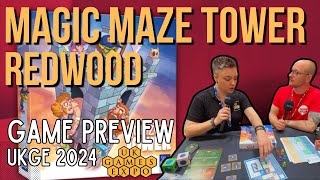
Redwood has captured the attention of board game reviewers across multiple channels, earning praise for its innovative mechanics and beautiful presentation. The game stands out in the modern board game landscape as something genuinely different, offering an experience that resonates with both casual and experienced players. Reviewers consistently highlight the game's unique approach to a nature photography theme, with its integration of physical templates and spatial estimation creating a distinctive gameplay loop that few other games attempt.
Core Mechanics That Define Redwood
Template-Based Movement and Photography
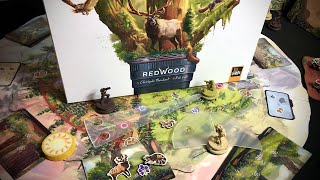
At the heart of Redwood lies a deceptively simple but challenging system: players must choose movement and photography templates simultaneously without any measurement or testing. The movement template determines where the photographer moves on the circular game board, while the shot template establishes the field of view for capturing wildlife. This blind selection creates immediate tension, as players must estimate distances and angles without physical verification. The moment players place their templates becomes final, with no takebacks allowed. Reviewers emphasize that this core mechanic is what makes Redwood distinctive, shifting photography from a thematic flourish into the mechanical engine that drives all decision-making. The challenge intensifies because players are working with millimeter precision, where tiny differences in template placement dramatically affect which animals and plants appear in their photographs.
Compound Scoring Across Multiple Categories
Redwood's scoring system rewards players through multiple independent tallies that accumulate throughout the five rounds. Players earn points for capturing specific animals and plants, completing botanical sets, creating adjacent panoramic views, managing sun icons carefully (one is valuable, multiple are detrimental), and fulfilling round-specific objectives. The game reveals new objective cards each round, creating a ramping challenge where later rounds demand increasingly sophisticated photography choices. This layered approach to scoring means that players cannot focus on a single strategy; instead, they must balance competing priorities while managing their limited template selections.
The Redwood Experience
Accessibility Wrapped in Challenge
Reviewers note that Redwood presents itself as accessible to new gamers while offering enough depth to engage experienced players. The rules themselves are straightforward, and the visual presentation immediately conveys the game's concept. The learning curve proves gentle for understanding the mechanics, though mastery takes time as players develop intuition for template distances and angles. Reviewers specifically mention that Redwood excels as an introduction game for newcomers because the theme instantly appeals and the concept is easily explained. However, they caution that the game's true depth emerges only through repeated plays, as players begin to anticipate template effects and plan multiple turns ahead.
Social Dynamics and Table Presence
The game generates significant entertainment value from its inherent tension. When players inevitably misjudge their templates, the results generate laughter and discussion. Reviewers highlight that spectating is genuinely interesting because observers can see whether a player's template placements succeed or fail, creating engagement even during other players' turns. The game best accommodates two players, with diminishing downtime at higher player counts. However, reviewers consistently mention recommending Redwood for game nights with mixed experience levels, where the game's visual appeal and unique mechanics make it an excellent conversation starter. The components, particularly the photographer miniatures and the string used to determine terrain boundaries, enhance immersion and make the game feel like a purposeful activity rather than mere point calculation.
What Makes Redwood Stand Out
A Completely Novel Mechanical Implementation
Reviewers emphasize that Redwood does not fit into established board game categories. This is not a worker placement game, resource management game, or area control game. Instead, it's a spatial puzzle wrapped in dexterity and estimation mechanics that operate within a thematic context. The physical templates themselves are the star of the experience, creating a bridge between traditional board games and more interactive activities. One reviewer notes that attempting to extract Redwood's core mechanic and retheme it would fundamentally break the game, indicating how deeply thematic and mechanical elements are integrated. The game's visual design reinforces this integration, with the board's circular layout and animal placement creating an environment where the photography theme makes mechanical sense.
Thematic Authenticity Through Mechanical Design
What makes Redwood particularly noteworthy is how its theme motivates every mechanical choice. The difficulty of capturing perfect photographs directly reflects the challenge of wildlife photography itself. Players don't just claim cards; they use calibrated physical tools to determine what their photographers can actually capture. The necessity of choosing movement and shooting angles before seeing final results mirrors real photography, where perfect composition requires preparation and adjustment. Reviewers note that other games with similar themes (like Wingspan or Earth) abstract their themes into mechanics, whereas Redwood makes the theme inseparable from how the game plays. This design choice means that success in Redwood requires genuine engagement with its central conceit, not just mechanical optimization.
Potential Drawbacks
Length and Practical Considerations
Reviewers identify game length as a primary consideration for potential players. While the rules state forty-five minutes, actual play time frequently extends beyond an hour, particularly with four players. The setup and explanation process adds significant time, and players benefit from taking their time with template selection and consideration. This extended playtime impacts when Redwood fits into gaming sessions, making it less suitable for casual quick-play situations. Reviewers recommend Redwood for dedicated gaming blocks rather than slots between other activities. Additionally, the game requires substantial table space for the circular board, template organization, and individual player boards, which may challenge players with limited surfaces.
Limited Replayability Variability and Depth Ceiling
While reviewers praise Redwood's unique mechanics, some note that the strategic depth remains relatively light. The game rewards tactical responsiveness to available templates and animal positions more than deep strategic planning. Advanced players may find that after multiple plays, the puzzle-solving becomes predictable, and the game offers limited strategic paths to victory. The basic and expert game modes provide some variation, but the core experience remains consistent across plays. Additionally, the game is most enjoyable at two players, which limits player count flexibility for larger groups. Reviewers also observe that some players who appreciate deeper Euro-style decision-making might find Redwood's relatively quick turn sequences and limited interaction less engaging than expected.
If You Enjoy Redwood
Players who love Redwood typically appreciate games with strong thematic integration and novel mechanical implementations. Wingspan offers similar nature theming with elegant card mechanics, though it takes a more traditionally abstract approach. Earth provides another nature-focused engine builder with beautiful presentation but more traditional resource management. Gizmos delivers satisfying combo-chasing and streamlined turn sequences without the spatial puzzle element. For those drawn specifically to the template and estimation mechanics, Redwood is relatively singular in the modern board game market, making it a unique addition to most collections. The game particularly appeals to players who value interactive, media-friendly experiences that generate conversation and create memorable moments, even if strategic depth remains modest.
What Reviewers Are Saying
"Redwood is a game about wildlife photography in this game you move your photographer by using something like calipers and you frame your shot by placing angles of various sizes on the environment decorated by plants and animals. This mechanic is clearly inspired by its theme. It is in fact so thematic that is the reason why I don't own this game because it is so technically involved that I would rather go outside and actually take photographs of animals than go through the mechanics of the calipers and the framing of the shot."
— Board Game Dad
"What stands out about Redwood is how different it is. This doesn't play like anything we have in our collection. You are moving your photographers around and you're using these like what seems like very mathematical tools in which to do so. At first when we saw these and you had to pick your movement and then your camera angle we kind of thought it would be easier than it actually was. Our estimates were way off. We would thought we would just kind of move a quarter across the board and easily get these things and we would end up way on the other side."
— Allies or Enemies
"It's a cool theme that's been done in some other card games but to actually take it and put it on a map with like little dexterity elements using the template like where you going to point your camera, that is pretty cool. The idea being that you are photographers taking pictures of wildlife and scenery. Your miniatures are on this sort of circular map but in order to move somewhere you have to use a template that you kind of have to kind of guess what you know what length it's going to be and what curve it's going to have."
— The Broken Meeple