/pic5376430.png)

























Reef Deep Dive
What the Community Thinks About Reef
Reef stands out as a beautifully crafted abstract strategy game that captures the imagination through spatial puzzle design and serene coral-building mechanics. Reviewers praise its elegant simplicity paired with tactical depth, making it accessible to newcomers while offering meaningful decisions to experienced gamers. The tactile satisfaction of building three-dimensional coral structures appeals to players who value both functional gameplay and aesthetic presentation. Its straightforward design philosophy has made it a favorite for those seeking a quick, satisfying gaming experience that doesn't require lengthy rules explanations.
Core Mechanics That Define Reef
Card Drafting and Tile Placement
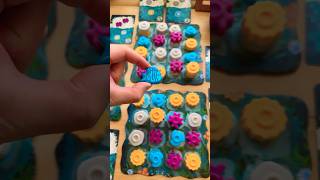
At its heart, Reef combines card drafting with spatial tile placement. Each turn, players select a card from the market that determines two things: the pieces they receive and their scoring opportunity. The top of each card shows which colored coral pieces a player gains, while the bottom reveals the scoring condition. This elegant dual-use system forces constant decisions about whether to prioritize immediate benefits or work toward longer-term scoring objectives. The interplay between building your coral reef and accessing scoring cards creates the strategic tension that drives the entire experience.
Compound Scoring and Pattern Recognition
Scoring in Reef rewards players for creating specific color patterns adjacent to their tallest pieces. The game's scoring cards present varied objectives, from simple color combinations to more complex spatial arrangements. By building strategically, players position themselves to score high-value patterns while simultaneously blocking opponents from accessing the same arrangements. This creates a puzzle-like quality where players must visualize future board states and plan their coral growth accordingly. The scoring system emphasizes forward planning and pattern completion, rewarding those who think several moves ahead.
The Reef Experience
A Satisfying Spatial Puzzle
Playing Reef feels like solving an elegant spatial puzzle with physical components. Players build upward and outward, creating three-dimensional coral formations that evolve throughout the game. The tactile nature of stacking pieces and placing tiles engages multiple senses, creating a deeply satisfying play experience. Even players who struggle with spatial awareness find something rewarding in watching their reef slowly form, though those with strong visualization skills gain a natural advantage. The game's pacing works well for casual and competitive play alike, completing quickly enough for several rounds without dragging.
Accessible Yet Engaging Gameplay
Reef exemplifies how an abstract game can be both simple and engaging. The rules teach quickly, with the dual-use card system becoming intuitive after the first turn or two. Newcomers grasp the fundamentals immediately, yet experienced players find depth in the strategic positioning and long-term planning required. The game scales gracefully across player counts and experience levels, making it equally enjoyable for families, casual groups, and competitive players. Its brief 30-45 minute playtime respects players' schedules while still delivering meaningful decisions.
What Makes Reef Stand Out
Beautiful Component Design and Visual Appeal
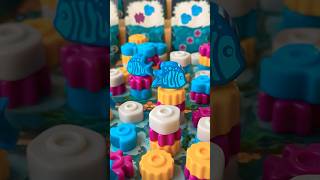
Reef distinguishes itself through thoughtful production choices. The colorful, translucent coral pieces create an underwater aesthetic that enhances immersion without overwhelming the gameplay. The board layout is functional and clean, avoiding unnecessary ornamentation while maintaining visual clarity. Recent editions made thoughtful updates to color schemes, improving accessibility for colorblind players without sacrificing the vibrant tropical feel. The overall presentation makes Reef a game players enjoy pulling off the shelf repeatedly.
Elegant Mechanical Design
The game achieves remarkable elegance in its core mechanics. Rather than requiring expansions or variants to sustain interest, Reef delivers a complete, satisfying experience from the base game alone. Designers avoided the trap of over-complexity, trusting players to find depth within simple systems. Each element serves the core puzzle, with no wasted mechanics or unnecessary chrome. This streamlined approach makes Reef feel fresh even after multiple plays, as new card combinations and board states create different optimization challenges.
Potential Drawbacks
Spatial Thinking as a Barrier
While Reef's accessibility is a strength, players who struggle with spatial visualization may find it frustrating. Those without natural aptitude for three-dimensional puzzle-solving sometimes feel overwhelmed by the constant need to visualize future coral placements and score potential patterns. Teaching tends to confuse players unfamiliar with abstract spatial reasoning, as the "why" behind good placements requires players to think in multiple dimensions. This hurdle isn't insurmountable but represents a real accessibility concern for certain player types.
Limited Strategic Variety
While engaging, Reef's strategic space has natural boundaries. After several plays, experienced gamers recognize optimal patterns and understand the fundamental principles governing successful play. The game doesn't offer the wild variability found in some other abstracts, though the card drafting element and opponent interaction still create fresh moments. Some players seeking maximum strategic depth may eventually exhaust the decision space, though casual groups typically find continued enjoyment through friendly competition.
If You Enjoy Reef
Players drawn to Reef's elegant design should explore Azul, which similarly combines tile placement with pattern building, though Azul focuses on two-dimensional placement. Century Spice Road offers comparable card-drafting mechanics and resource management wrapped in a different theme. For those seeking more spatial puzzle elements, Gizmos provides satisfying tableau building with marble-based chain reactions. Aquatica delivers an underwater theme with slightly more complex mechanisms, while Sagrada serves players wanting abstract color-pattern design with added spatial complexity through dice-placement mechanics.
What Reviewers Are Saying
"This game is one of those things that we're building up our coral piece by piece, and I really love what I've just done."
— Meeple University
"Reef is still a really cool game. I prefer this one to Azul. Azul is only that good at two player, and I still like the base game of Reef."
— The Broken Meeple
"The premise of this where you're building this kind of 3D sculpture of all these different coral pieces and trying to score based on patterns is a really cool game."
— The Dice Tower